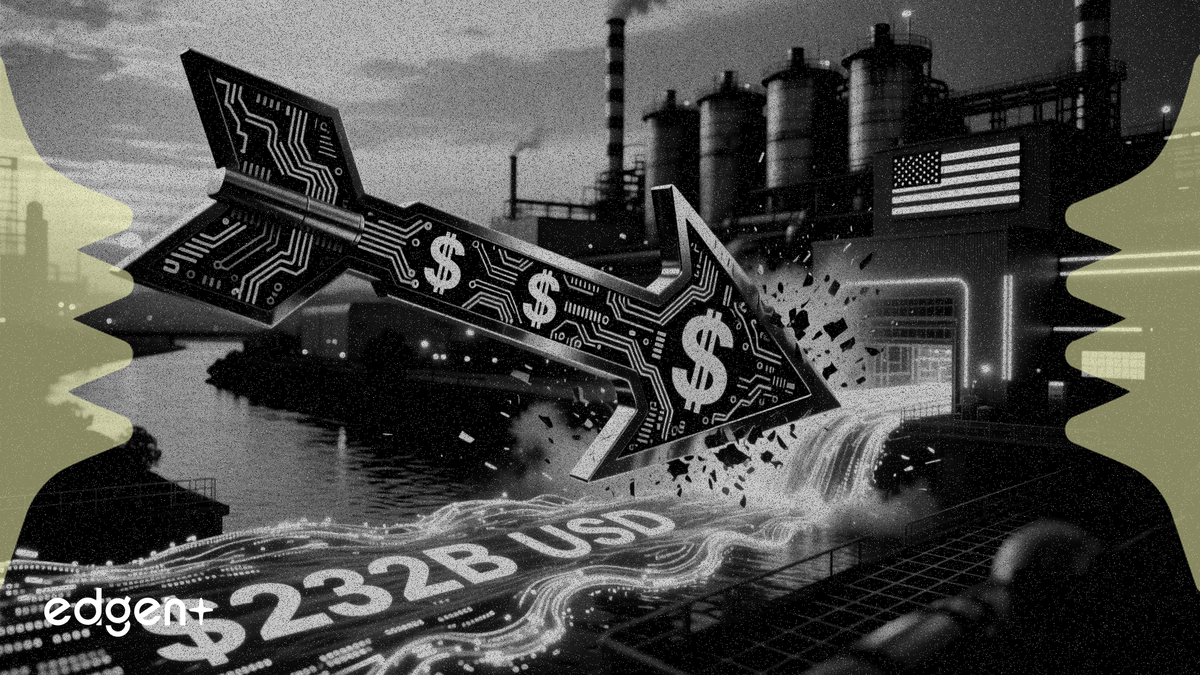
Companies poured $232 billion into US facilities in 2025, reversing a four-year FDI slump as tariff policy rewrote the calculus of global supply chains.
Foreign direct investment into the United States reached $232 billion in 2025, snapping four consecutive years of decline, as multinational corporations rushed to build domestic capacity before President Trump's tariffs made importing cost-prohibitive.
The 54% jump from the prior year's $151 billion represents the largest single-year inflow in nearly a decade, according to Bureau of Economic Analysis data released Wednesday. Of 38 investor signals tracked after the April "Liberation Day" tariff announcement, 36 indicated a pivot toward US-based production — a 95% response rate that shows the policy's immediate effect on capital allocation.
Semiconductor and manufacturing sectors absorbed much of the new capital, with companies that previously relied on overseas fabrication and assembly lines now pouring money into domestic alternatives. The shift dovetails with the February 2025 America First Investment Policy, which encourages foreign capital in non-sensitive sectors while maintaining national security reviews for defense and critical infrastructure.
The 2024 figure of $151 billion had represented a 14% year-over-year decrease, continuing a downward trajectory that worried policymakers. That trend is now decisively reversed, though the underlying motivation — fear of tariff exposure rather than organic enthusiasm for US expansion — adds complexity to the headline number.
Tariffs as a Relocation Catalyst
The April 2025 reciprocal tariffs carried a blunt message: produce in America or pay up. The previous tariff escalation in 2018-2019 under Trump's first term triggered a similar but smaller onshoring response, with FDI rising roughly 20% over two years before plateauing. The current surge more than doubles that pace, suggesting companies view the latest tariff regime as more durable.
The semiconductor angle is particularly significant. Mining operations, node infrastructure and the hardware backbone of advanced industries all depend on chip availability. More domestic semiconductor production could eventually reduce supply chain risks for US-based technology and manufacturing companies, though the full capacity buildout will take years.
What the Inflow Means for Investors
The sustainability of this FDI wave hinges on trade policy stability. Companies are not investing in the US because they discovered new attractions — they are investing because tariffs changed the cost calculus of operating elsewhere. If trade policy shifts again, so could the capital flows.
The gap between the 2024 low of $151 billion and the 2025 figure of $232 billion is dramatic enough to suggest the tariff incentive is genuinely powerful. Whether that power translates into durable industrial expansion or simply reshuffles where companies park their factories will define the investment landscape for the next several years.
This article is for informational purposes only and does not constitute investment advice.