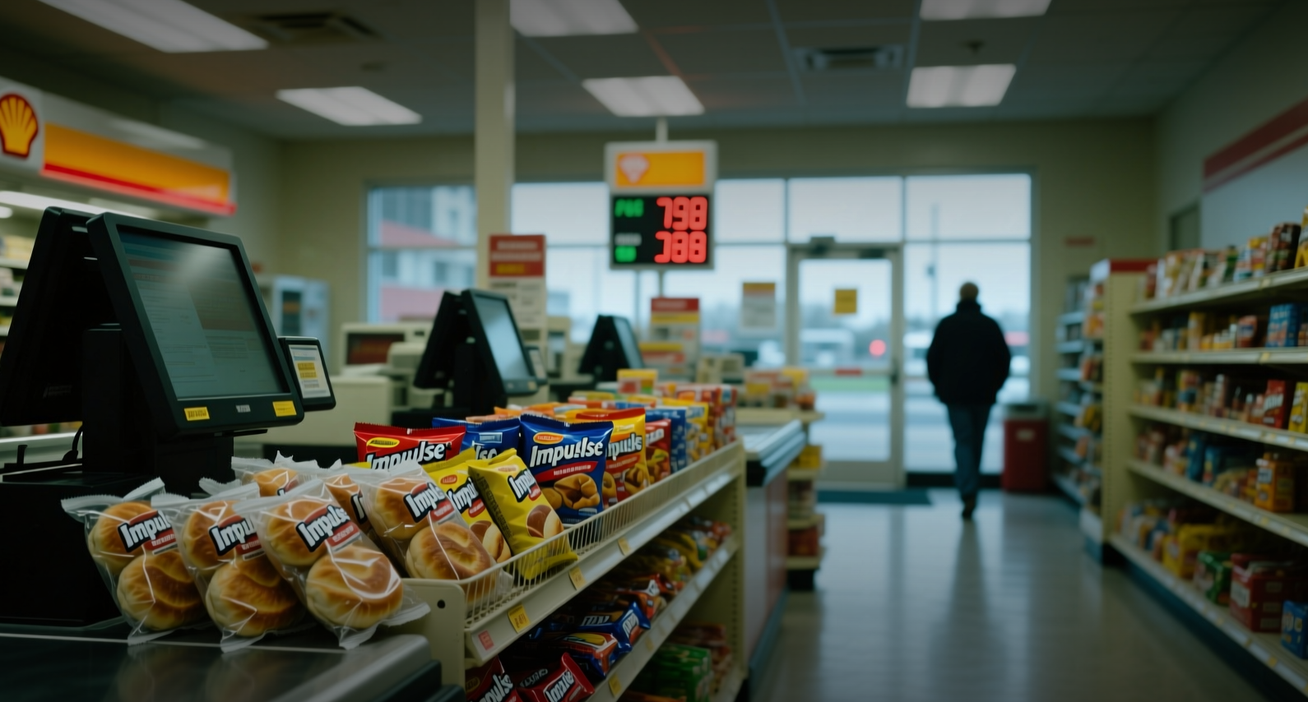
Smucker's Sweet Baked Snacks sales fell 7 percent from a year earlier in the latest quarter, as elevated gasoline prices curbed impulse purchases at convenience stores and tightened household budgets.
The decline tracks research from the Federal Reserve Bank of San Francisco showing that when households expect gas prices to climb, they raise their inflation expectations and become more cautious about discretionary spending. The effect is strongest among lower-income households, who devote a larger share of budgets to fuel, the FRBSF Economic Letter found.
U.S. retail gasoline averaged $4.65 per gallon in May 2026, up from $3.06 in February before the U.S.-Iran conflict disrupted global energy markets, according to the FRBSF analysis. The run-up has pushed consumers to cut back on non-essential purchases, with impulse snack items among the first casualties.
The 7 percent decline in Smucker's Sweet Baked Snacks segment — which includes Hostess and Uncrustables — shows that fuel costs are now eating into even low-ticket discretionary items. PepsiCo and other consumer packaged goods companies with significant convenience-store distribution face similar pressure as foot traffic and basket sizes shrink.
FRBSF research shows the relationship between gas price expectations and inflation expectations is asymmetric: a 10 percentage point upward revision in expected gas price growth is associated with a 0.24 percentage point rise in one-year inflation expectations, while comparable downward revisions produce little change. This suggests that even if gas prices ease, consumer caution may persist.
The convenience-store channel is particularly exposed. Impulse snack purchases — candy bars, single-serve baked goods, and grab-and-go items — depend on frequent store visits and discretionary spending. When fuel costs consume a larger share of household income, these low-priority purchases are among the first to be cut.
The FRBSF analysis also found that upward revisions in gas price expectations are associated with greater perceived inflation uncertainty. A 10 percentage point upward revision in expected gas price growth corresponds to a 3.3 percent increase in the interquartile range of one-year inflation expectations, meaning households see a wider range of inflation outcomes as plausible.
For Smucker and its peers, the question is whether fuel costs stabilize before the key holiday snacking season. Investors will watch upcoming earnings calls for guidance on whether the impulse-buying slowdown is temporary or a structural shift in consumer behavior.
This article is for informational purposes only and does not constitute investment advice.