
The U.S. Army's selection of Hanwha Defense USA for its Mobile Tactical Cannon program hands South Korea's largest defense company its first major U.S. military contract.
The U.S. Army's selection of Hanwha Defense USA for its Mobile Tactical Cannon program hands South Korea's largest defense company its first major U.S. military contract.
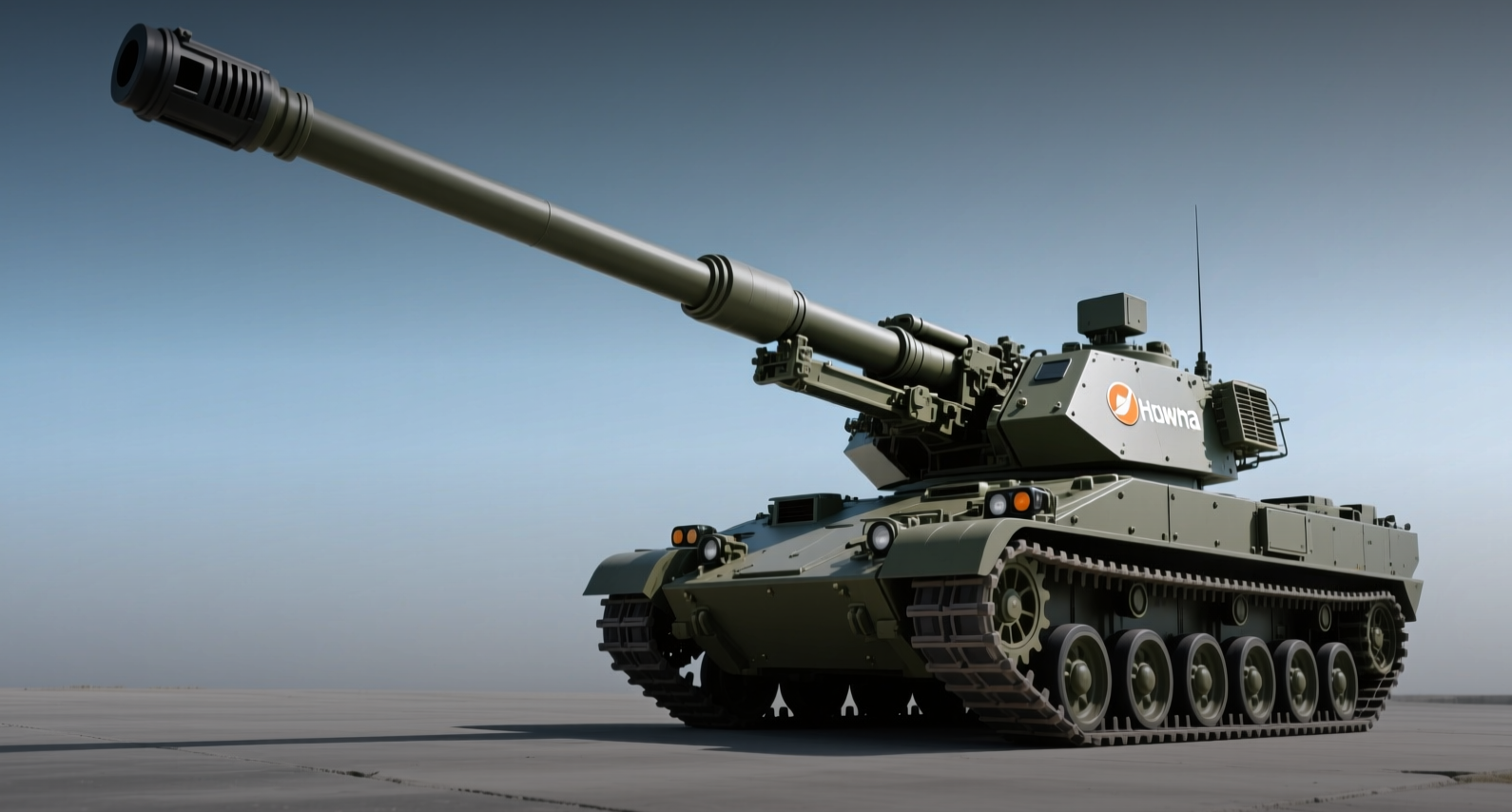
The U.S. Army's selection of Hanwha Defense USA for its Mobile Tactical Cannon program hands South Korea's largest defense company its first major U.S. military contract.
The U.S. Army selected Hanwha Defense USA to supply six prototype Mobile Tactical Cannon systems in a deal worth up to $233 million, marking the South Korean firm's first major contract with the U.S. military.
"The K9MH is the total artillery solution and will be the centerpiece of Army Fires' transformation into a more modern, more lethal force," said Mike Smith, COO and President of Land Systems at Hanwha Defense USA.
The agreement includes an option for 12 additional systems. Hanwha Aerospace shares surged 9.69 percent to 1.257 million won on the announcement, touching 1.28 million won intraday — a gain of more than 10 percent — while the broader Korean premarket fell 3.75 percent.
The award gives Hanwha a foothold in the world's largest defense market as the U.S. Army moves to replace its M777 towed howitzers and M109A7 self-propelled guns. The Army will conduct operational testing of the prototypes before deciding on full-rate production, a process that could determine whether the program expands into a multi-billion-dollar production contract.
The K9 Mobile Howitzer, a 155mm self-propelled artillery system, has been fielded in more than 2,500 units globally across South Korea, Finland, Norway, Poland, and Romania. Hanwha's selection places it ahead of competitors including Elbit America, Anduril, Oshkosh Defense's SIGMA, Leonardo DRS and KNDS's CAESAR, Rheinmetall's RCH 155, and BAE Systems' Archer — a field that spans American, Israeli, European, and British defense primes.
Localization Strategy Takes Shape
Hanwha Defense USA is establishing a phase I integration and test facility in Opelika, Alabama, under a three-year lease, part of a broader localization strategy that has seen the company build production capacity in Australia, Egypt, Poland, and Romania. "Localization is central to Hanwha's global business model, leveraging our global leading industrial technology and process in Korea to create sovereign industrial strength in the U.S.," said Michael Coulter, CEO of Hanwha Defense USA.
The Alabama facility will serve as the U.S. integration and test hub for Hanwha's family of K9 Mobile Howitzers. The company's phased localization approach means American manufacturing jobs and supply chain investment will follow if the Army exercises its options and moves toward full-rate production. Hanwha's wartime production ethos — the ability to surge output under conflict conditions — was a factor in the Army's selection, according to the company.
What the Contract Means for the Artillery Market
The MTC program is part of the U.S. Army's broader modernization push under its long-range precision fires initiative. The service plans to replace its existing towed and tracked artillery platforms with a more mobile, more survivable system capable of keeping pace with armored formations. The contract value of up to $233 million for six prototypes — roughly $38.8 million per system — reflects the complexity of integrating a wheeled 155mm artillery platform into U.S. Army operations.
The K9MH is the wheeled variant of the tracked K9, providing what Hanwha describes as "designed-in margin for the future fight." The system is compatible with the Army's full suite of munitions, a requirement that could reduce integration costs during the testing phase.
The selection also carries geopolitical weight. The U.S. joining nearly a dozen allies that operate or produce the K9 creates a shared industrial network spanning Asia, Europe, and now North America. For South Korea, the award confirms its defense export strategy at the highest level — winning business in the U.S. market, which has historically been dominated by American and European prime contractors. The last time a non-U.S. company won a major U.S. Army artillery program was in the 1980s, when the Army adopted the M119 howitzer, a British design produced under license.
Hanwha Aerospace's stock reaction — up nearly 10 percent while the broader market fell — reflects investor recognition that the U.S. Army contract opens a significant new revenue stream. If the Army exercises the option for 12 additional systems and moves to full-rate production, the program could be worth substantially more than the initial prototype phase. The Army's operational testing timeline will determine the program's trajectory. A successful evaluation could position Hanwha for a multi-year production contract, while any performance shortfalls would reopen the competition to the six other bidders that submitted proposals.
This article is for informational purposes only and does not constitute investment advice.
