
Leapmotor is joining Tesla in embodied robotics, betting its in-house EV R&D transfers to humanoid machines as it diversifies beyond cars.
Leapmotor is joining Tesla in embodied robotics, betting its in-house EV R&D transfers to humanoid machines as it diversifies beyond cars.
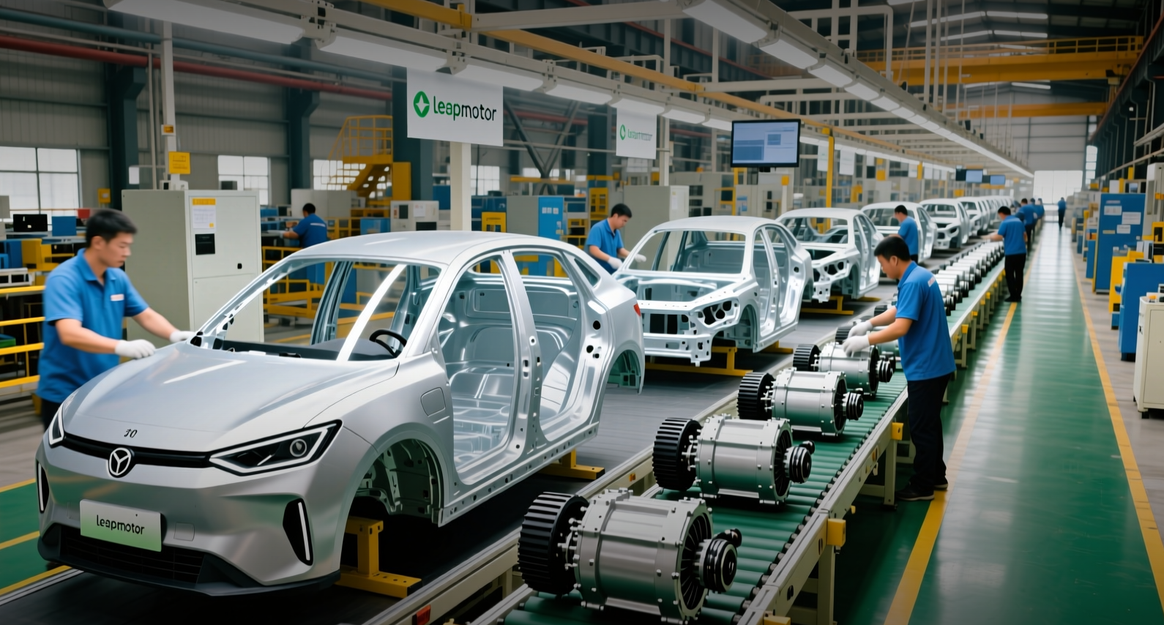
Leapmotor confirmed plans to enter embodied robotics, saying its full-stack in-house R&D makes it one of the best-positioned NEV makers to build humanoid machines, as it posted a 57.2 percent jump in first-half revenue.
"NEV companies, especially those with full-stack in-house R&D capabilities, are among the enterprises best positioned to develop robotics businesses," Li Tengfei, vice president and CFO at Leapmotor, said during an interim earnings call Monday.
Li said the company has developed plans for the robotics business but did not disclose product form, development progress or investment size. Business registration records show Huzhou Lingsheng Precision Manufacturing Co Ltd, a Leapmotor subsidiary, was established in late July with RMB210 million in registered capital, its scope covering industrial robot manufacturing, intelligent robot R&D and auto parts production. Wu Cun, senior vice president and head of the electric-drive product line, serves as legal representative.
The move puts Leapmotor alongside Tesla, whose Optimus humanoid is the sector's benchmark, and follows Chairman and CEO Zhu Jiangming's disclosure in early 2025 that the company had formed a robotics pre-research team of dozens of staff. Leapmotor shares fell 7.25 percent on the day, even as the company reported H1 net profit of RMB210 million, up about 600 percent from RMB30 million a year earlier.
Embodied robotics — machines with physical bodies that can interact with their environment — has become a favored diversification target for Chinese automakers, which see overlap in sensors, actuators, battery systems and autonomous-driving software. Tesla's Optimus, unveiled in 2022, set the benchmark for the sector, while peers including BYD, NIO and XPeng have signaled interest. Leapmotor's pitch rests on vertical integration: the company develops its own electric-drive systems, batteries and assisted-driving software, capabilities it argues transfer directly to robot hardware. That in-house stack, which also underpins its Leap 4.0 architecture built on Qualcomm's 8797 chips, gives it a cost and supply-chain edge that contract assemblers lack.
The robotics disclosure came as Leapmotor trimmed its full-year net profit target to about RMB3 billion from RMB5 billion, citing raw-material inflation that pushed first-half gross margin down to 11.7 percent from 14.1 percent a year earlier. Revenue rose 57.2 percent to RMB38.11 billion, while deliveries climbed 60.8 percent to about 356,400 vehicles, making Leapmotor the top-selling Chinese EV startup by volume. Exports surged 372.6 percent to about 96,200 vehicles, roughly 27 percent of total sales, with the company targeting 200,000 overseas deliveries in 2026 and 350,000 to 400,000 in 2027.
Leapmotor shares, which fell 7.25 percent on the day, trade well below their 52-week high as investors weigh rapid volume growth against thinner margins. The robotics business, if it follows the Tesla playbook, could open a second revenue stream, but Li gave no timeline or investment figure. The company plans a technology event September 16 to unveil a new assisted-driving world model, battery and electric-drive advances, and its Spanish plant with Stellantis begins B10 production in October.
This article is for informational purposes only and does not constitute investment advice.
