
The Pentagon's $22.9 billion Tomahawk contract is a down payment on a problem that money alone cannot solve.
The Pentagon's $22.9 billion Tomahawk contract is a down payment on a problem that money alone cannot solve.
The Pentagon's $22.9 billion Tomahawk contract is a down payment on a problem that money alone cannot solve.
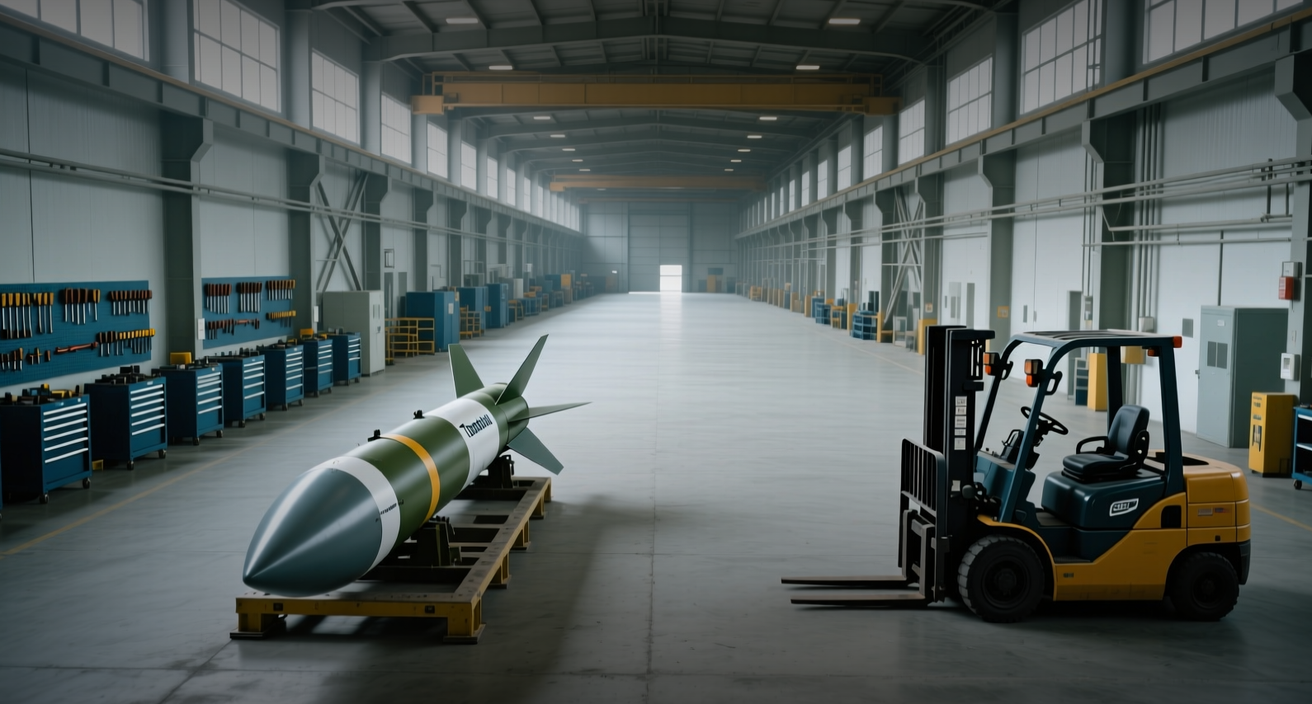
The Pentagon's $22.9 billion Raytheon contract to scale Tomahawk production from 60 to 1,000 missiles a year masks a systemic shortfall rooted in budget instability and export-control rules that block allied manufacturing.
"The strategic arithmetic is simple," wrote William Schneider Jr., senior fellow at the Hudson Institute and former undersecretary of state for national security affairs, and David A. Deptula, dean of the Mitchell Institute for Aerospace Studies, in a Wall Street Journal op-ed. "The U.S. should counter this advantage by treating the industrial capacity of trusted allies as an extension of its own rather than striving for self-sufficiency."
The shortfall spans multiple weapons systems. The US Army's 2027 budget request values the Patriot PAC-3 Missile Segment Enhancement program at $12.229 billion, with the acquisition target raised from 3,376 to 13,773 interceptors. NATO Secretary-General Mark Rutte said on March 12 that the Alliance must increase air defense capabilities fivefold — a 400 percent expansion — and remains far from that target. A Government Accountability Office report found lead times for electronic components in missile programs stretched from 19 to 34 months, while the DoD relies on more than 200,000 suppliers with limited visibility into deeper supply-chain layers.
The stakes extend beyond the Pentagon's balance sheet. China's manufacturing base dwarfs America's, and Russia, China, Iran, and North Korea can reinforce each other's defense-industrial capabilities. Without reform of the Arms Export Control Act of 1976 and a shift toward common-design production across allied nations, the U.S. enters the next conflict with an industrial system built for a bygone era.
The pattern of cutting munitions production to bank savings has deep roots. After the Cold War, Washington harvested the "peace dividend," cutting forces and procurement and allowing much of the production capacity behind them to disappear. Continuing resolutions have delayed new starts and prevented program managers from executing long-term orders, leaving industry with little incentive to invest in plant, tooling, suppliers, or workers. When inventories are limited, planners reduce requirements to make them appear adequate — defense planning has become more budget-led than strategy-led.
Recent experience demolishes the assumption that wars will be intense but short. Russia's war with Ukraine began 4.5 years ago; the U.S. war in Afghanistan lasted 20 years. A crisis may also create opportunities for adversaries elsewhere, increasing pressure on finite inventories.
The U.S. already has proof that common-design production works. The Liberty Ship program used 18 American shipyards to produce more than 2,700 ships from a common design in four years. U.S.-German cooperation on the Rolling Airframe Missile has endured for decades. Japan already produces Patriots and agreed last year to produce Advanced Medium-Range Air-to-Air Missiles. German industry is authorized to manufacture the Patriot PAC-2 GEM-T interceptor.
Yet the Arms Export Control Act of 1976 and the regulatory structure built around the International Traffic in Arms Regulations make such cooperation difficult. Created during the Cold War to prevent sensitive technology from reaching adversaries, that system is poorly suited to an era in which the U.S. needs trusted allies to co-develop, manufacture, and sustain common weapons. The AUKUS trilateral partnership among Australia, the U.K., and the U.S. points toward the solution: broad licensing exemptions for defense trade among authorized participants.
European allies are already investing. The SAMP/T NG, developed with France through OCCAR and Eurosam, combines Leonardo's Kronos Grand Mobile High Power radar with engagement modules from Thales and MBDA Italia. A contract worth approximately 700 million euros launched five batches for the Italian Air Force. France and Italy authorized licensed production of the Aster 30 in Ukraine, and the UK's £118 million contract for six Land Ceptor launchers doubles its deployable Sky Sabre component. Germany's Bundestag authorized four Patriot systems and missiles worth almost 1.4 billion euros, with deliveries staged through 2030.
The Pentagon should base munitions requirements on the possibility of prolonged multitheater conflicts rather than the hope of a brief campaign. Congress should provide stable multiyear funding at economically meaningful production rates and ensure excess manufacturing capacity for surge requirements. And the Arms Export Control Act should be replaced with a system designed to expand industrial collaboration among trusted allies working from common designs.
The U.S. has all the advantages it needs: allies, technology, capital, and demand. It lacks only the institutional framework necessary to turn those advantages into military production. Rebuilding the arsenal requires rebuilding the system behind it.
This article is for informational purposes only and does not constitute investment advice.
