
SpaceX's $100 billion Louisiana spaceport will be the largest launch facility ever built, supporting thousands of Starship launches annually.
SpaceX's $100 billion Louisiana spaceport will be the largest launch facility ever built, supporting thousands of Starship launches annually.
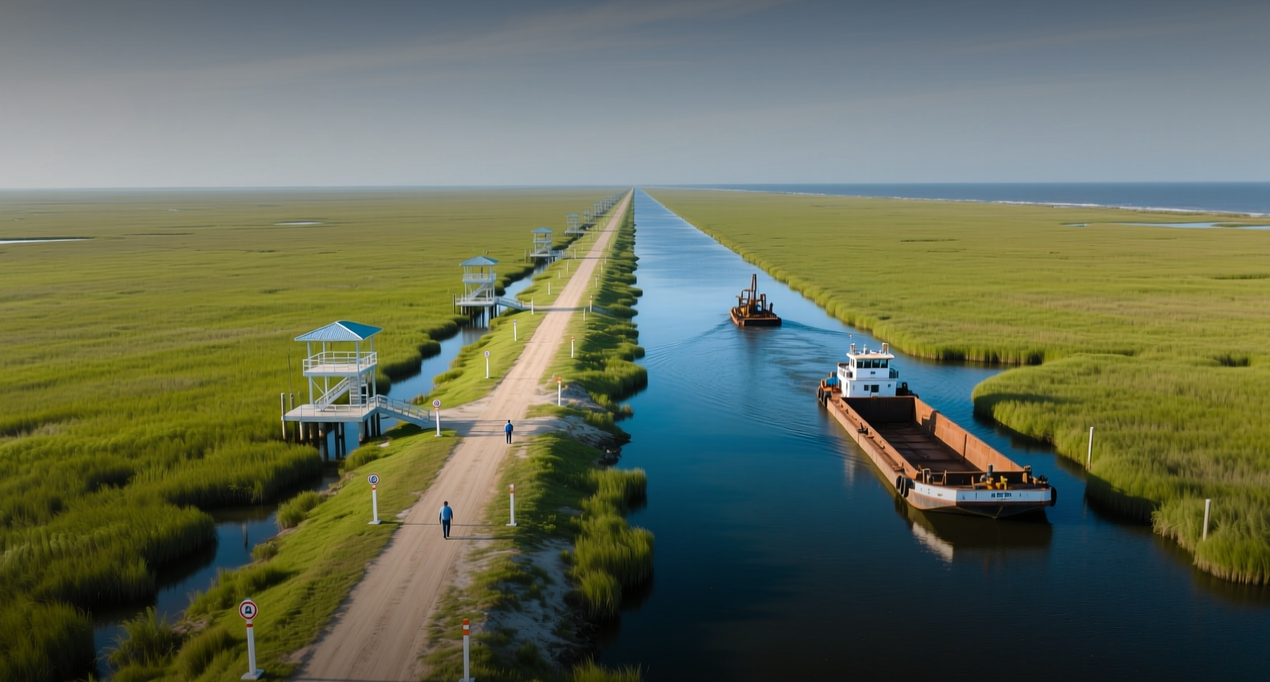
SpaceX will invest $100 billion in a Louisiana spaceport capable of thousands of Starship launches annually — its fourth and largest site, built to power orbital data centers and expand satellite internet.
"We're preparing to build a spaceport that, until now, has only existed in science fiction," Elon Musk, founder and CEO of SpaceX, said at the announcement in Abbeville. "Starbase Louisiana will unlock that future."
The project spans roughly 125,000 acres at Pecan Island in Vermilion Parish, compared with about 350 acres at Starbase Texas. At full buildout, the site will include five launch complexes, each with two launch pads and a propellant farm, plus propellant production, power generation, vehicle processing and residential housing. Construction begins in 2027, with the first launch targeted for 2029.
The investment is expected to create 3,000 direct jobs paying an average of $92,600 annually — 192 percent above the Vermilion Parish average — plus more than 8,100 indirect jobs. SpaceX will pay the parish $25 million annually for 25 years under a PILOT agreement, generating more than $820 million in local payments.
Why Louisiana's coast won the bid
The site offers advantages neither Texas nor Florida can match. Louisiana's 125,000 acres dwarfs Starbase Texas's roughly 350 acres, and the location sits close to the Intracoastal Waterway with deep-water access for moving rockets and payloads. The southward-facing coastline provides access to polar orbits with only a short traverse over Mexico, which matters because a majority of SpaceX's orbital data center satellites are expected to fly in near-polar orbits. The location is also relatively close, by barge, to SpaceX's Starfactory in South Texas near Boca Chica beach.
The state offers abundant natural gas for propellant production and power generation. Gwynne Shotwell, SpaceX's president and chief operating officer, said the facility would become a "self-sustaining spaceport" with propellant production, power generation, deep-water shipping capabilities, vehicle processing facilities and an airport on site.
"This will be a project like no other," Shotwell said.
The land became available through a legal settlement resolving dozens of lawsuits that blamed ExxonMobil for pollution and coastal land loss. Louisiana officials said they first heard from SpaceX about six months ago.
Environmental and economic stakes
The project sits in coastal wetlands that support waterfowl and other wildlife, and Louisiana loses 1 to 3 meters of coastline annually. SpaceX said it will partner with state and federal agencies to expand Louisiana's Coastal Master Plan, including Gulf shoreline protection breakwaters to slow erosion. The company said it will use only a small portion of the acreage while preserving wetlands for wildlife and recreation.
Louisiana Economic Development estimates the project will generate more than 11,100 total job opportunities across Acadiana. Gov. Jeff Landry called it a defining moment that pushes the state beyond $250 billion in new investment. SpaceX has also joined Source Louisiana, the state's online contracting database, and will host town halls in the coming months.
The company will donate $25 million to the Community Foundation of Acadiana and offer Vermilion Parish residents a 50 percent discount on Starlink internet plans.
Investment implications
The announcement shows SpaceX's intent to scale Starship operations far beyond current capacity. The company currently operates one operational Starship launch site at Starbase Texas, with another in development and three more pads under construction at Cape Canaveral in Florida. Louisiana's spaceport would give SpaceX unfettered range access — unlike Florida, where a half-dozen other private launch companies compete for range time.
For investors tracking the private space sector, the $100 billion commitment demonstrates the scale of capital required to make orbital data centers and high-frequency launch operations viable. The project also makes Louisiana a competitor to Texas and Florida for aerospace infrastructure, potentially reshaping where future launch capacity concentrates. SpaceX aims to make Starship operational at scale, supporting national priorities including a base on the Moon and eventual human exploration of Mars, according to the company.
This article is for informational purposes only and does not constitute investment advice.
