

Deere faces a contentious 2027 labor negotiation after UAW members rejected a two-year contract extension.
Deere faces a contentious 2027 labor negotiation after UAW members rejected a two-year contract extension.
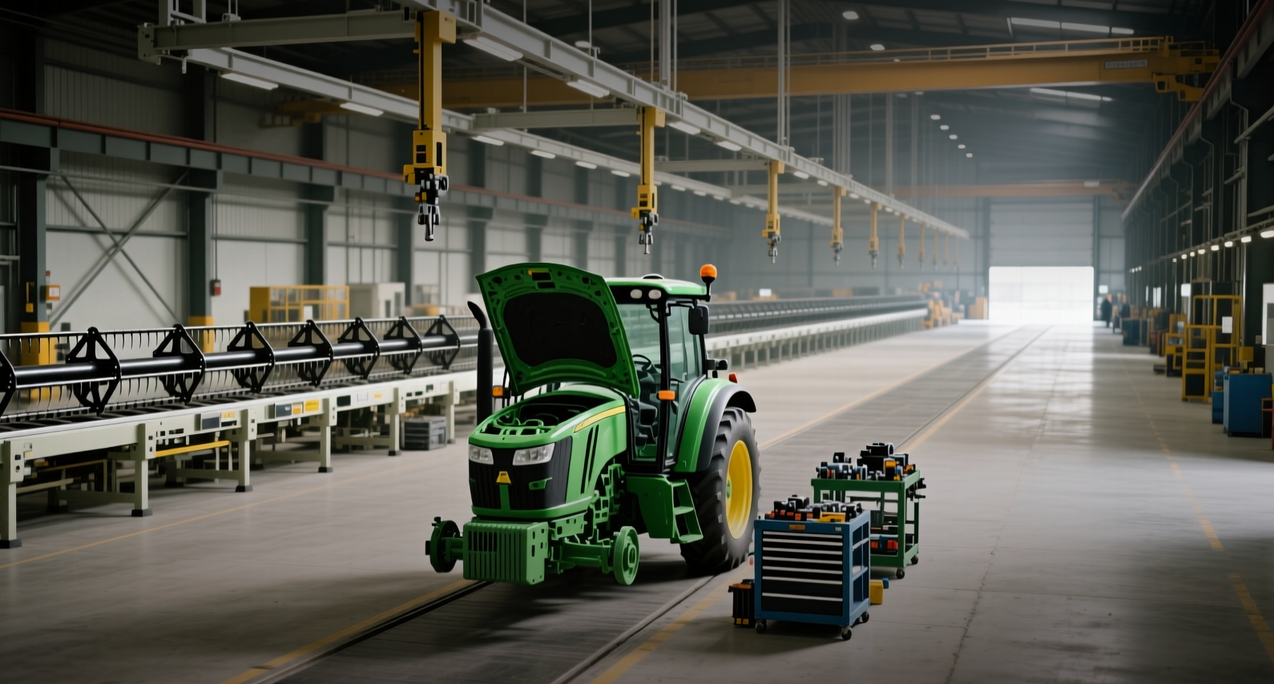
UAW members at Deere & Co. voted down a two-year contract extension offering 4 percent annual raises and $3,000 bonuses, rejecting a deal that would have pushed the current labor agreement from its 2027 expiration to 2029.
UAW President Shawn Fain called the offer an effort to avoid the usual bargaining process, according to the union. The rejection means the current contract, which covers Deere's U.S. manufacturing workforce, will expire as scheduled in 2027.
The proposal, made last month, would have delivered two years of 4 percent wage increases and one-time $3,000 bonuses if accepted by the end of August. Deere shares rose 4.27 percent on the news, suggesting investors saw the rejection as removing near-term cost uncertainty rather than pointing to immediate disruption.
The vote resets the clock on what is likely to be a hard-fought negotiation. Deere's last major labor confrontation came in 2021, when more than 10,000 UAW members struck for over a month before ratifying a new contract. With the current agreement running through 2027, both sides now have roughly a year to prepare for what Fain has framed as a fundamental test of the company's commitment to its workforce.
What the rejection means for Deere
The rejection carries immediate and longer-term implications for Deere's cost structure and operational planning. The company had sought to lock in labor costs through 2029, which would have provided predictability for its capital expenditure plans and pricing strategy across its agricultural and construction equipment lines. By declining the extension, workers preserved their ability to negotiate for higher wages and stronger job security protections when the current contract expires.
Deere's stock reaction — up 4.27 percent — reflects a nuanced investor read. The rejection removes the possibility of a quick, low-cost settlement, but it also pushes any potential work stoppage more than a year into the future, giving the company time to manage inventory and adjust production schedules. Deere shares have been supported by strong demand for agricultural equipment, though the sector faces headwinds from elevated interest rates that have raised financing costs for farmers and constrained equipment purchases.
The timing of the vote also matters. The offer was structured with an end-of-August deadline, a compressed window that gave workers little time to evaluate the terms. The rejection suggests the union viewed the proposal as a take-it-or-leave-it proposition rather than a genuine opening bid, a dynamic that could harden positions on both sides as formal negotiations approach.
The road to 2027
The 2021 strike remains the reference point for what Deere workers expect. That walkout, which lasted more than five weeks, ended with a contract that included significant wage increases and improved benefits. The current agreement, ratified after that strike, runs through 2027.
Fain's characterization of the extension offer as an attempt to bypass normal bargaining suggests the union is positioning for a more aggressive posture in 2027. The UAW has demonstrated under Fain's leadership that it is willing to use strikes strategically, as seen in the 2023 work stoppages at General Motors, Ford, and Stellantis that secured record contracts for autoworkers. That playbook — targeting specific plants to maximize leverage while minimizing strike fund depletion — could be adapted to Deere's multi-plant footprint.
For Deere, the stakes are significant. The company's U.S. manufacturing footprint includes plants across the Midwest, and a prolonged work stoppage would disrupt production of tractors, combines, and other equipment that farmers rely on during planting and harvest seasons. Labor costs represent a meaningful portion of Deere's manufacturing expenses, and the outcome of the 2027 negotiations will shape the company's margin trajectory for years. Competitors including CNH Industrial and Caterpillar will be watching closely, as Deere's settlement could set a benchmark for labor costs across the broader equipment manufacturing sector.
The rejection also carries political implications. Deere has faced scrutiny over its decision to move some production to Mexico, a point of contention that UAW leaders have cited in previous negotiations. With the 2027 contract talks approaching, job security and production location guarantees are likely to be central demands, potentially complicating Deere's efforts to optimize its global manufacturing footprint.
This article is for informational purposes only and does not constitute investment advice.
