World Liberty Financial says its USD1 stablecoin has grown to more than $4 billion in circulation on institutional demand, rejecting claims that the token's rise depends on the Trump family's political connections.
"USD1 grew because institutions trust how it operates, and confidence at enterprise scale deserves the backing of federal supervision," Zach Witkoff, CEO of World Liberty Financial, said in a statement after the company received preliminary approval for a national trust bank.
Witkoff told CNBC's "Squawk Box" that USD1 trades more than $1 billion daily, with $1.7 billion in the trailing 24 hours. The token launched in March 2025 and got an early boost when Abu Dhabi-backed MGX used it to settle its $2 billion investment in Binance, the world's largest crypto exchange by trading volume.
The Office of the Comptroller of the Currency granted preliminary conditional approval to World Liberty Trust Company on Aug. 14, a step that would let the firm bring USD1 issuance and custody in-house from BitGo under federal supervision.
Binance concentration raises questions about demand breadth
Although World Liberty cites the MGX transaction as evidence of market adoption, the token's concentration on Binance has prompted questions about how widely that demand is distributed. A February Forbes report based on Arkham Intelligence data found that Binance-controlled wallets and customer accounts held around $4.7 billion in USD1 at the time, roughly 87 percent of its $5.4 billion supply. Analysts cited in that report said the concentration could create liquidity, governance, and counterparty risks.
USD1 circulation has since fallen from the February level, though World Liberty's latest disclosure places the total above $4 billion. Stablecoin supply rises or falls as authorized participants mint tokens or redeem them for the assets backing them.
Beyond Binance, World Liberty lists USD1 on U.S.-accessible exchanges including Coinbase, Kraken and Crypto.com, plus Bybit, OKX, Bitget, Gate, KuCoin and MEXC, along with decentralized venues Uniswap and PancakeSwap. The company has also deployed USD1 natively on the Canton Network, where it became the largest native stablecoin, according to Ledger Insights. Binance ran a January campaign offering $40 million worth of WLFI tokens to eligible USD1 holders.
OCC charter still requires final authorization
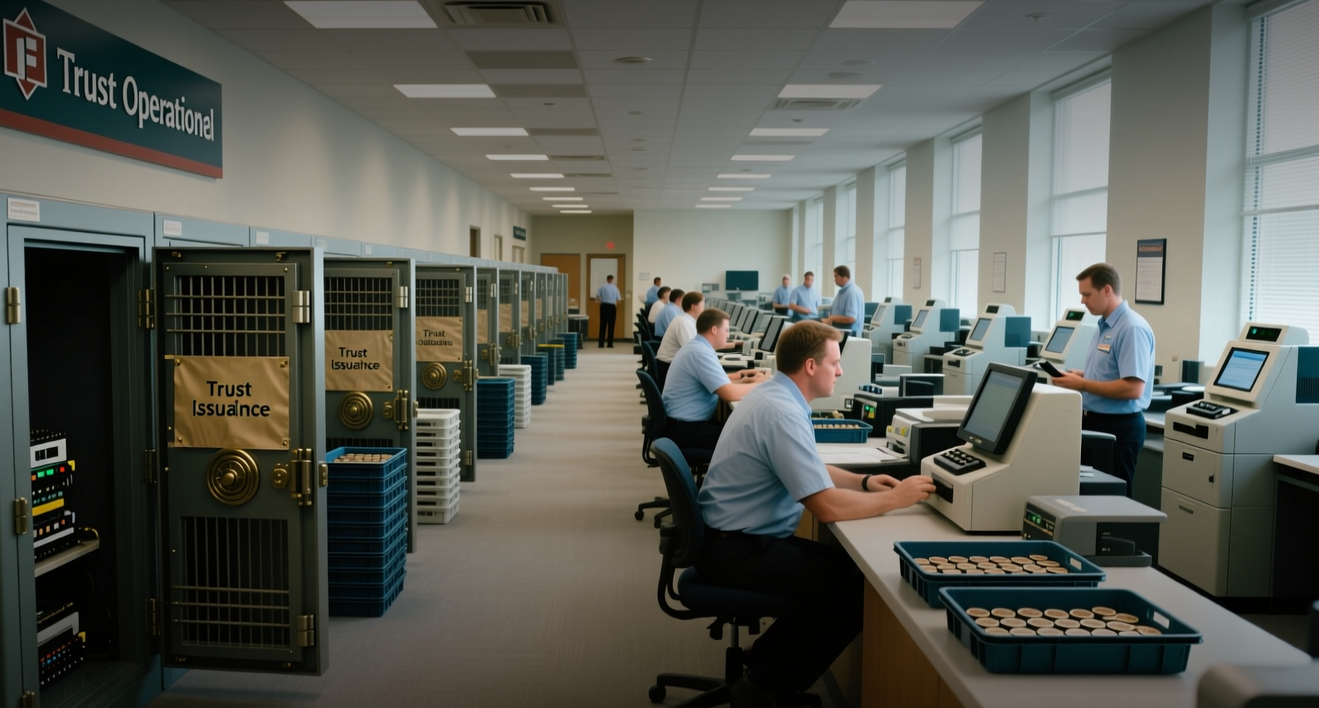
World Liberty submitted its application through WLTC Holdings LLC in January. Under the proposed structure, the trust company would directly issue and redeem USD1, manage its reserves, and provide digital asset custody to institutional customers. BitGo currently performs those functions.
Preliminary approval does not permit the trust company to begin operating. The OCC requires World Liberty Trust to maintain at least $20 million in eligible capital, submit an updated operating plan, and appoint a qualified internal audit manager. The entity would operate as a national trust bank, not a commercial bank, and would not accept retail deposits, provide checking accounts, or issue loans.
Trump ties keep World Liberty under political scrutiny
World Liberty's ownership and foreign transactions have drawn attention from Democratic lawmakers who argue that Trump's financial interest in the company conflicts with his administration's role in regulating digital assets. An entity affiliated with Trump and his family owns about 38 percent of World Liberty's holding company, according to public disclosures cited by Reuters. Witkoff is the son of Steve Witkoff, Trump's special envoy and a co-founder emeritus of the crypto company.
Questions intensified after reports that Aryam Investment 1, an Abu Dhabi-based vehicle backed by UAE National Security Adviser Sheikh Tahnoon bin Zayed Al Nahyan, acquired a 49 percent stake in World Liberty for $500 million. Sheikh Tahnoon also chairs MGX, the company that used USD1 for the Binance investment. In June, Democratic senators requested hearings into the reported transaction and asked whether it influenced U.S. decisions involving arms sales and access to advanced AI chips.
The OCC addressed some foreign ownership concerns in its approval decision, stating that non-U.S. investors were not considered principal shareholders of the proposed trust bank. Several investors signed passivity agreements promising not to control or influence the institution's operations. Eric Trump signed one such commitment as president of DT Marks, a Trump family-linked investment vehicle.
Witkoff said he has "never talked to" the president about business and "never has, never will," maintaining that his focus is on making USD1 a useful payment asset as stablecoins become a core part of internet commerce. Trump's annual financial disclosure showed income of about $515 million from World Liberty token sales and $65 million from equity in the holding company in 2025.
The outcome matters beyond World Liberty: if the OCC grants final authorization, USD1 would become one of the first stablecoins issued and custodied by a federally supervised trust bank, setting a template for how dollar-pegged tokens are governed in the U.S. market.
This article is for informational purposes only and does not constitute investment advice.