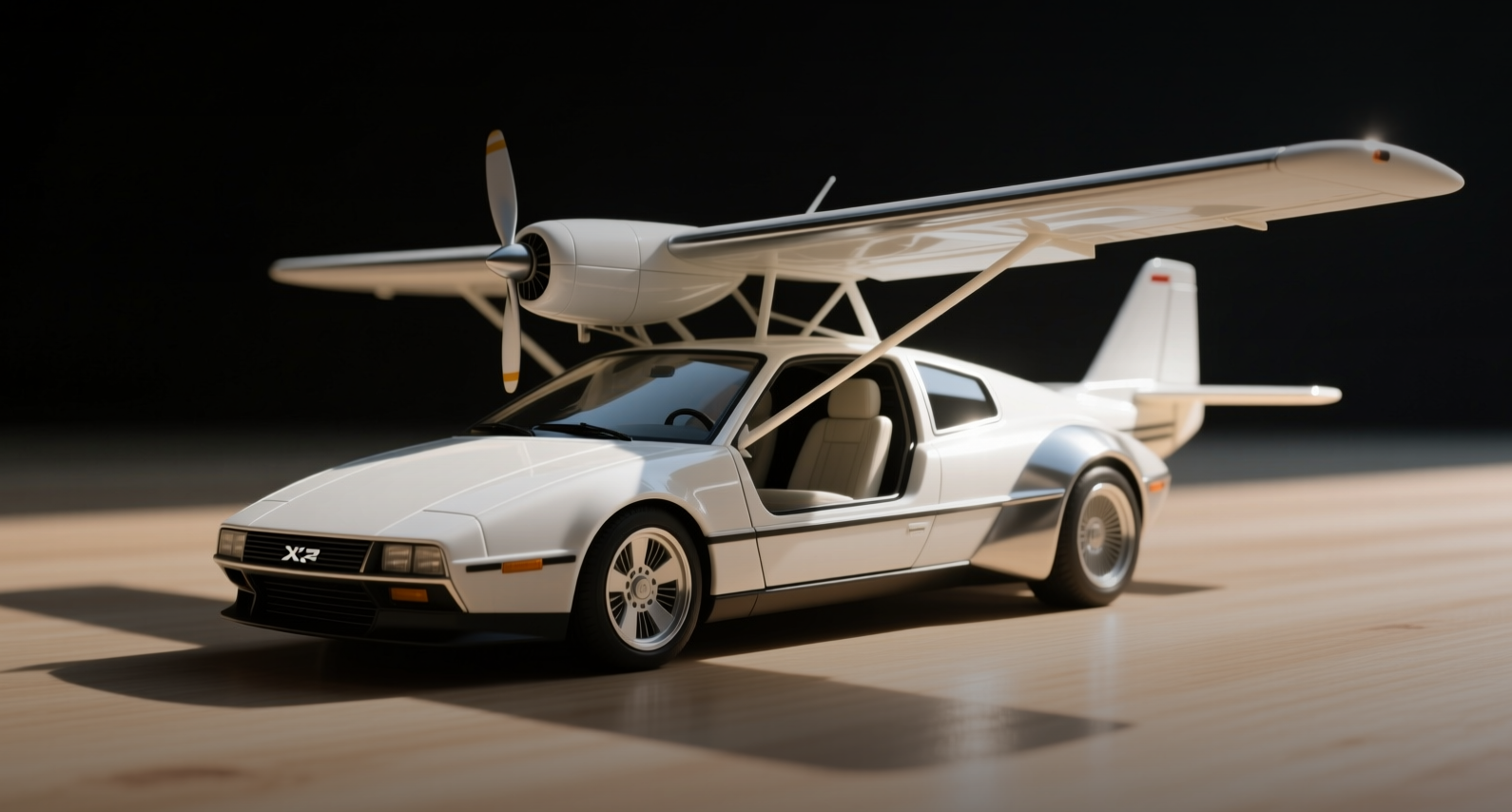
XPeng's bet on flying cars is taking off faster than its EV business.
XPeng Group will begin mass production of its first flying car this year, the Land Aircraft Carrier, after accumulating more than 7,000 orders for the $300,000 modular vehicle that splits into an electric minivan and a detachable two-seat aircraft.
"We will continue to focus on areas such as low-altitude travel and bipedal robots, with the goal of making people's mobility simpler and more intelligent," Brian Gu, vice-president at XPeng, said at CES 2025.
The Land Aircraft Carrier measures 5.5 meters long, 2 meters wide and 2 meters high, fitting standard parking spaces and requiring only a regular driver's license to operate. XPeng Aero HT, the company's aerospace arm, began construction on a mass-production facility in Guangzhou last year to support the vehicle's 2026 delivery timeline. The vehicle was first unveiled at CES 2025, where XPeng said it had already secured 3,000 orders — a figure that has since more than doubled to 7,000.
The 7,000-plus order book provides rare near-term revenue visibility in an eVTOL sector where most competitors remain years from commercialization. XPeng's diversification into flying cars and humanoid robotics — including its IRON humanoid robot, which the company positions as a fully self-developed platform — extends beyond the crowded Chinese EV market, where it faces price pressure from BYD and other domestic rivals. The company's L03 EV, its mass-market model starting at €35,600 ($40,000), is launching across 60 countries this year.
Flying Cars and Humanoids: A Diversification Play
XPeng's strategy mirrors a broader push by Chinese EV makers to expand beyond four-wheeled vehicles. BYD has focused on battery technology and commercial vehicles, while XPeng is betting on two adjacent frontiers: low-altitude aviation and general-purpose robotics. The flying car addresses urban congestion in China's megacities, where regulators are gradually opening airspace for eVTOL operations.
The company's IRON humanoid robot, meanwhile, targets commercial deployment starting with in-store sales roles at XPeng's own retail locations in China by the first quarter of 2027, with overseas expansion planned for the second quarter of 2028. XPeng began construction on a humanoid mass-production facility in Guangzhou in the first quarter of 2026, targeting more than 1,000 IRON units by the end of this year.
Investor Implications
XPeng's flying car order book validates demand for a product category that has generated more hype than revenue across the industry. Rivals including EHang and Joby Aviation have logged test flights and regulatory approvals but lack the production scale XPeng is targeting. The 7,000 orders, at $300,000 per unit, imply a potential revenue pipeline of more than $2.1 billion — though actual revenue recognition depends on production ramp and regulatory certification across markets.
XPeng shares trade as a pure EV play despite the company's expanding portfolio. The flying car program, if it reaches mass production on schedule, could force a revaluation as investors assign a separate multiple to the aerospace business. For now, the company's core EV operations face margin pressure from China's price war, making the diversification thesis both a growth story and a hedge.
This article is for informational purposes only and does not constitute investment advice.