
XPeng's IRON humanoid robot has completed automated assembly and walked off its production line, marking the company's shift from R&D prototyping to line manufacturing ahead of year-end mass production.
XPeng's IRON humanoid robot has completed automated assembly and walked off its production line, marking the company's shift from R&D prototyping to line manufacturing ahead of year-end mass production.
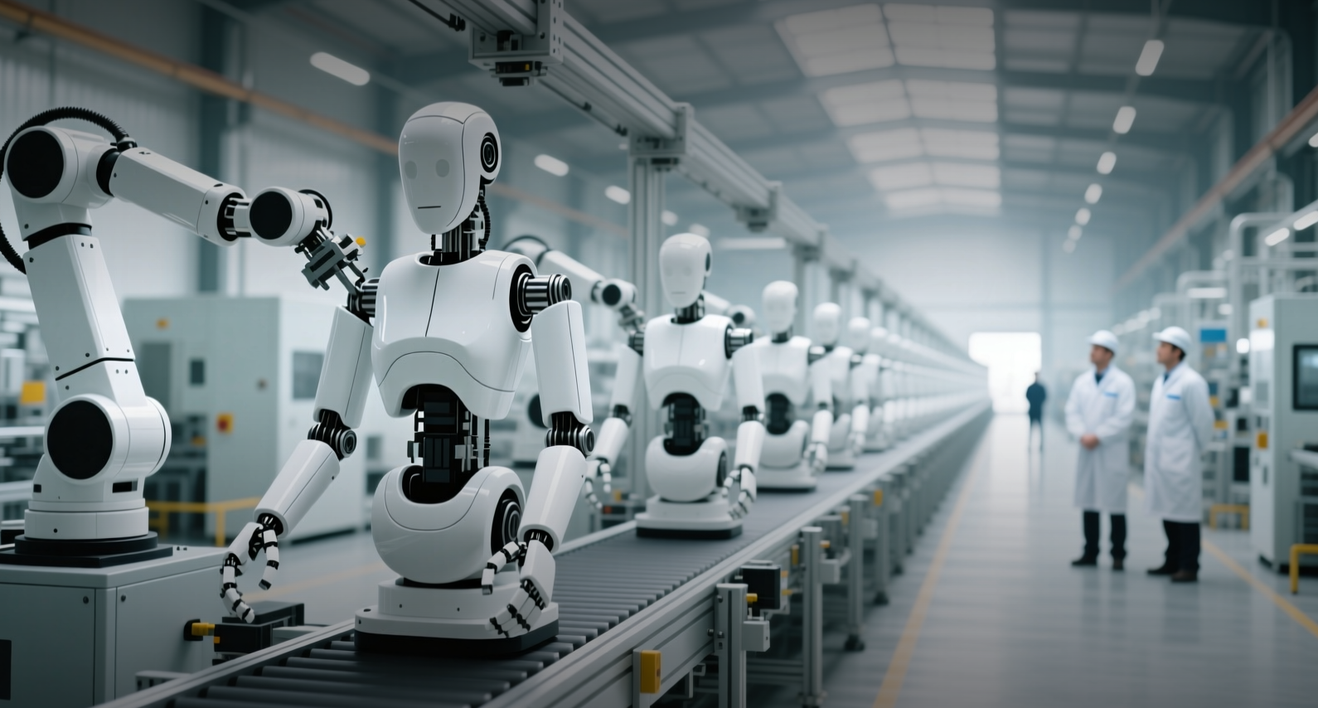
XPeng has commissioned what it calls the world's first automated production line for advanced humanoid robots, with over 80 percent of core processes automated, moving its IRON robot toward mass production by year-end.
"The robot production lines were created from scratch with no precedent to follow," He Xiaopeng, chairman and CEO of XPeng, said. "Today's step is small, but XPeng is building the production lines for an entirely new product category."
IRON carries 76 degrees of freedom across its body and 21 in each hand, powered by three in-house Turing AI chips delivering up to 2,250 TOPS of effective computing power. The production lines integrate automotive-grade quality systems from XPeng's smart EV manufacturing and are designed for scale from day one. The robotics business, housed under subsidiary Dogotix, raised over US$900 million in August at a post-money valuation above US$6.3 billion — the largest single-round private capital raise in China's embodied AI industry — led by IDG Capital with Gaorong Ventures, Alibaba, and Tencent participating.
Mass production begins by the end of this year, with initial commercial deployments in XPeng's own stores and campuses, followed by official market launch and deliveries in China and overseas in 2027. XPeng expects gross margin per unit in advanced humanoid robotics to significantly exceed that of new energy vehicles, citing high technical barriers and limited high-quality supply in the segment.
The commissioning extends XPeng's automotive manufacturing expertise into a new product category, applying quality management, supply chain, and AI systems developed for its smart EVs to humanoid robot production. XPeng delivered 39,107 vehicles in August, its second-highest monthly total this year, while second-quarter revenue rose 8 percent as net losses nearly tripled — showing why the company is pushing robotics as a second growth curve alongside automotive and globalization.
XPeng's move places it in direct competition with Tesla's Optimus program, Figure AI, and China's Unitree Robotics in the race to commercialize general-purpose humanoid robots. The production-line approach, with over 80 percent automated core processes, targets manufacturing consistency and rapid capacity expansion from the outset. XPeng has not disclosed the line's specific capacity or IRON's price point.
XPEV shares traded at $10.91, down 0.37 percent, following the announcement. The August 24 robotics financing news was followed by an 8.53 percent decline in the following 24 hours, suggesting the market has yet to fully price in the robotics division's value. XPeng retains control of Dogotix and will continue to consolidate the robotics unit's financial results after the transaction closes.
The robot is designed as a general-purpose platform capable of supporting a broad range of applications, with XPeng's physical AI foundation model running directly on the robot for autonomous task execution without remote operation. The company frames robotics as one of three growth curves — automotive, robotics, and globalization — with the production line milestone marking the transition from R&D prototyping to industrialized deployment.
This article is for informational purposes only and does not constitute investment advice.
