

Amazon's AWS cloud unit grew at its fastest pace in 15 quarters while operating margins hit a record high, validating the company's $200 billion infrastructure bet.
Amazon's AWS cloud unit grew at its fastest pace in 15 quarters while operating margins hit a record high, validating the company's $200 billion infrastructure bet.
Amazon's AWS grew 28% to a $150 billion annualized run rate in the second quarter, its fastest expansion in 15 quarters, while operating margins reached a record 13.1% — validating the company's bet that massive AI infrastructure spending would accelerate, not dilute, profitability.
"The investments we're making in custom silicon and capacity are cumulatively quite attractive on free cash flow and ROIC," Chief Executive Officer Andy Jassy said on the earnings call, pointing to Trainium chips that he said will "save us tens of billions of dollars of CapEx each year."
Revenue rose 17% year over year to $181.5 billion, topping the $178.2 billion consensus. Earnings per share of $2.78 beat the $1.65 estimate, though the figure included a one-time gain from Amazon's Anthropic investment. AWS's $37.6 billion quarterly revenue reflected accelerating enterprise demand for cloud computing and AI workloads, with the unit's backlog swelling to $364 billion.
The results challenge a prevailing bear narrative that Amazon's near-$200 billion in planned 2026 capital expenditures would crush free cash flow and margins. Trailing free cash flow did fall 95% to $1.2 billion as Q1 capex hit $44.2 billion, but the margin expansion suggests the base business is absorbing the buildout. Amazon shares trade at roughly 32 times forward earnings, below the 35x multiple of Microsoft, as investors weigh near-term spending against a contracted revenue pipeline that now exceeds half a trillion dollars when including Trainium commitments and the Anthropic deal.
AWS Custom Silicon Emerges as Margin Multiplier
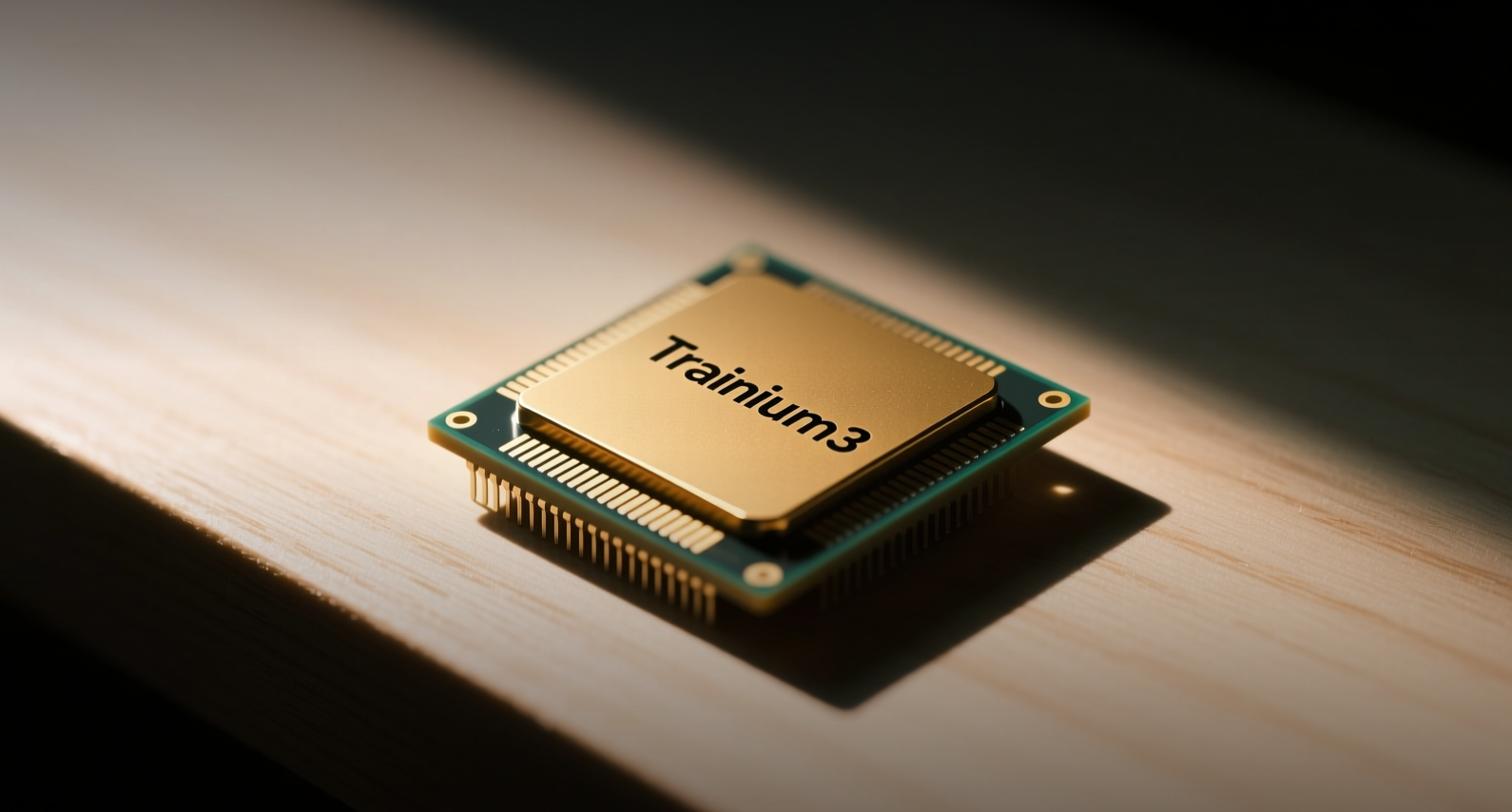
Amazon's in-house chip strategy is becoming a financial differentiator. Trainium2 is largely sold out, Trainium3 nearly fully subscribed, and the custom silicon business — spanning Trainium, Graviton, and Nitro — crossed a $20 billion revenue run rate with triple-digit year-over-year growth. OpenAI has committed to roughly 2 gigawatts of Trainium capacity starting in 2027, Anthropic to as much as 5 GW, and Meta to tens of millions of Graviton cores. Total Trainium revenue commitments exceed $225 billion, excluding a separate $100 billion-plus deal with Anthropic.
The margin math is straightforward. Jassy said Trainium at scale will provide "several hundred basis points of operating margin advantage" by replacing Nvidia GPUs with lower-cost in-house alternatives. Nvidia's H100 commands roughly $25,000 per unit at list price; Amazon's Trainium3 offers comparable inference performance at a fraction of the cost, according to company disclosures. If realized, that advantage could widen AWS's operating margin from the current 37.7% — already compressed from 39.5% a year earlier due to buildout costs — back toward the 40% threshold that bulls have targeted.
The $200 Billion Question
The scale of Amazon's infrastructure commitment is unprecedented. The company plans to deploy roughly $200 billion in capex this year, funded in part by a $25 billion bond offering in July that drew $62 billion in orders. Long-term debt has climbed to $119.1 billion from $65.6 billion, and interest expense rose to $800 million from $541 million.
Yet the demand side shows no signs of softening. AWS's $364 billion backlog grew 28% year over year, its fastest clip in recent history, and management guided second-quarter revenue between $194 billion and $199 billion with operating income of $20 billion to $24 billion. The risk is not demand but timing: if AI workload adoption slows or customers delay multi-gigawatt commitments, the capex overhang could pressure shares for multiple quarters.
Investor Takeaway
At $247, Amazon shares sit 12% below their 52-week high of $278.56, with 62 of 66 analysts rating the stock a Buy and a consensus target of $313 implying 25% upside. The bull case rests on AWS's backlog converting to revenue faster than capex grows, a dynamic Jassy has signaled will play out through 2027. The bear case centers on free cash flow and insider selling — 75 recent insider transactions show net selling. For now, the operating margin data suggests the infrastructure bet is working, even if the payoff remains a few quarters away.
This article is for informational purposes only and does not constitute investment advice.
