

Fabrinet is betting its manufacturing expansion can capture a multi-year wave of AI optical demand that CEO Seamus Grady says shows "no end in sight."
Fabrinet is betting its manufacturing expansion can capture a multi-year wave of AI optical demand that CEO Seamus Grady says shows "no end in sight."
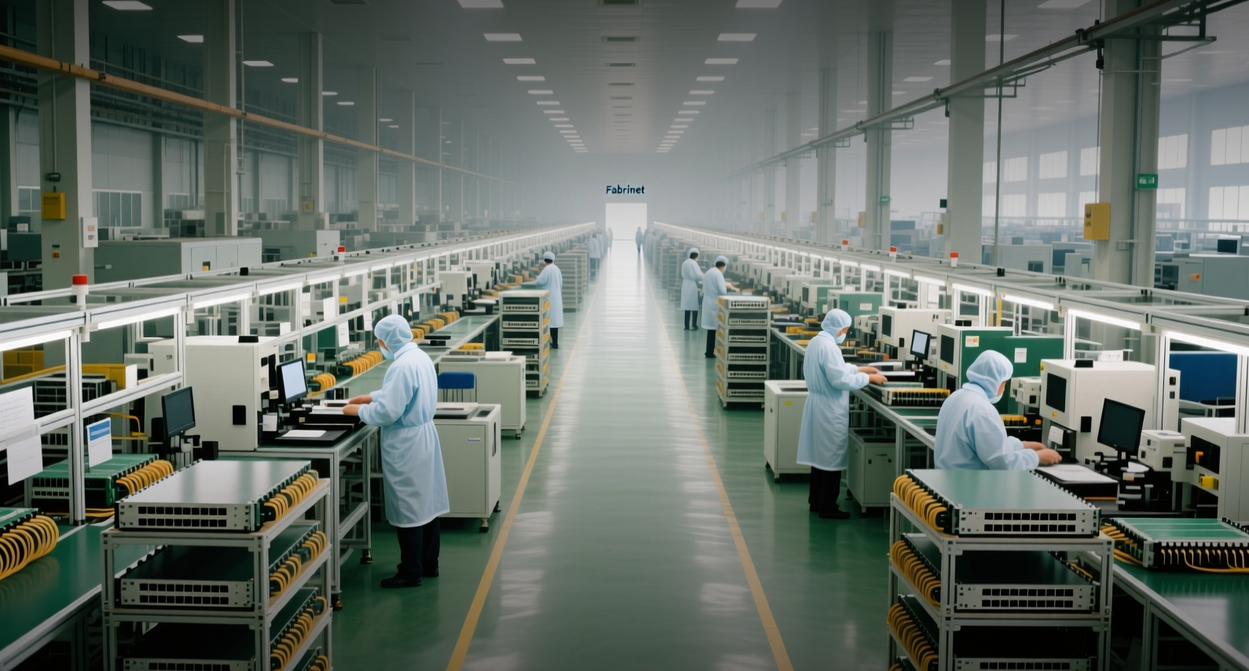
Fabrinet is betting its manufacturing expansion can capture a multi-year wave of AI optical demand that CEO Seamus Grady says shows "no end in sight."
Fabrinet is expanding manufacturing capacity to support as much as $14 billion in annual revenue as AI-driven demand for optical transceivers and data center interconnect shows no sign of slowing, Chairman and CEO Seamus Grady said.
"Data center demand remains insatiable, with customers providing visibility through the end of fiscal 2027 and beyond," Grady said on the company's earnings call. "There appears to be no end in sight."
Q4 revenue rose 45 percent to $1.316 billion, beating the $1.275 billion consensus, while data center revenue jumped 68 percent to $669 million, now 51 percent of total revenue. The buildout positions Fabrinet to capture more of the AI infrastructure cycle, but the stock fell 10 percent in premarket trading as investors weighed thin margins and heavy capital spending against the growth.
Data Center Becomes Fabrinet's Largest End Market
Fabrinet reorganized its reporting to group data center networking, Data Center Interconnect (DCI), high-performance computing and other AI infrastructure applications under one segment. Under that structure, Q4 data center revenue reached $669 million, up 68 percent year over year and 13 percent sequentially, making data center the company's largest reported end market.
DCI was the biggest contributor, with an annualized revenue run rate exceeding $1 billion. Management said new transceiver programs should begin adding growth during fiscal 2027, with demand spanning multiple customers rather than a single account.
The results echo a trend visible across the optical supply chain. Lumentum recently reported accelerating demand for 1.6T transceivers, NPO and high-power optical components, while Fabrinet's own datacom customer base is broadening beyond established relationships to include large cloud operators and merchant transceiver makers. Initial programs outside its core base focus on 800-gigabit short-reach transceivers.
Capacity Expansion Targets $12.5-14 Billion
Fabrinet is investing heavily to keep production ahead of demand. Building 10 at its Chonburi campus in Thailand will add 2 million square feet by early 2027, contributing roughly $3 billion to $3.5 billion of annual revenue capacity. The company is also expanding its Pinehurst and Nava Nakorn facilities and more than doubling its Silicon Valley footprint in Santa Clara.
Together, the additions target enough capacity to support $12.5 billion to $14 billion in future revenue, up from roughly $4.7 billion in fiscal 2026 sales. A partnership with Raytech is expected to add precision packaging capabilities on a Fabrinet campus in Thailand, supporting advanced optical packaging programs.
The spending is not cheap. Fabrinet generated $55 million in operating cash flow during Q4 but spent $92 million on capital expenditures, producing negative $37 million of free cash flow for the quarter. For the full fiscal year, operating cash flow totaled $257 million while free cash flow was $4 million. The company ended the year with $876 million in cash and short-term investments.
Margins and Valuation Frame the Debate
The growth comes with a margin profile that remains thin for a manufacturer. Non-GAAP gross margin was 12.2 percent, up 10 basis points sequentially but down 30 basis points from a year earlier. Operating leverage helped non-GAAP operating margin reach 10.9 percent, its highest level in three years, but Fabrinet's gross margin sits well below semiconductor and optical component suppliers.
For fiscal Q1 2027, Fabrinet expects revenue of $1.375 billion to $1.425 billion, roughly 43 percent growth at the midpoint, and non-GAAP EPS of $4.10 to $4.25, above the $3.96 estimate. GAAP EPS guidance of $3.39 to $3.54 came in below the $3.78 consensus, a gap that contributed to the after-hours selloff.
The reaction does not invalidate the AI optical thesis. It shows how high the bar has become for companies whose valuations already assume sustained AI infrastructure growth. Fabrinet can keep growing rapidly while FN shares remain sensitive to valuation, margins and the pace at which new capacity converts into revenue. The question for investors is whether the $14 billion capacity target is a floor for the AI buildout or a bet that demand will outlast the current cycle.
This article is for informational purposes only and does not constitute investment advice.
