The September 3 launch of OpenAI's GPT-6 Astra has reignited the AI compute demand narrative that had been fading through the summer, sending semiconductor and memory stocks sharply higher and prompting a prominent tech investor to argue the industry is entering a fourth wave of exponential compute growth. The iShares Semiconductor ETF jumped 3.5 percent on September 4, with Micron gaining 6.1 percent and SanDisk climbing 11.9 percent, while South Korea's KOSPI rose 4.61 percent on September 7 as Samsung Electronics added 5.7 percent and SK hynix advanced roughly 8 percent.
"The previous three waves came from chatbots, reasoning models, and coding agents," Tae Kim, author of "The Nvidia Way" and former Barron's technology reporter, said in his newsletter Key Context. "Computer Use could be the fourth — it takes continuously running agents from programmers and puts them in front of every knowledge worker who sits at a computer." Kim's thesis centers on Astra's Computer Use capability, which allows the model to observe a screen, understand an interface, decide on actions, execute them, and verify results — a loop that consumes far more compute per task than a simple chat exchange.
OpenAI's own internal data lends weight to the argument. In a September 6 blog post, the company disclosed that by mid-August, the median researcher in its research organization was consuming more than $600 per day in inference at API prices through coding agents, up roughly 3.7 times from $162 in July. The 90th percentile user now burns through more than $7,000 worth of tokens daily. The research organization runs the equivalent of 3.1 agent-workdays for every eight-hour human workday, up from below parity before June, with an increasing number of researchers running four or more agents concurrently.
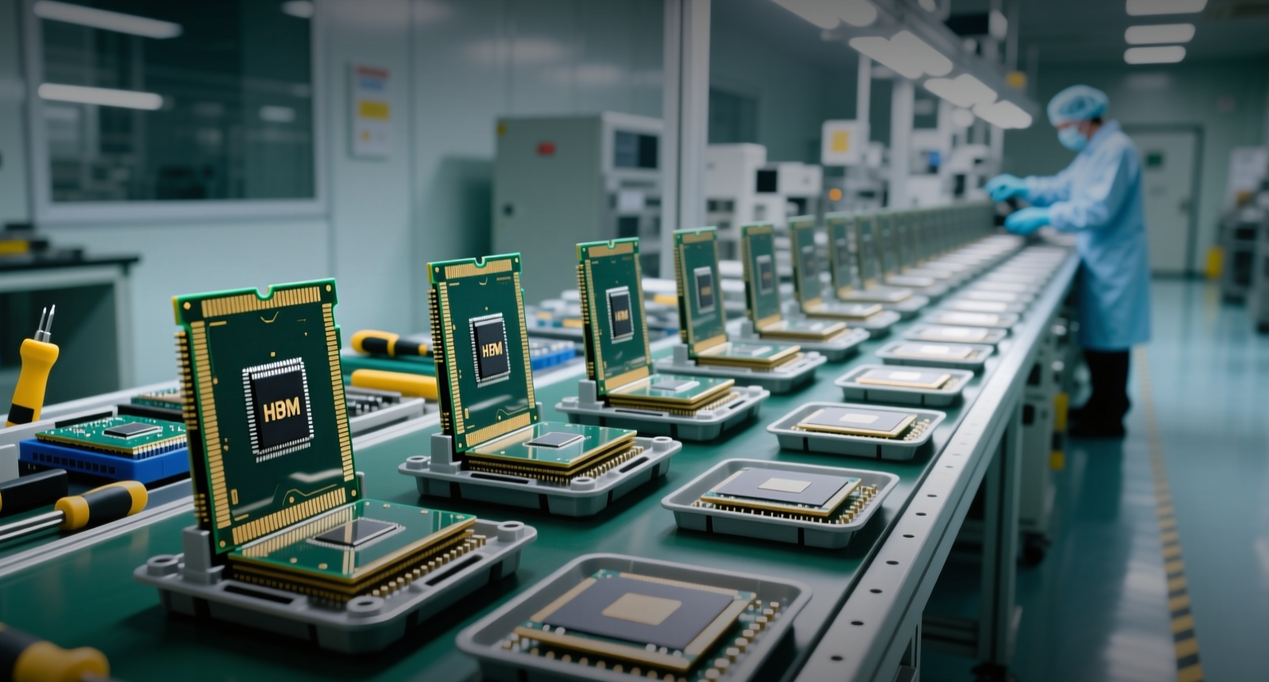
The market reaction reflects a broader reversal of the bearish sentiment that had weighed on AI infrastructure stocks through the summer, when concerns about overheated capital expenditure and peaking compute demand triggered sharp pullbacks in semiconductor names. MarketWatch described the post-Astra rally as having "reignited the memory-chip trade," with memory makers outperforming even Nvidia in the immediate aftermath. The logic: Computer Use workloads that run continuously require not just more GPUs but also longer context windows, larger KV caches, and more HBM and DRAM per inference — making memory the standout beneficiary of any sustained agent expansion.
The Jevons Paradox argument
The core investment thesis rests on a Jevons Paradox dynamic: as models become more efficient and reliable, users delegate longer, more complex tasks to AI agents, driving total compute consumption higher rather than lower. Traditional software becomes cheaper to run per user as it improves; generative AI appears to behave in the opposite direction. Kim's own test after Astra's launch — asking the model to research the Space Shuttle and build a 3D model in Blender, a program he had never used, in about 10 minutes — illustrates how Computer Use converts a single human instruction into dozens of vision-understanding, reasoning, and tool-calling cycles.
But the fourth-wave thesis remains an investment hypothesis rather than a verified industry pattern. OpenAI has not published post-launch Computer Use task volumes, per-user token curves, or GPU utilization data for Astra. The company's internal coding-agent figures, while striking, measure usage inside its own research organization — a population of highly technical users who are not representative of the broader knowledge-worker market Computer Use would need to reach.
Signs of compute strain
Some evidence suggests Astra's launch has already begun to stress OpenAI's infrastructure. On September 4, the company's status page reported performance degradation across Asia-Pacific regions affecting ChatGPT, Work, and Codex Cloud. Four days later, OpenAI announced a multi-year agreement with Firmus, a data center operator backed by Nvidia, to secure dedicated compute capacity from two facilities in Malaysia. Developer communities in Asia have reported slower response times and reduced reliability on complex tasks compared with US-based accounts, though OpenAI has not confirmed whether this reflects capacity constraints, regional routing issues, or account-level rate limiting.
A September 8 screenshot circulating on X showed a GPT-6 Astra "capacity full" message, with the user reporting all four of their accounts were affected. The image was shared by Tibo, a prominent AI commentator, with the caption "we are so back" — treating model saturation as evidence that AI demand has not peaked.
The economics question
Whether Computer Use truly opens a fourth wave of compute demand depends on three unresolved questions. First, reliability: real enterprise work involves pop-ups, permission changes, and data updates that can derail an agent mid-task. Second, cost: if an AI can complete one hour of equivalent human computer work for $10 versus a $50 employee wage, demand would likely explode; at $100 per hour, the addressable market shrinks dramatically. OpenAI's $600-per-day internal usage figure cuts both ways — it demonstrates that agents can generate enormous demand, but also that this mode of work remains expensive.
Third, Computer Use may partially cannibalize its own market. As Salesforce, Microsoft, Adobe, and enterprise software vendors expose API and MCP interfaces, many tasks will not require simulating mouse clicks and keyboard input at all. The more likely end state is a hybrid: structured interfaces called directly where available, with visual Computer Use reserved for legacy systems and open web environments that lack programmatic access.
For investors, the stakes are clear. Nvidia, Micron, Samsung, SK hynix, and the broader AI infrastructure complex have already repriced higher on the Astra thesis. But the rally is trading on expectation, not verified usage data. If OpenAI or hyperscalers publish post-launch compute consumption metrics in the coming weeks that confirm sustained per-user growth, the fourth-wave narrative gains real traction. If those numbers disappoint, the memory-chip rally could prove as short-lived as the summer's bearish correction was wrong.
This article is for informational purposes only and does not constitute investment advice.