Iowa's net farm income has collapsed 53% since 2022, pushing a Democrat to the front of the governor's race.
Iowa's net farm income has collapsed 53% since 2022, pushing a Democrat to the front of the governor's race.
Iowa's net farm income has fallen 53 percent since 2022, and the resulting voter discontent has given Democratic state Auditor Rob Sand a 48 percent to 44 percent lead over Republican Zach Lahn in the governor's race, a Suffolk University poll shows.
"These races are within the statistical margin of error," said David Paleologos, director of the Suffolk University Political Research Center, noting that voters who picked Trump by double digits in 2024 are now split almost evenly on governor and Senate.
The Suffolk survey, conducted Aug. 20-23 among 500 likely voters with a margin of error of plus or minus 4.4 points, mirrors a string of summer polls. An Emerson College survey had Sand up 48 percent to 43 percent, while a Fox News poll in late June showed his widest lead at 53 percent to 44 percent. The Cook Political Report has moved the race from Toss-Up to Lean Democrat, ranking Iowa as Democrats' best gubernatorial pickup opportunity of the cycle.
The stakes extend beyond Des Moines. Republicans hold a 53-47 Senate majority, and Iowa's open Senate seat — to replace retiring Republican Joni Ernst — is now a toss-up, with Republican Rep. Ashley Hinson leading Democrat Josh Turek 45 percent to 41 percent in the Suffolk poll. A Democratic sweep in Iowa would reshape the battle for Congress ahead of the Nov. 3 election.
Net Farm Income Down 53% Since 2022
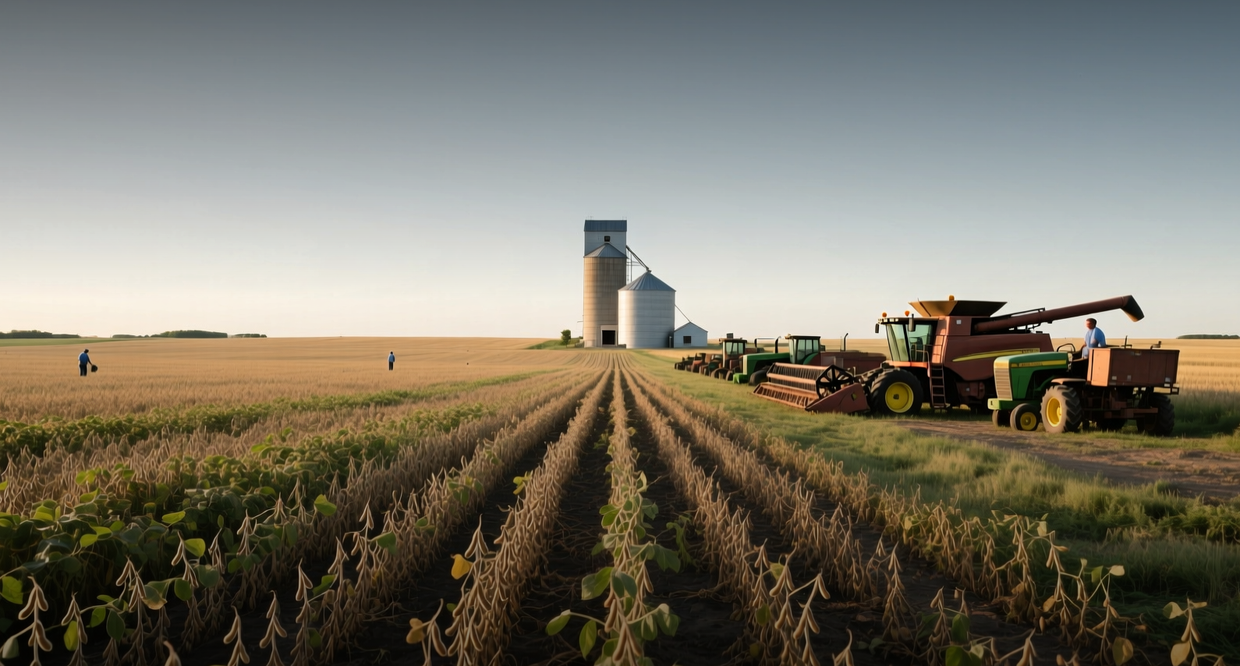
Iowa's agricultural sector has absorbed one shock after another. Trump's tariffs disrupted soybean exports to China, the Israel-Iran war squeezed global fertilizer supplies and pushed up fuel costs, and a global supply glut has depressed prices. Iowa State University economist Chad Hart told the Associated Press that "there's been just large supplies globally, and that has led to depressed prices."
Iowa Senator Chuck Grassley, a Republican, called the tariffs "a stupid policy" and warned of farm stress not seen since the 1980s. Aaron Lehman, president of the Iowa Farmers Union, said "we are just not on the right path."
The economic pain is compounded by trade tensions with Canada. Sand immediately noted that "30 percent of Iowa's exports go to Canada. This is going to hurt us" when Trump escalated tariffs on Canadian goods. Lahn, by contrast, has attempted to blame Iowa's woes on agricultural consolidation that predates the Trump tariffs.
Trump's Iowa Rating Slides 19 Points
Trump's popularity in Iowa has slipped alongside the economic pressure. The Fox News poll found voters view him negatively by 13 points, with 42 percent favorable and 55 percent unfavorable — a 19-point swing from his rating in the November 2024 election. A June poll showed his rating at 45 percent favorable to 52 percent unfavorable.
The last time a Republican president's approval rating fell this far in a farm state ahead of midterms was in 2018, when Trump's trade war with China cost Republicans two House seats in Iowa's neighboring states. The comparison is instructive: Iowa backed Obama in 2008 and 2012 before swinging to Trump in 2016, 2020, and 2024 by more than 13 points.
Sand has built his campaign on crossover appeal, courting what he calls "Rob-publicans" and touting donations from more than 2,400 registered Republicans. He posted a 21-point net favorability rating in the Fox News poll, 54 percent to 33 percent, well ahead of every other candidate tested in either statewide race.
Lahn, a farmer and businessman who won a crowded four-way Republican primary in June by roughly a point over Trump-endorsed Representative Randy Feenstra, has struggled to define himself. His favorability is underwater by 3 points, with 20 percent of voters unable to rate him at all. Sand's campaign has cast him in early advertising as a "part-time Iowan" who moved from Kansas.
Senate Race Tightens as Crossover Voting Grows
The Senate race has been just as volatile. The Fox News survey in late June gave Turek a 4-point edge, 50 percent to 46 percent. Emerson's early-August poll flipped that, putting Hinson ahead 48 percent to 45 percent. A Pollsmax average of nine polls puts Hinson ahead by 3.5 points, 48.2 percent to 44.7 percent.
Crossover voting could prove decisive. Eleven percent of Hinson's own supporters said they favor Sand for governor, compared with 7 percent of Turek's supporters who back Lahn. Emerson found independents breaking toward both Democrats, by 26 points for Sand and 11 points for Turek.
Undecided voters cluster in similar pools across both races: Iowans who sat out the 2024 presidential election, self-described casual voters, and those who say family and friends are their main source of political information. Turnout among that group is likely to decide both contests.
Iowa's general election falls on Nov. 3. Strategists in both parties expect heavy outside spending in the final stretch, and a real fight over whether Iowa is genuinely in play or drifting back toward its recent Republican baseline before Election Day.
This article is for informational purposes only and does not constitute investment advice.
