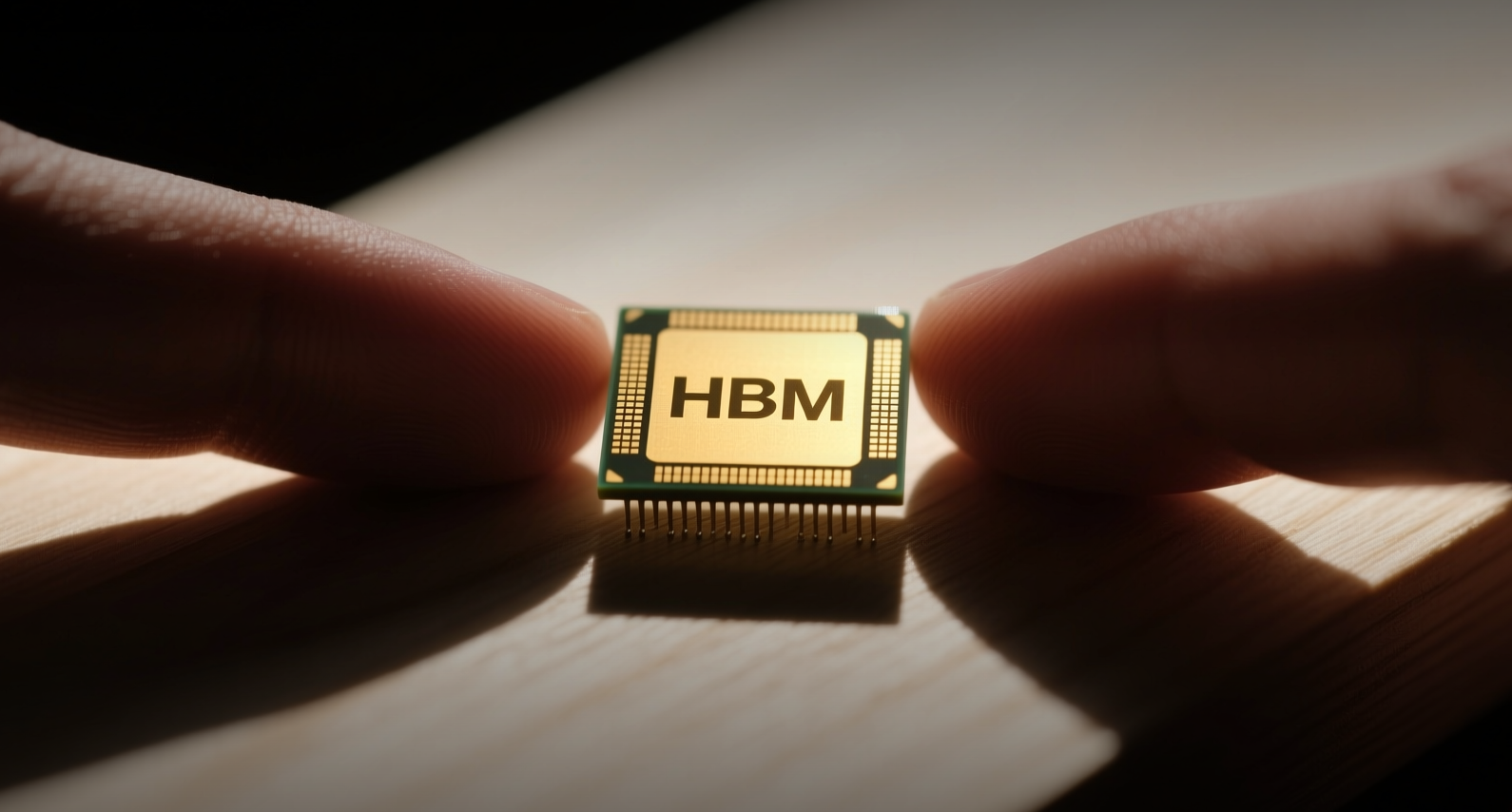
SK Hynix controls more than half the global market for the memory chips that make AI accelerators work — and it just locked in supply deals through 2030.
The world's dominant high-bandwidth memory supplier secured $500 billion in forward purchase agreements with Nvidia at last week's Korea AI Summit, cementing a supply chain that will shape AI computing through the end of the decade.
"AI customers are now seeking far more memory than previously anticipated," SK Group Chairman Chey Tae-won said at the summit, citing discussions with Nvidia, Anthropic, OpenAI, and Broadcom as evidence of demand that is reshaping what supply commitments need to look like.
SK Hynix holds approximately 56% of the global HBM market by revenue, according to IDC data cited in the company's SEC filing. Its HBM4 — which doubles the interface width to 2,048 bits and delivers up to 2 terabytes per second per stack — will power Nvidia's Vera Rubin DSX platform, which entered full production in May. The company's M15X facility in South Korea is slated to begin production by mid-2027, with a new US advanced packaging plant in Indiana not expected to reach mass production until the second half of 2028.
SK Hynix trades at less than 6 times expected 2026 earnings and below 4 times consensus forecasts for 2027 and 2028 — a valuation that reflects lingering skepticism about whether the memory supercycle can sustain its current trajectory. The forward purchase agreements, which convert an unpredictable spot market into a managed multi-year pipeline, may force a reassessment.
The scale of the supply lock-in is difficult to overstate. All three major HBM suppliers — SK Hynix, Samsung, and Micron — had their 2026 production fully sold out before the summit. Global contract DRAM prices rose 93% to 98% quarter-over-quarter in the first three months of 2026, the largest quarterly memory price spike ever recorded, according to TrendForce. NAND flash prices rose more than 50% in the same period. Industry analysts warn that meaningful new HBM capacity will not arrive until 2027 or 2028 at the earliest.
The shortage is not merely cyclical — it reflects a structural reallocation of the world's silicon wafer capacity. Each HBM wafer produced displaces roughly two to three conventional DRAM wafers because HBM requires substantially more process steps and clean-room time. Micron CEO Sanjay Mehrotra stated on the company's fiscal Q1 2026 earnings call that "the gap between the demand and supply for all of DRAM, including HBM, is really the highest that we have ever seen."
HBM's Bottleneck and the Economics of Scarcity
High-bandwidth memory solves a specific problem: AI accelerators process data faster than conventional memory can supply it. HBM stacks multiple DRAM dies vertically, connecting them through microscopic through-silicon vias, and mounts the assembly on a silicon interposer directly adjacent to the GPU. Where standard GDDR memory uses a 32-bit-wide connection per channel, a single HBM stack uses a 1,024-bit or 2,048-bit interface — the difference between a fire hose and a garden hose.
The economics explain why the reallocation is likely permanent. HBM generates three to five times more revenue per wafer than standard consumer DRAM. With hyperscalers signing multi-year forward purchase contracts at guaranteed volumes, memory manufacturers face a straightforward optimization problem: build HBM for Nvidia on a long-term contract or build LPDDR5X for a smartphone OEM at spot prices. New capacity coming online in 2027 and 2028 will not change which option maximizes per-wafer returns. IDC has described the current reallocation as "potentially permanent."
What the Supply Lock-In Means for Investors
The forward purchase agreements serve two purposes. For SK Hynix, they provide the demand certainty needed to justify the billions in capital expenditure required to build new HBM fabrication facilities — investments that cannot be responsibly committed without guaranteed offtake. For Nvidia, they convert an unpredictable and increasingly expensive spot market into a managed supply pipeline through 2030.
The consequences extend beyond the signatories. AI startups and mid-tier cloud providers without long-term HBM supply agreements face compute rationing or sharply higher GPU costs through 2027. Gaming GPU production has been cut 30% to 40% in the first half of 2026 as memory manufacturers prioritize higher-margin HBM over the GDDR7 used in consumer graphics cards. Consumer DRAM prices have tracked the same surge: a 32GB DDR5 kit that sold for $100 to $200 in October 2025 had risen above $350 by early 2026.
SK Hynix's ADR, which began trading in the US in June, closed Friday at $159 — approximately 32% above its fair value of $120, calculated by converting the local Korean share price. The premium reflects scarcity: under Korea's rules, a maximum of 2.5% of the company's total outstanding shares are allowed as ADRs. For investors with access to local shares, the Korean-listed stock trading at below 6x forward earnings offers a more direct path to what may be the most mispriced asset in the AI supply chain.
This article is for informational purposes only and does not constitute investment advice.