


Memory chip stocks fell as much as 5 percent in premarket trading after Samsung Electronics' record payout plan disappointed investors, exposing a crowded trade.
Memory chip stocks fell as much as 5 percent in premarket trading after Samsung Electronics' record payout plan disappointed investors, exposing a crowded trade.
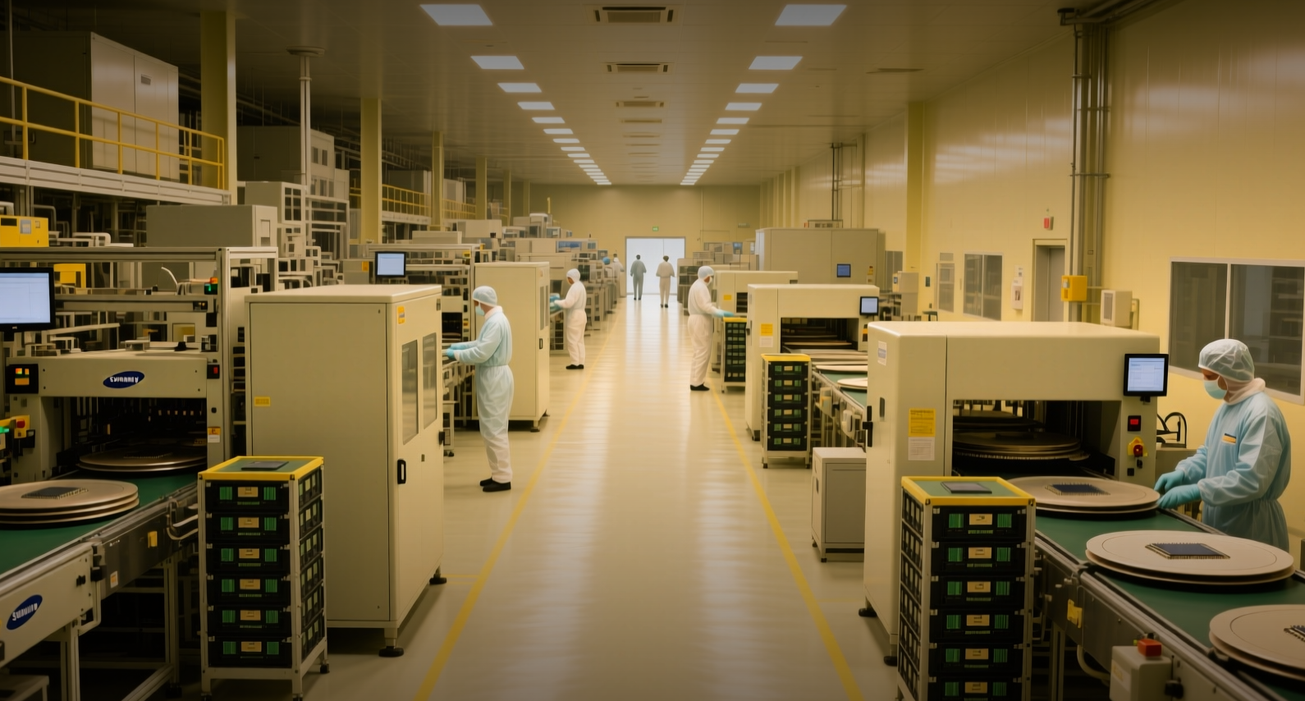
Memory chip stocks slid as much as 5 percent in premarket trading Monday as Samsung Electronics' record shareholder-return plan fell short of expectations, triggering profit-taking in one of 2026's most crowded semiconductor trades.
"This feels less like a fundamental reset and more like a positioning unwind," Daniel O'Regan, an analyst at Mizuho, said. "AI spending, data-center demand and adoption remain intact."
SanDisk fell 5.39 percent to $1,509.80, while Micron Technology dropped nearly 4 percent and SK Hynix lost about 3 percent. AMD slipped 2 percent to $463.08 and Intel fell 2 percent to $88.30. In Seoul, Samsung plunged 9 percent after its plan to return between 90 trillion won and 110 trillion won to shareholders in 2026 lacked immediate buyback commitments.
The selloff lands ahead of Nvidia's earnings Wednesday and the Federal Reserve's Jackson Hole gathering, tests that will determine whether AI infrastructure spending can sustain the memory pricing that has driven Micron's gross margin to 84.6 percent.
Samsung's payout plan triggers a sector-wide trim
Samsung's 9 percent plunge gave investors a reason to take profits after a powerful rally. The Korean chipmaker authorized a 2026 shareholder payout of 90 trillion won to 110 trillion won, including about 30 trillion won in third-quarter dividends, with the remainder to be set in January 2027. JPMorgan analysts said the absence of an instant buyback cancellation and an unchanged return figure could lead to short-term disappointment.
The move rippled across the memory complex. Coherent fell about 5 percent and Lumentum 4.5 percent, while Corning and Seagate each slipped around 3 percent. The weakness extended to Asia, where SK Hynix lost about 3 percent in Seoul.
A crowded trade meets stretched expectations
Memory stocks have been among the biggest AI winners, powered by data-center investment, tight supply and stronger pricing. Micron reported fiscal third-quarter revenue of $41.46 billion with a GAAP gross margin of 84.6 percent and net income of $28.24 billion, up from $9.30 billion in revenue a year earlier. SK Hynix has more than doubled in 2026.
That success made the trade heavily owned. When positions become crowded, investors do not need negative fundamental news to sell — a weaker risk backdrop can be enough. Nasdaq-100 futures were down about 0.6 percent Monday as investors trimmed technology exposure.
Jensen Investment Management managing director Allen Bond said memory and storage companies are "the most exposed to that incremental supply and demand" from continuing data-center construction. VistaShares investment strategist David Fetherstonhaugh characterized the weakness as macro-driven rather than evidence of deterioration in the underlying memory story.
Nvidia's report becomes the fundamental test
The underlying memory thesis remains stronger than Monday's share-price action suggests. Bank of America's Vivek Arya reiterated a Buy rating on Micron and raised his target to $1,550, arguing Wall Street underestimates the company's longer-term earnings power. The 47-analyst consensus remains Strong Buy with an average target of $1,515, implying about 57 percent upside from Friday's close of $966.78.
A longer-dated supply question also looms. The parent of Yangtze Memory Technologies seeks to raise 33 billion yuan ($4.9 billion) through a Shanghai listing to fund production upgrades, adding potential NAND capacity even as U.S. trade restrictions limit YMTC's reach.
Micron shares, trading near record levels after a 2026 surge, face their next test when Nvidia reports Wednesday and Marvell Technology follows Thursday. Any indication that AI infrastructure investment remains strong could help stabilize the semiconductor trade; a miss would deepen the pullback in a sector where expectations leave little room for disappointment.
This article is for informational purposes only and does not constitute investment advice.
