
Russia's shift to jet-powered Geran drones has cut Ukraine's interception rate from 92 percent to 87 percent in two months, forcing a costly rearmament of its air defense.
Russia's shift to jet-powered Geran drones has cut Ukraine's interception rate from 92 percent to 87 percent in two months, forcing a costly rearmament of its air defense.
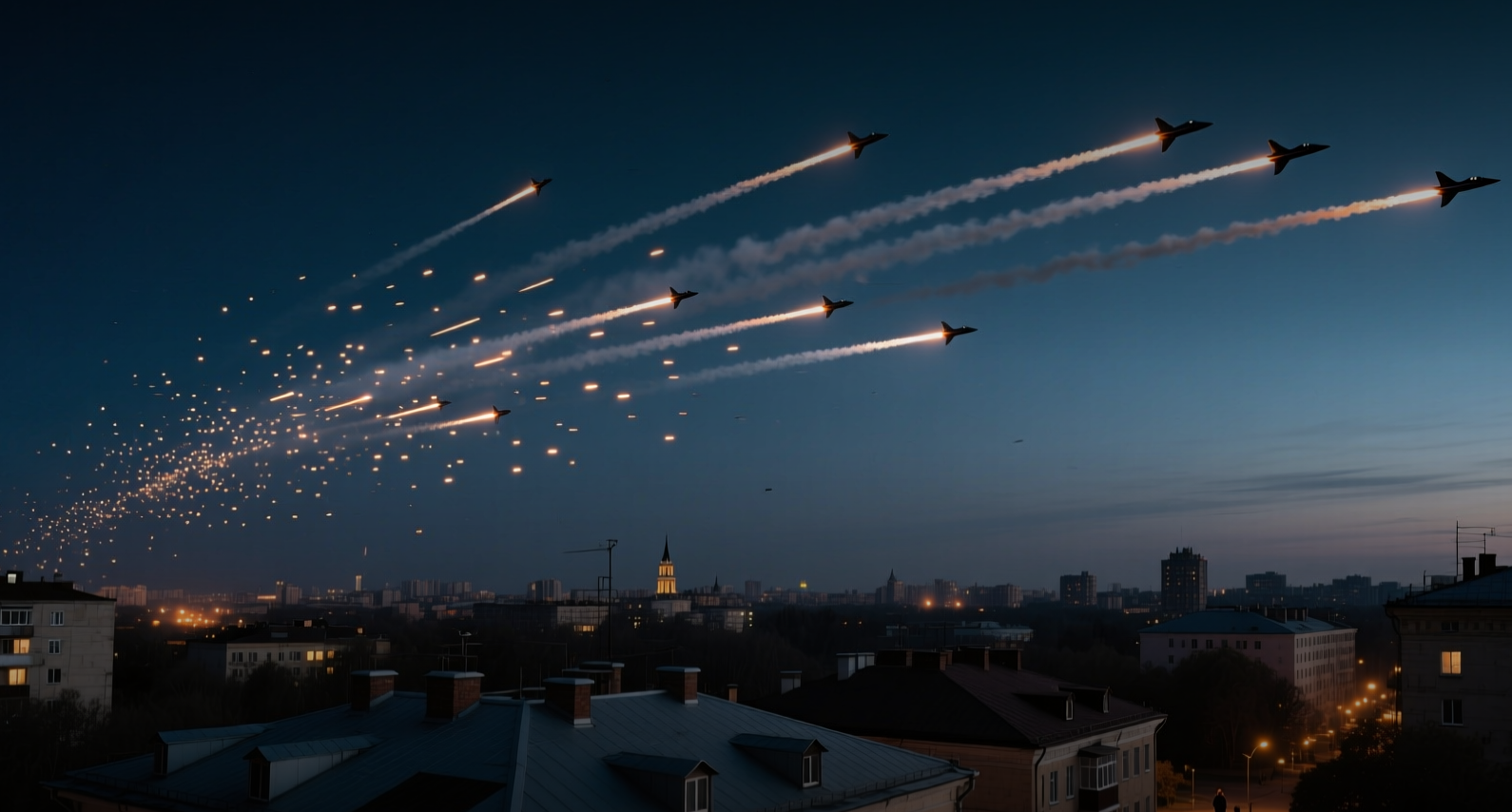
Russia's jet-powered Geran output overtook piston variants in August, cutting Ukraine's interception rate to 87 percent from 92 percent in June as jet launches hit about 2,500 in August, up from 1,500 in July.
"Sometimes, two-thirds of all drones launched during the day are jet-powered," Colonel Yurii Ihnat of the Ukrainian Air Force said.
Piston Geran launches fell from nearly 7,500 in May to under 2,500 by mid-August, while jet launches rose roughly fivefold from June to July, according to Ukrainian tracking of launch volumes and factory activity. The jet models reach speeds above 600 km/h, about three times the piston variant's pace, and fly at altitudes around 5 km — beyond the effective engagement range of mobile fire teams and portable surface-to-air missile systems. Ukrainian estimates place jet production at roughly 3,000 units per month against a stated Russian goal of a 50 percent jet share, a target the August figures suggest has already been passed.
The shift is forcing Ukraine to spend more per interception. The Geran-4's unit cost is assessed at something over $100,000, roughly twice a Geran-2, and the faster airframes trade away a substantial share of the piston variant's range. But what Russia buys with that money is a degraded interception rate — the mobile fire groups that form the cheapest layer of Ukraine's air defense lose most of their utility against targets moving at those speeds, pushing engagements onto interceptor drones and missiles costing considerably more per shot.
Russia launched 258 drones plus two Oniks anti-ship missiles and Iskander-M ballistic missiles from about 18:00 on 26 August, with approximately one third of the strike munitions jet-powered, according to the Ukrainian Air Force. Across 28 and 29 August, more than 550 Banderol, Shahed and Gerbera types were launched alongside decoys, with Ukrainian forces claiming roughly 86 percent interception across strike packages running more than 28 hours. Ukraine reported 233 drones downed or suppressed overnight into 29 August, then a further 224 launched between 06:30 and 18:00 that day with 199 claimed intercepted — evidence of a move to sustained daytime launching rather than concentrated night raids.
The daytime campaign has upended daily life in Kyiv. Eight air raid alerts sounded in the capital by lunchtime Monday, and public transit has become unpredictable as bridges close during attacks. President Volodymyr Zelensky said Russia launched 1,500 long-range drones against Ukraine over four days beginning Thursday, of which around 800 were jet-powered. "Right now, Russia's tactic is to wear down Ukraine and Ukrainians — first and foremost, our people," he said on Sunday.
Ukraine's answer has been to build interceptors that can match the speed. The Alexa Spatium, a catapult-launched turbojet interceptor quoted at 600 km/h and recoverable when it does not engage, was codified into service on 21 August with Geran-3, Geran-4 and Geran-5 named as its targets. Mi-8 helicopters have also been fitted to carry up to 12 F7 Litavr interceptor drones on external pylons, keeping the aircraft clear of the air-to-air missiles carried by some armed Geran-4 variants.
Defence Minister Yevhen Khmara said on 29 August that four candidate interceptors have completed field testing against jet Shaheds, with the task now to "scale up production to thousands of units." Ukrainian presidential technical adviser Serhii Beskrestnov put the current interception rate for jet-powered Shaheds at up to 80 percent, but said Ukrainian interceptor drones currently reach approximately 300 km/h and physically cannot catch up with targets moving at 600 km/h.
The engines powering Russia's new drones are traced to Telefly Telecommunications Equipment of Shenzhen, which reportedly removed turbojet material from its English-language website after Ukraine identified the engines in captured airframes while retaining the same material in Chinese. Photographs circulated in late August show a Geran-5 with a cylindrical fuselage, near-straight wings and a cruciform tail — a configuration closer to a conventional cruise missile than to the delta layout of the Geran-2 and Geran-3 — with reported range near 600 km.
The last time Russia shifted its long-range strike mix this sharply was in late 2022, when it introduced Shahed drones as a cheap way to flood Ukraine's air defenses and allow costlier missiles to get through. That strategy succeeded in exhausting air defense stocks but failed to break Ukrainian morale. The jet-powered evolution raises the stakes: with interception rates slipping and per-shot costs rising, Ukraine's ability to sustain its defense through the autumn will depend on scaling interceptor production from hundreds to thousands of units. For European defense contractors including Rheinmetall, BAE Systems and Leonardo, the sustained escalation reinforces demand for air defense systems and counter-drone technology.
This article is for informational purposes only and does not constitute investment advice.
