
Key Takeaways: Singapore's government mobilized a multi-agency taskforce to combat an unprecedented cicada invasion, capturing 22,000 insects in a display of efficient governance.
Key Takeaways: Singapore's government mobilized a multi-agency taskforce to combat an unprecedented cicada invasion, capturing 22,000 insects in a display of efficient governance.
Singapore's government mobilized a multi-agency taskforce to combat an unprecedented cicada invasion, capturing 22,000 insects in a display of efficient governance.
Singapore's government formed a Cicada Management Taskforce after tens of thousands of orange-winged cicadas — a species previously recorded only in the Philippines — swarmed residential neighborhoods, prompting officials to capture 22,000 insects this year.
"When the cicada surges escalate to a point where it starts to significantly disrupt home life across a neighborhood, we had to act decisively," said Desmond Choo, the member of parliament representing the hardest-hit area.
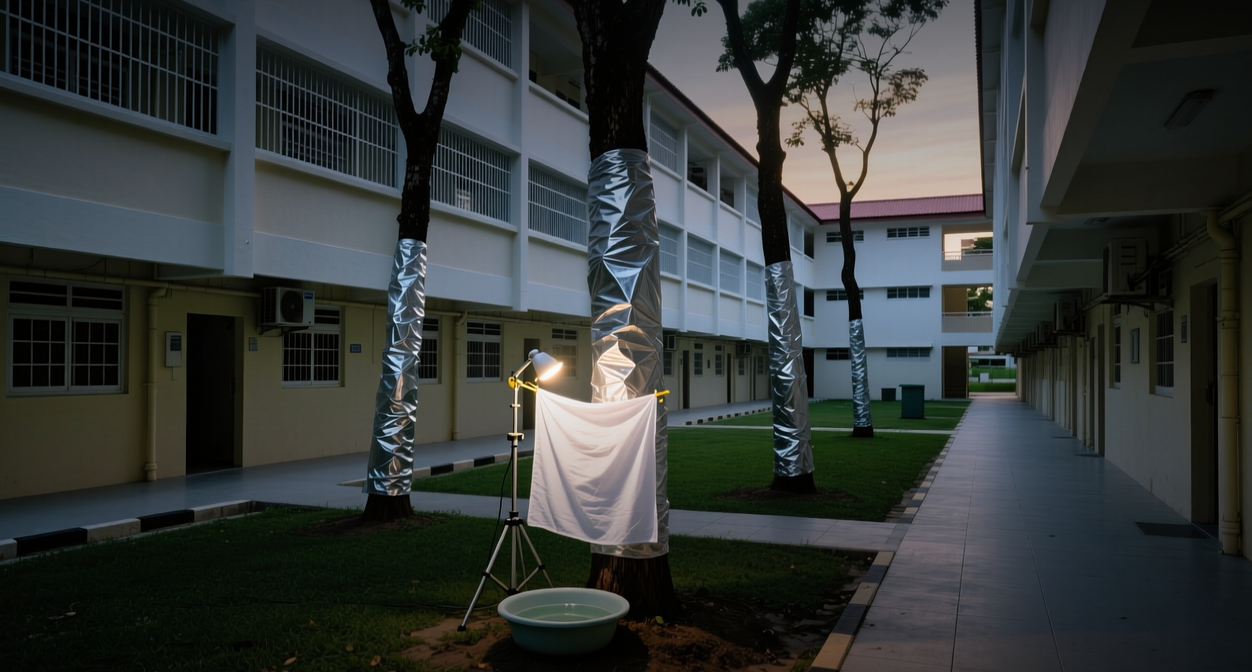
The taskforce wrapped more than 500 trees in foil or plastic to disrupt nymph molting, deployed light traps made from sheets and soapy water, and masked ceiling lights in public housing blocks. Entomologist Foo Maosheng of the National University of Singapore caught 1,733 cicadas over three nights using light traps, and now stores 1,363 moltings in his lab.
The response reflects Singapore's governance model — a city-state that has transformed from a postcolonial trading post into a top-ranked livability hub, where citizens expect rapid resolution of public nuisances. Officials are now exploring targeted pesticides and early tree pruning ahead of next year's season, which runs from March to June.
The cicadas arrived in numbers never before seen on the island, which sits roughly 85 miles north of the equator and previously hosted 10 known cicada species. Residents described insects banging into windows, preventing children from sleeping, and flying blindly into people in open-air hallways.
"All over the corridor, the floors, the wall," said Ashukumar Veerappan, 65, a resident of a housing complex menaced by the intruders. "They hit on your face and everywhere. They just fly blindly."
The government's response follows a pattern familiar to Singaporeans. The People's Action Party, which has governed since 1959, has built a reputation for decisive action on public issues — from effectively banning chewing gum to maintaining spotless streets. A 2024 Straits Times article dubbed the country "complain nation," noting that complaining has become a national pastime that drives government responsiveness.
"Because cicada surges are not well-studied in dense tropical urban settings, no single agency had an off-the-shelf solution," Choo said.
The approach contrasts sharply with the United States, where the Environmental Protection Agency advises that cicadas are largely harmless and will leave eventually. Singapore's taskforce, by contrast, deployed municipal workers with nets, wrapped tree trunks, and used light traps to corner the bugs.
Foo, who usually specializes in cockroaches, said Singaporeans "tend to have this concept of creating a working group in order to handle the situation. It's very similar to back in the Covid times."
The long-term outlook remains uncertain. Foo estimated the orange-winged cicadas spend between two and six years underground, meaning next year's bugs may be offspring of adults from several years prior. Local officials said residents reported less noise and the situation appeared to stabilize after the 22,000 captures.
For next year, officials are exploring very targeted pesticides and will prune trees early to remove potential egg-laying sites.
"We moved away from broad guesswork," Choo said. "We now have a clearer, better-tested playbook."
The episode offers a window into how Singapore's governance model handles unexpected public challenges — with speed, coordination, and a willingness to deploy resources at scale. For residents like Veerappan, who is on the executive committee of the opposition Singapore Democratic Party, the response was satisfactory even from a political opponent's perspective.
"They do look into it when more people start to complain," he said.
This article is for informational purposes only and does not constitute investment advice.
