
The far-right AfD's attack on the Bauhaus school has become the party's only misstep in an otherwise flawless campaign toward a possible absolute majority in Saxony-Anhalt's Sept. 6 election.
The far-right AfD's attack on the Bauhaus school has become the party's only misstep in an otherwise flawless campaign toward a possible absolute majority in Saxony-Anhalt's Sept. 6 election.
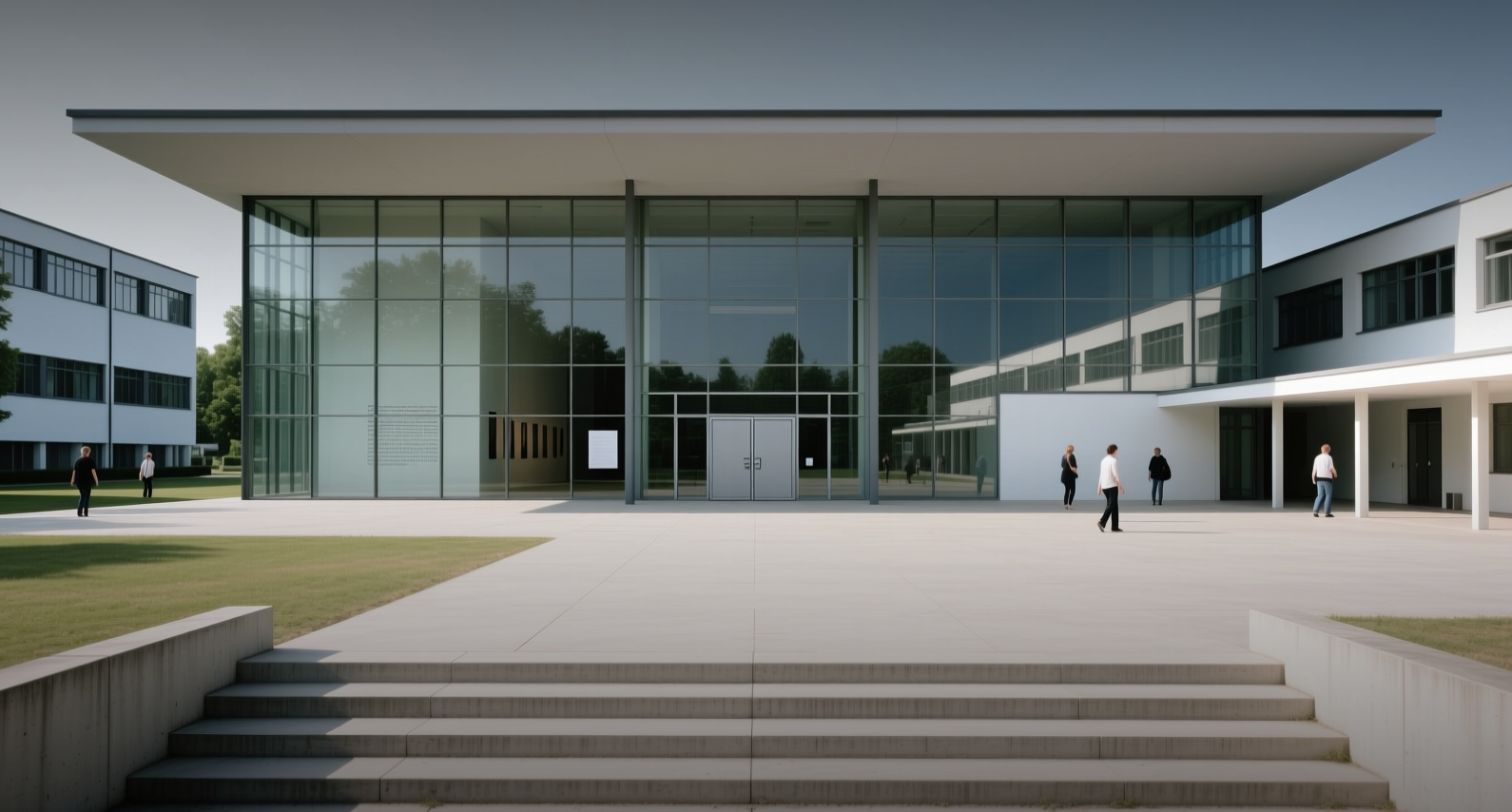
The far-right AfD's attack on the Bauhaus school has become the party's only misstep in an otherwise flawless campaign toward a possible absolute majority in Saxony-Anhalt's Sept. 6 election.
The far-right AfD has turned the 100-year-old Bauhaus into a culture-war battleground, attacking its "rootless" architecture as polls show a double-digit lead ahead of Saxony-Anhalt's Sept. 6 vote.
"The Bauhaus was always an object of political debate—even during the Cold War," said Barbara Steiner, director of the Bauhaus Dessau Foundation. "Whether and how things intensify, or whether it turns out like in 1932, no one knows."
The AfD's 256-page election manifesto calls for replacing the state's "#modernthinking" Bauhaus marketing campaign with a "#Germanthinking" one, arguing the school "always strove to negate any notion of national rootedness." The party's Saxony-Anhalt chapter is under covert surveillance by Germany's domestic intelligence agency as an extremist organization promoting an ethnic understanding of national identity. Polls suggest the AfD could win an absolute majority in the state of 2.3 million people, which would mark the first time a far-right party has come to power in a German state since World War II.
A victory would collapse the firewall strategy—a 13-year-old informal pact by all German parties to refuse coalition with the AfD. The federal government and Unesco unveiled a joint "Bauhaus Manifesto" on Thursday pledging support for "openness to the world instead of nationalism," while the Bauhaus Dessau Foundation has taken steps to shield its funding and governance structure ahead of the vote.
The anti-Bauhaus campaign echoes the rhetoric of Nazi architect Paul Schultze-Naumburg, who in the 1920s lambasted the school as a "cathedral to Marxism" and argued its internationalist, flat-roofed designs were un-German and better suited to desert nomads. The parallels have not been lost on opponents. "German democracy was born in Weimar," said Georg Maier, a Social Democratic Party lawmaker and interior minister of neighboring Thuringia, where the Bauhaus was founded in 1919 before being forced to move to Dessau. "A few years later, the National Socialists were officially part of the government. We know what happened."
The Bauhaus's history carries its own contradictions. A 2024 exhibition in Weimar revealed that 15 percent of the 1,200 students who attended the school had joined the Nazi Party. Fritz Ertl, a Bauhaus alumnus, sketched the first layout for the Auschwitz-Birkenau extermination camp. Yet the school's most prominent members—founder Walter Gropius, architect Ludwig Mies van der Rohe and painter László Moholy-Nagy—rose to global prominence in the U.S., and the international style of architecture that dominated global trends in the 1950s and 1960s is widely seen as a child of the Bauhaus.
The Bauhaus is arguably Saxony-Anhalt's only global tourist draw. The school and other Bauhaus institutions in Weimar and Berlin draw 250,000 tourists each year, and monthly visitor numbers are up 20 percent this year as centennial festivities unfold. For Dessau, the Bauhaus buildings are a significant economic asset for the town's businesses and coffers.
The AfD's candidate, Ulrich Siegmund, a 35-year-old with a campaign motto of "everything is possible," has focused on a forward-looking message about change, deporting migrants and combatting "gender ideology." Some AfD officials privately concede the Bauhaus campaign may have been a distraction and have reached out to Steiner with assurances that her funding is secure.
If the AfD secures an absolute majority on Sept. 6, it would mark the first time a far-right party has governed a German state since the Nazi era. Nationally, the party already tops popularity rankings ahead of Chancellor Friedrich Merz's conservative CDU. The collapse of the firewall would force mainstream parties to confront a new political reality, potentially reshaping Germany's political environment and adding a fresh layer of uncertainty for European markets already navigating a fragile economic recovery.
The last time a far-right party gained state-level power in Germany was in 1932, when the Nazis won Thuringia's election—a prelude to the national takeover a year later. While the AfD's trajectory is not identical, the historical echo is unmistakable to observers like Maier, who said he can see the Buchenwald concentration camp from his office window.
For Steiner, the immediate priority is protecting the Bauhaus's legacy. "I'm not sure the Bauhaus is the number one topic for the people of Dessau," she said. "They're probably more interested in when gas prices will drop or how they can pay their rent."
This article is for informational purposes only and does not constitute investment advice.
