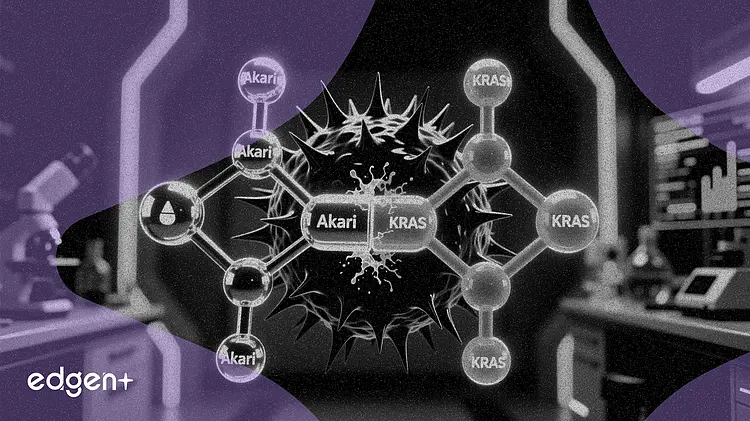
Akari Therapeutics Plc (Nasdaq : AKTX) a annoncé des données précliniques positives pour son principal candidat conjugué anticorps-médicament (ADC), l'AKTX-101, montrant qu'il agit en synergie avec les inhibiteurs de KRAS pour tuer les cellules cancéreuses pancréatiques. Ces résultats, publiés dans le cadre de la réunion annuelle de l'American Society of Clinical Oncology (ASCO), suggèrent une nouvelle stratégie pour s'attaquer aux cancers mutés KRAS, notoirement difficiles à traiter.
« Ces données suggèrent que notre charge utile de modulateur d'épissage de l'ARN PH1 peut offrir un mécanisme fondamentalement différencié capable d'améliorer l'activité des inhibiteurs de KRAS », a déclaré Abizer Gaslightwala, président et directeur général d'Akari Therapeutics. Il a ajouté que cela représentait une opportunité passionnante pour l'AKTX-101 et pour la modulation de l'épissage de l'ARN en tant que nouvelle stratégie thérapeutique pour les tumeurs induites par KRAS.
L'étude a évalué l'AKTX-101 en combinaison avec l'adagrasib, un inhibiteur de KRAS approuvé, dans des modèles de cancer du pancréas présentant des mutations KRAS G12D et G12C. La combinaison a démontré une destruction cellulaire synergique, un effet non observé avec les ADC TROP2 concurrents qui utilisent des charges utiles d'inhibiteurs de la topoisomérase I traditionnelles. En revanche, ces ADC ont montré un antagonisme lorsqu'ils étaient associés à l'adagrasib, ce qui suggère que le mécanisme unique de la charge utile PH1 d'Akari est la clé de la synergie. La société a récemment obtenu environ 5,5 millions de dollars dans le cadre d'un placement privé pour faire avancer le programme.
Un nouvel angle sur une cible difficile
Les mutations KRAS sont présentes dans près de la moitié des cancers colorectaux et sont courantes dans d'autres tumeurs solides comme le cancer du pancréas, entraînant une croissance tumorale agressive. Bien que les inhibiteurs de KRAS aient marqué une avancée significative, les tumeurs développent souvent une résistance. Les données d'Akari suggèrent que son ADC, qui cible le récepteur TROP2 sur les cellules cancéreuses, peut surmonter ce problème en utilisant une nouvelle charge utile, PH1, qui module l'épissage de l'ARN. Ce mécanisme peut dégrader les transcrits pré-ARNm qui portent des mutations cancérigènes.
L'AKTX-101 est un conjugué anticorps-médicament, une classe de thérapie qui utilise un anticorps pour délivrer une toxine puissante directement aux cellules cancéreuses. Le candidat principal d'Akari utilise un lieur exclusif pour transporter sa charge utile PH1. Contrairement aux charges utiles d'ADC conventionnelles qui endommagent l'ADN ou les microtubules, le PH1 est conçu pour perturber l'épissage de l'ARN, un processus critique pour la survie cellulaire, tout en activant le système immunitaire. Cette approche différenciée a montré une puissance supérieure dans les modèles précliniques par rapport à d'autres ADC TROP2 dans les cancers de la vessie, du poumon et du sein.
La société développe également l'AKTX-102, un autre ADC utilisant la charge utile PH1, qui cible CEACAM5, un antigène tumoral validé présent dans de multiples tumeurs solides.
Prochaines étapes pour les investisseurs
Les données positives constituent un coup de pouce pour Akari, une société de biotechnologie au stade clinique. La société a lancé des études permettant le dépôt d'une demande d'IND pour l'AKTX-101 et vise le début d'un essai clinique de phase 1 chez l'homme d'ici la mi-2027. Le récent financement de 5,5 millions de dollars, bien que modeste, est destiné à financer la société jusqu'à cette prochaine étape critique.
Le financement comprend la vente d'American Depository Shares (ADS) à 3,74 $ par action, ainsi que divers bons de souscription. Cette injection de liquidités offre à Akari une marge de manœuvre jusqu'à une étape clinique clé. Pour les investisseurs, l'histoire en est encore à un stade précoce et à haut risque, mais le mécanisme d'action unique et les données précliniques positives dans un type de cancer notoirement difficile à traiter offrent un scénario potentiel de rendement élevé. La clé sera de reproduire ces résultats précliniques dans des essais chez l'homme.
Cet article est uniquement à titre informatif et ne constitue pas un conseil en investissement.