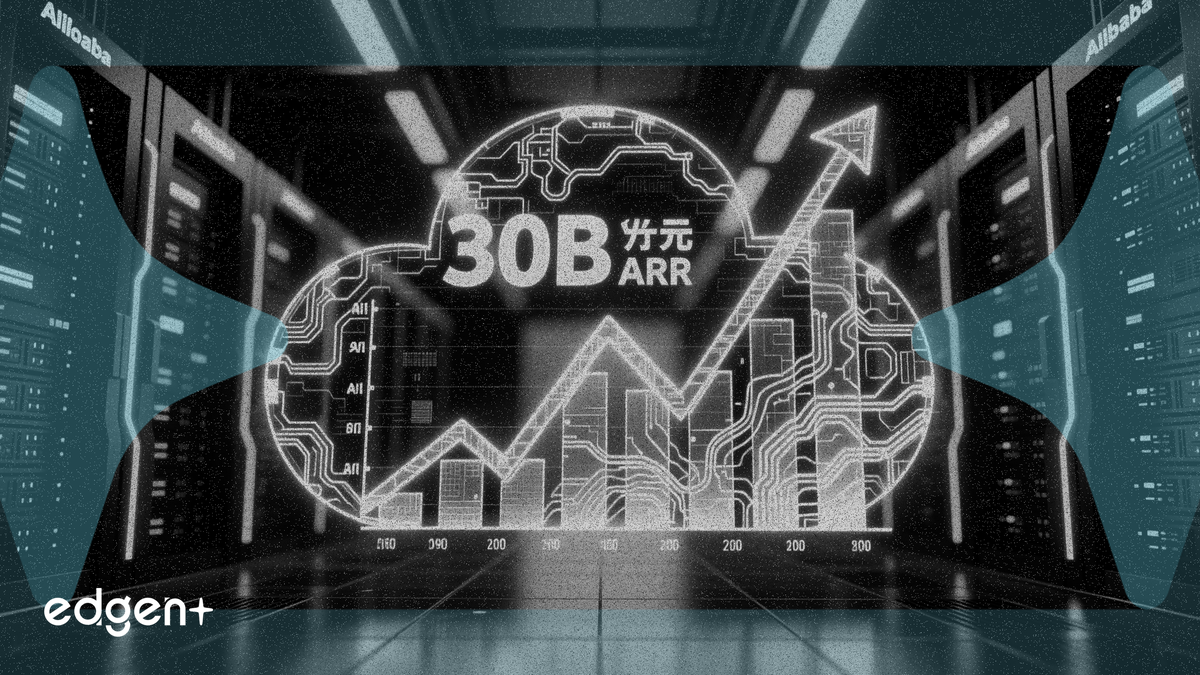
Alibaba Group Holding Ltd. (NYSE: BABA) is trading a temporary collapse in earnings for a dominant position in China’s artificial intelligence race, telling investors it expects annualized recurring revenue from its model and application services to hit 30 billion yuan by year-end.
“The AI and cloud commercialization inflection point has arrived,” Chief Executive Officer Eddie Wu said on the company’s May 13 earnings call. “We expect that in about one year, AI-related product revenue will cross the 50% threshold, becoming the primary engine driving the cloud business’s revenue growth.”
The strategic pivot was underscored in the firm’s fiscal fourth-quarter results. While group revenue grew 11% year-over-year on a like-for-like basis, adjusted EBITA fell 84% to $740 million and free cash flow swung to a negative $2.51 billion. The declines were driven by a deliberate surge in spending, including $3.9 billion in capital expenditures, to scale its AI and cloud offerings. The investment is already showing returns, with the Cloud Intelligence Group’s external revenue growth accelerating to 40% and AI-related product revenue maintaining triple-digit growth for the 11th straight quarter.
For investors, the heavy spending is a clear bet that capturing China’s AI cloud market, where Alibaba currently holds a 35.8% share, will create more long-term value than protecting quarterly profits. The move comes as Alibaba faces rising competition from rivals like Tencent and AI startups such as Moonshot and MiniMax.
A Deliberate Financial Trade-Off
The sharp drop in profitability was a calculated decision. In a letter to shareholders, Chairman Joe Tsai and CEO Eddie Wu confirmed the company is increasing investment in AI infrastructure and its own proprietary chips to establish “AI + Cloud” as a new growth engine.
“Our strategic priorities remain laser-focused on AI cloud and consumption businesses,” Chief Financial Officer Toby Xu said on the call, acknowledging the investments dragged on earnings. The company’s cash position remains strong, with approximately $59 billion in net cash, giving it the confidence to “invest for growth.”
Wall Street Sees Long-Term Value
Analysts are looking past the short-term margin pressure, focusing instead on the strong demand signals from the cloud business. Following the report, both Barclays and Mizuho raised their price targets on Alibaba to $195 per share.
Barclays cited accelerating cloud momentum, while Mizuho’s Wei Fang acknowledged the EBITA miss but argued the underlying trend in AI cloud would support a re-rating of the shares. “The same token demand pressuring margins is also the clearest demand signal bulls want to see,” Fang wrote.
T-Head Chips Provide Supply Chain Autonomy
A key part of Alibaba’s strategy is its T-Head semiconductor unit, which is developing the company’s proprietary Zhenwu PPU AI chips. The company has already deployed over 100,000 of these chips, with over 60% of the compute capacity serving external customers.
This in-house hardware provides a crucial advantage, giving Alibaba autonomy over its supply chain and a potential cost advantage against competitors reliant on chips from companies like Nvidia. CEO Eddie Wu noted that this structural advantage is favorable for both revenue growth and gross margin improvement in an environment of compute scarcity. The company is also reportedly planning to list the T-Head unit to further fund its development.
This article is for informational purposes only and does not constitute investment advice.