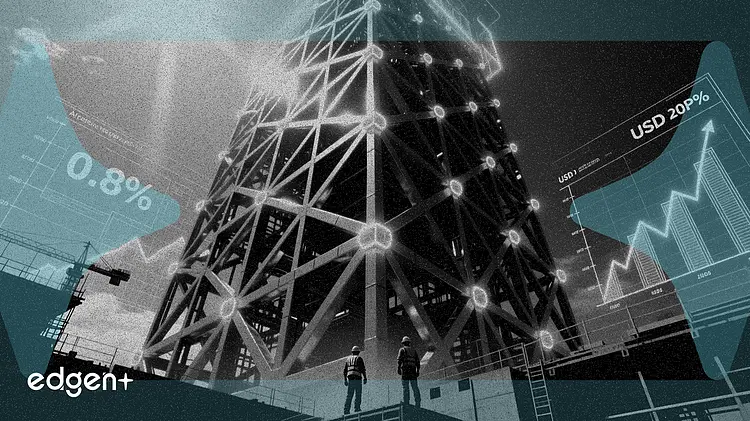
AI infrastructure spending has reached just 0.8% of US gross domestic product, a fraction of past transformational investments, suggesting the build-out remains in its infancy.
US generative AI infrastructure spending stands at roughly 0.8% of GDP, compared with 4.5% for UK railroads in the 1860s and about 2% for US electricity in the 1920s, according to BlackRock's 2026 thematic outlook. The asset manager, which oversees more than $11 trillion, argues the comparison shows the current AI capex cycle has room to run for years.
"On the scale of other major transformational events within the United States, AI capex has still not reached the upper echelons of that type of investment," Jay Jacobs, US head of equity ETFs at BlackRock, said in a podcast interview with The Motley Fool recorded May 31. "This country has been through transformations before. It's taken a tremendous amount of investment in each of these transformations."
Token consumption — a measure of AI model usage — grew 17 times last year, not 17%, Jacobs said, as demand for compute from large language model providers and enterprise customers outstrips supply. The narrative has shifted from concern about over-investment to the risk of under-investment, with some of the most powerful models potentially facing throttling due to capacity constraints, he added.
Demand Backs the Capex
The current build-out differs from the telecom boom of the 1990s, which spent about 1.5% of GDP before crashing, because AI compute is being monetized almost immediately, Jacobs said. "This is not the same as speculatively building telecom infrastructure, and then, 'if we build it, they will come' scenario. This is meeting real demand in real time."
Agentic workloads — AI systems that complete multistep tasks autonomously — could increase compute intensity by a factor of 1,000, the report noted. That surge would flow across the entire AI tech stack: power and data center infrastructure, semiconductors including GPUs and memory chips, proprietary training data, large language models, and application-layer products.
McKinsey projects cumulative global infrastructure investment will top $100 trillion by 2040, driven by AI compute, national security, and supply chain resilience. Despite this, the average infrastructure allocation in the S&P 500 is only about 3%, Jacobs said, creating what he called a potential allocation gap for long-term investors.
Thematic ETFs as Precision Tools
Thematic exchange-traded funds have grown 11 times over the past decade, yet only about 12% of US advisor portfolios hold any thematic ETFs, with the average moderate allocation at 3.6%, according to BlackRock data. The firm's own internal model portfolios have a 7.5% thematic allocation.
Jacobs argued that sector funds provide imprecise exposure to structural growth themes. "A lot of people out there think they're getting exposure to AI by allocating to the technology sector," he said. "But as we've also seen this year, the tech sector also has exposure to software names that have been disproportionately hurt by the rise of artificial intelligence."
Looking ahead three to five years, Jacobs highlighted the intersection of AI and healthcare as an underappreciated opportunity, with potential for both revenue acceleration through drug discovery and cost reduction in clinical development. He also pointed to the transition from digital AI to physical AI — robotics and autonomous vehicles — as an increasingly important part of the conversation.
For investors evaluating these themes, Jacobs recommended a framework focused on three questions: the state of the technology, the size of the opportunity behind its use case, and the probability that it gets fulfilled. "Where we are with artificial intelligence today is really in a sweet spot where it's still very early," he said. "But we have enough evidence to believe that this is here to stay."
This article is for informational purposes only and does not constitute investment advice.