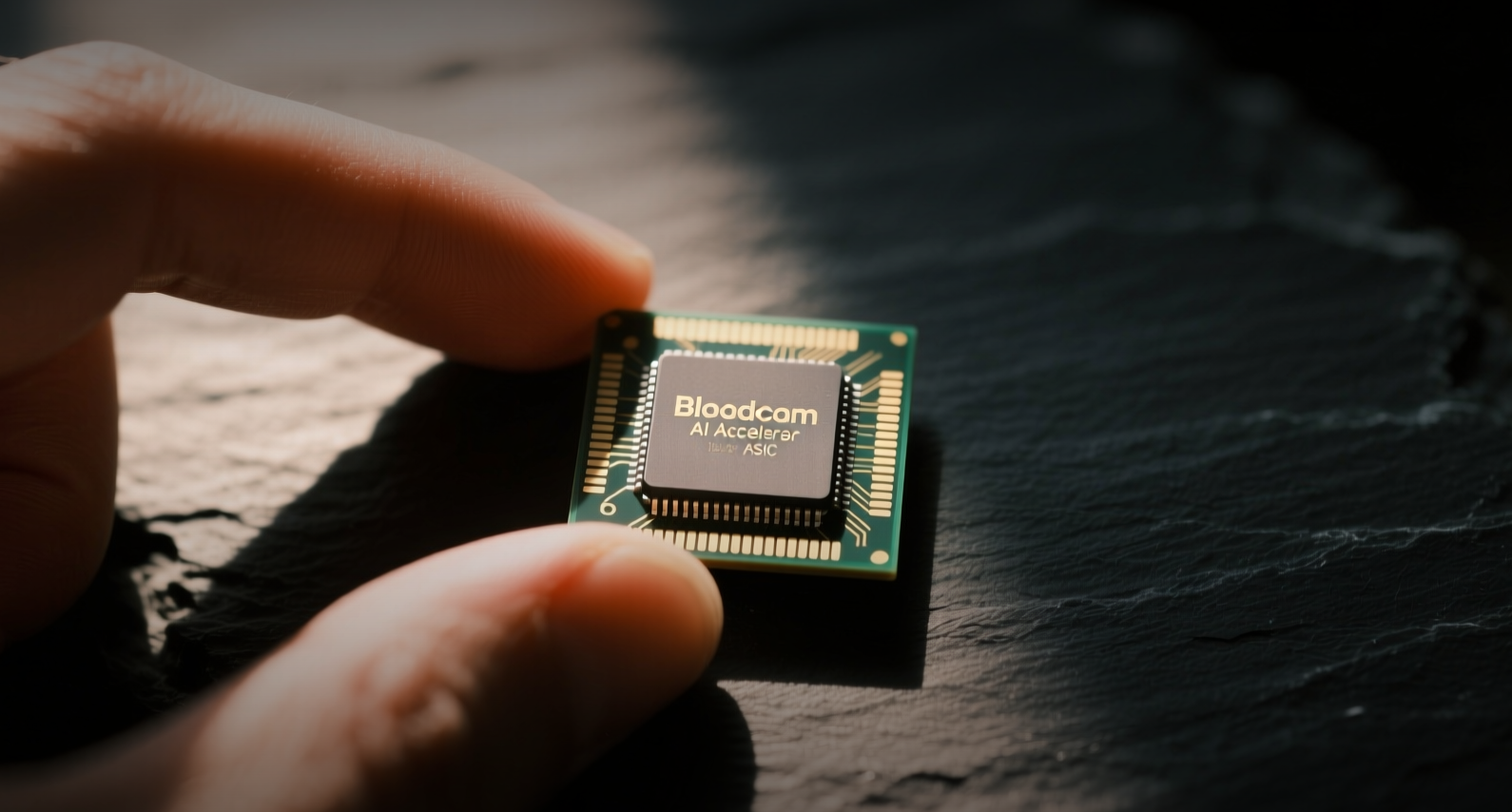
Broadcom fell 6% to $390.69 after BofA flagged $370 billion in AI financing debt, while AMD rose 4% to $502.95 on Baird's $1,250 target.
"The $370 billion isn't Broadcom's debt; the vehicle raises capital and leases custom AI accelerators to customers," Bank of America analyst Tom Curcuruto said in a note that also cut Broadcom's issuer and bond ratings to Marketweight from Overweight.
Curcuruto estimated Broadcom's chip-financing vehicle could reach $370 billion of senior debt by mid-2029 at 20-gigawatt scale, including roughly $150 billion of new issuance in 2027 alone. Broadcom agreed to backstop lease payments for five years, with maximum exposure of up to $29 billion on the initial transaction. Baird's Tristan Gerra doubled his AMD price target to a Street-high $1,250 from $625, implying AI GPU platform revenue of $147 billion by 2030 on 15% share of the data center accelerator market.
The split reaction within a single AI theme reveals opposing verdicts on how AI infrastructure gets financed. Broadcom's fiscal Q2 2026 revenue was $22.19 billion, up 47.9% year over year, with AI chip revenue up 143%, and management guided to $16 billion of AI semiconductor revenue for the current quarter. AMD's Q2 2026 revenue was $11.54 billion, up 50.1%, with Data Center revenue more than doubling to $6.72 billion, though flat gross margin guidance of 56% for Q3 2026 triggered a 9% post-earnings drop.
NVIDIA went public this week with a plan to collectively finance AI computing deals totaling roughly $500 billion alongside Goldman Sachs, Blackstone, Apollo Global Management, KKR, BlackRock and Brookfield. Jensen Huang clarified NVIDIA's support would cover as much as 25% of an opportunity, with no deals signed at announcement. Broadcom's structurally similar arrangement, anchored by Apollo and Blackstone, got a number attached Friday and the stock fell. Intel dropped 2% and the iShares Semiconductor ETF slipped 0.7%, confirming a repricing of individual balance sheets rather than the broader AI trade.
AMD's put-to-call open interest ratio has climbed to 1.15, and its 20-day Chaikin Money Flow reads -0.142, the weakest of 10 major chip names, while NVIDIA, Broadcom, Taiwan Semiconductor and Qualcomm show accumulation. Options positioning hedges AMD even as sell-side targets rise.
The decline puts Broadcom at its lowest since early June, testing the $386.41 Fibonacci support after breaking below the $395.25 retracement. Investors will watch whether Broadcom's backstop exposure grows beyond the disclosed $29 billion as the AI XPV Platform scales toward 20 gigawatts, and whether NVIDIA's $500 billion framework converts into signed contracts.
This article is for informational purposes only and does not constitute investment advice.