
BYD's flash charging network doubled in five months, putting the automaker halfway to a 20,000-station target that would give it the largest ultra-fast charging footprint in China.
BYD's flash charging network doubled in five months, putting the automaker halfway to a 20,000-station target that would give it the largest ultra-fast charging footprint in China.
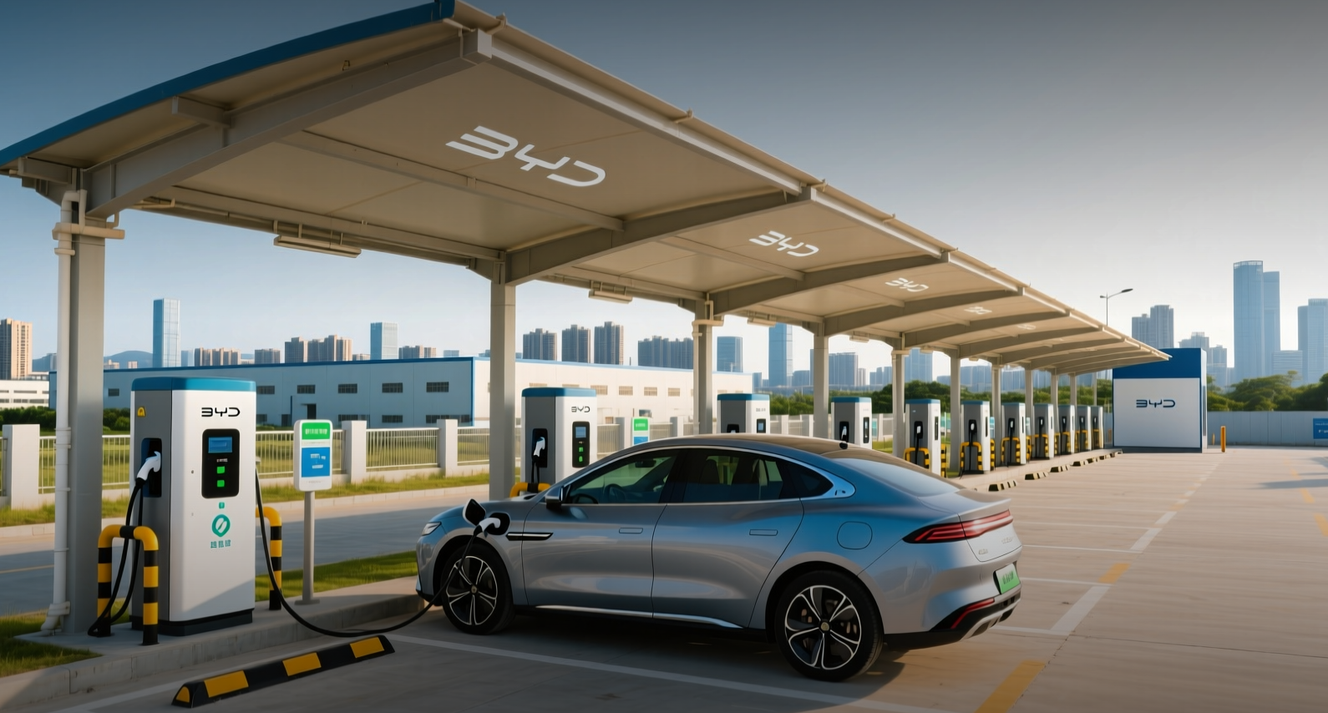
BYD completed its 10,000th flash charging station in Shenzhen on Friday, doubling its network in under five months and putting the automaker halfway to a 20,000-station target by year-end.
The milestone station, located in Shenzhen's Longhua district, took less than six months to build. BYD said cumulative users of its flash charging network have surpassed 1.83 million, with nearly one-third of those users driving vehicles from other brands — evidence that the network is becoming a cross-brand infrastructure asset rather than a captive BYD system.
The network has grown from 5,000 stations on April 1 to 7,018 across 325 Chinese cities by June 30, then to 10,000 by late August. Each flash charger delivers up to 1,500 kilowatts through a single connector, making it the world's most powerful mass-produced charger. Vehicles fitted with BYD's second-generation Blade Battery can charge from 10 to 70 percent in five minutes and reach 97 percent in nine. Even at minus 30 degrees Celsius, charging from 20 to 97 percent takes about 12 minutes — just three minutes longer than at room temperature.
The infrastructure push underpins BYD's product blitz. The Great Han flagship sedan, third-generation Tang, Sealion 08 and Fang-Cheng-Bao sports line all depend on the promise of megawatt-speed charging to move buyers. BYD shares closed at €9.96 on Thursday, down 1.8 percent, roughly 23 percent below the 52-week high of €12.99 touched in August 2025.
BYD's pace dwarfs Western efforts. Tesla has installed roughly 38,000 charging ports in the US over 14 years, with its latest V4 Superchargers delivering 500 kilowatts — one-third of BYD's flash charging capability. Geely's fastest-charging consumer brand claims a 10 to 70 percent charge in 4 minutes and 22 seconds, while CATL says it has a battery in development that could charge from 10 to 80 percent in 3 minutes and 44 seconds. BYD's Blade 2.0 battery quotes a 10 to 70 percent time of five minutes.
The company is also converting fuel stations into EV charging hubs through a partnership with Sinopec, China's state-owned oil company. The first converted station opened in Shanghai this month, with flash chargers being added to complement existing fuel infrastructure at other Sinopec locations.
BYD's charging expansion arrives as its sales tell a two-speed story. July marked the third consecutive month of rising new-energy vehicle deliveries, with 419,211 units sold. But exports jumped 124 percent to 179,841 vehicles, offsetting a 9 percent decline in domestic sales — a shift that raises questions about whether the premium push can revive the home market.
The interim results, formally adopted Friday, are expected to show revenue of 210.19 billion yuan and earnings per share of 0.85 yuan. The Yangwang U7 luxury sedan completed a 30,000-kilometer endurance test in under nine days, retaining 98.7 percent of battery capacity after more than 350 fast-charging cycles. The Great Han, which opened for orders Monday as the first D-segment flagship in the Dynasty family, starts at 249,900 yuan (about $37,200) with a CLTC range of up to 1,008 kilometers.
The Sealion 08, a flagship SUV with battery options up to 115 kilowatt-hours, launches September 2 and will be the first concrete test of whether the charging network translates into purchase decisions. The third-generation Tang follows in the fourth quarter.
BYD shares trade roughly 23 percent below their 52-week high, with 30-day volatility of 22 percent suggesting investors expect large swings. The charging network's cross-brand adoption — nearly one-third of users from other manufacturers — could expand BYD's revenue streams beyond vehicle sales. But the company's domestic sales decline and the simultaneous launch of multiple models carry execution risk. The Sealion 08 launch on September 2 and the Tang's fourth-quarter rollout will provide the first hard data points on whether the premium push can command higher prices without stalling volume.
This article is for informational purposes only and does not constitute investment advice.
