Caterpillar's $20.5 billion quarter shows the AI boom has a physical supply chain, and mining know-how is the edge.
Caterpillar is applying two decades of autonomous mining experience to deploy AI across its operations, betting that discipline can power the data center boom behind its record $20.5 billion quarter.
"The hard part about autonomy and about physical AI is incorporating that technology into the customer jobsite and into the workflows," Jaime Mineart, chief technology officer at Caterpillar, said.
Caterpillar reported second-quarter sales and revenue of $20.5 billion on Aug. 4, up 24 percent from $16.6 billion a year earlier, its first quarter above $20 billion. Power & Energy sales rose 17 percent to $8.2 billion, with segment profit up 30 percent to $2 billion, while power-generation retail sales jumped 72 percent on demand for generator sets and turbines used in data centers. The company's order backlog reached a record $72 billion, up 92 percent year over year, with power and energy customers placing orders through 2030.
Caterpillar shares have climbed nearly 90 percent over the past 12 months, pushing the stock to a forward price-to-earnings ratio above 30 — more expensive than Microsoft, Alphabet and Nvidia. Morgan Stanley's Angel Castillo, previously the biggest bear on the stock, upgraded Caterpillar and more than doubled his price target to $915, while the analyst consensus target of $991.21 sits more than 20 percent above the current price.
The mining lesson is the product
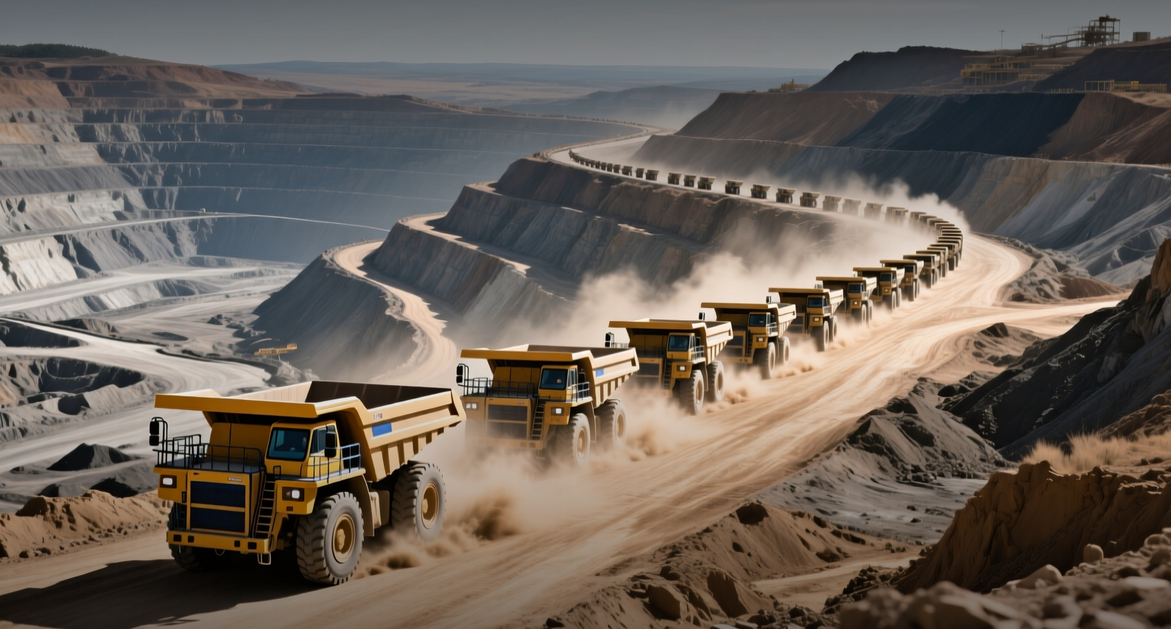
Caterpillar's strongest AI credential is not a lab demo but a mine site. More than 820 Cat autonomous trucks are operating worldwide and have hauled more than 11 billion tonnes of material with no reported injuries, according to the company's autonomy materials. The first eight autonomous Cat 793F trucks began commercial work in Western Australia in 2013 after years of testing with Carnegie Mellon University and large mining customers.
That history matters because data centers are not forgiving places either. Downtime costs money, and a bad deployment costs money in lost output on-site. Caterpillar's pitch to hyperscalers rests on the same thing it sold to miners: equipment that runs and is serviced inside real industrial conditions, reporting data as it goes.
The company has the data spine to support that pitch. Mineart said Caterpillar has about 1.6 million connected assets globally and more than 16 petabytes of structured data. That feeds tools such as Cat AI Assistant, which lets technicians use voice commands to pull up repair procedures, troubleshoot issues and identify parts while standing next to a machine. At CES 2026, Nvidia said the assistant ran on its Jetson Thor platform in a Cat 306 CR Mini Excavator, with speech handled by Nvidia Riva and responses processed on the machine rather than through a cloud round trip.
The power bet is already booked
Caterpillar's AI power business is not theoretical. In January, American Intelligence & Power Corporation, Caterpillar and Boyd CAT announced a strategic alliance tied to AIP's Monarch Compute Campus, a planned power and infrastructure platform for hyperscale and enterprise data center customers. Under the purchase agreement, AIP ordered 2 gigawatts of fast-response natural gas generator sets, with deliveries scheduled from September 2026 through August 2027.
The Cat G3516 platform can ramp from zero to full load in about seven seconds, according to Caterpillar. That number matters because AI data center loads can move quickly, and builders are hunting for power that arrives on their own timelines rather than waiting for the grid to catch up. CEO Joseph Creed told analysts the company is also bringing back production of a 10-megawatt medium-speed gas reciprocating engine platform it stopped making in 2022, with shipments expected to start in the fourth quarter and capacity ramping toward 1.5 gigawatts over 18 months.
Caterpillar is spending on the workforce behind that shift. The company plans to invest $100 million over five years to train its roughly 118,000 employees in AI, autonomy and robotics, Mineart said. If the AI product lives on a jobsite, in a machine cab or beside a generator, the people who install and service it matter as much as the chip inside it.
Caterpillar shares, trading above 30 times forward earnings, have already priced in much of the AI-driven growth. The question is whether the $72 billion backlog — with power and energy orders stretching into 2030 — supports the premium. Morgan Stanley's Castillo, who doubled his target to $915, argues it does, and the consensus target of $991.21 implies more than 20 percent upside. For investors, Caterpillar is no longer a slow-moving construction play; it is an AI infrastructure bet with a century of industrial data behind it.
This article is for informational purposes only and does not constitute investment advice.