
Beijing is spending 2 trillion yuan to build a unified national AI network — and squeezing out Nvidia in the process.
Beijing is spending 2 trillion yuan to build a unified national AI network — and squeezing out Nvidia in the process.
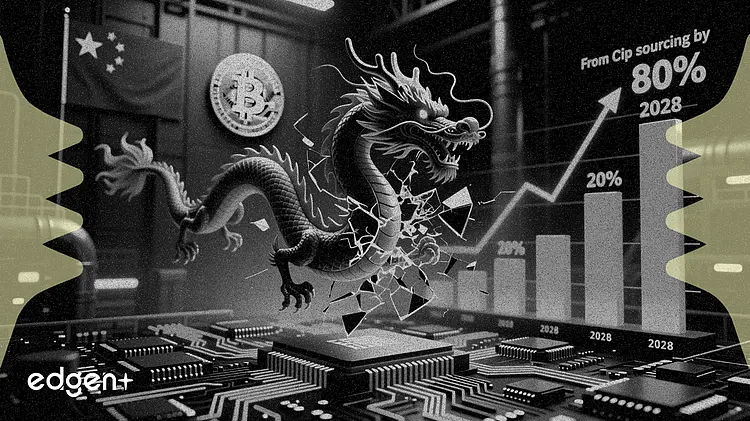
China plans to invest roughly 2 trillion yuan ($295 billion) over five years on a nationwide network of interconnected AI data centers, with at least 80% of chips sourced from domestic suppliers, Bloomberg News reported.
"This provides a clearer roadmap for China's AI localization and will benefit domestic foundries and OSAT players," Citi Research said in a note Tuesday, naming Semiconductor Manufacturing International Corp. (00981.HK) and Hua Hong Semiconductor Ltd. (01347.HK) as primary beneficiaries.
State-owned telecom operators China Mobile and China Telecom will operate the bulk of the facilities, relying on Huawei Technologies for the majority of AI accelerators. The localization target is achievable, Citi said, because domestic AI chipmakers have already captured the vast majority of China's AI accelerator market this year, while imports of Nvidia Corp.'s H200 have largely stalled.
The plan represents one of the largest state-directed technology investments in history and directly challenges Nvidia's dominance in China, a market that generated roughly $13.8 billion in data center revenue for the U.S. chipmaker in its most recent fiscal year. If fully executed, the initiative could permanently reshape the global semiconductor supply chain by creating a parallel, China-only AI hardware ecosystem.
The National Development and Reform Commission is among the key agencies drafting the blueprint, which aims to stitch together China's fragmented data center landscape into a cohesive national computing network by roughly 2028, according to people familiar with the matter. The initiative builds on the 8.2 billion yuan National AI Industry Investment Fund launched in January 2025 and aligns with the country's upcoming 15th Five-Year Plan.
Foundries and OSAT Players Stand to Gain
Beyond SMIC and Hua Hong, Citi identified several other beneficiaries across the semiconductor supply chain. Advanced Semiconductor Manufacturing Corp. (600584.SH) and Tongfu Microelectronics Co. (002156.SZ), both OSAT (outsourced semiconductor assembly and test) providers, are expected to see increased demand as domestic chip production scales. Equipment suppliers ASMPT Ltd. (00522.HK) and Vital Deeptech Co. (600641.SH) also stand to benefit from the buildout.
The 80% localization mandate effectively squeezes out Nvidia and Advanced Micro Devices Inc. from state-funded data center projects, extending a policy first reported by Reuters in November 2025 that required domestically made AI chips in any data center receiving state funds. Huawei's Ascend series of AI accelerators has emerged as the primary alternative, though independent benchmarks still show a performance gap compared with Nvidia's latest offerings.
A Parallel AI Ecosystem Takes Shape
China's AI sector gained unexpected momentum earlier this year when DeepSeek demonstrated that competitive large language models could be built with fewer high-end chips than previously assumed, reducing the strategic urgency of accessing Nvidia's most advanced hardware. The development strengthened the case for domestic chip alternatives.
In a separate but related development, reports emerged in May 2026 that China was exploring AI token futures on the Shanghai Futures Exchange, creating tradable tokens tied to computing resources — effectively turning AI compute into a commodity that could be priced and traded like oil or copper.
For context, U.S. technology companies are expected to spend more than $700 billion this year alone on their AI buildout plans, underscoring the scale of the global infrastructure race. China's state-directed approach, while smaller in absolute annual spending, carries the advantage of centralized coordination and guaranteed demand for domestic suppliers.
SMIC shares, trading at a premium to global foundry peers due to its monopoly on advanced-node manufacturing in China, could see sustained upward re-rating as the localization mandate drives wafer demand. Hua Hong, focused on mature-node specialty processes, benefits from the breadth of the buildout, which requires a wide range of chip types beyond just cutting-edge accelerators. For Nvidia, the plan accelerates an already underway decoupling — China accounted for roughly 17% of Nvidia's data center revenue in fiscal 2025, and that share is likely to shrink further.
This article is for informational purposes only and does not constitute investment advice.
