


Beijing is preparing to impose mandatory energy efficiency standards on the photovoltaic sector that could eliminate roughly a third of existing production capacity, according to market sources.
Beijing is preparing to impose mandatory energy efficiency standards on the photovoltaic sector that could eliminate roughly a third of existing production capacity, according to market sources.
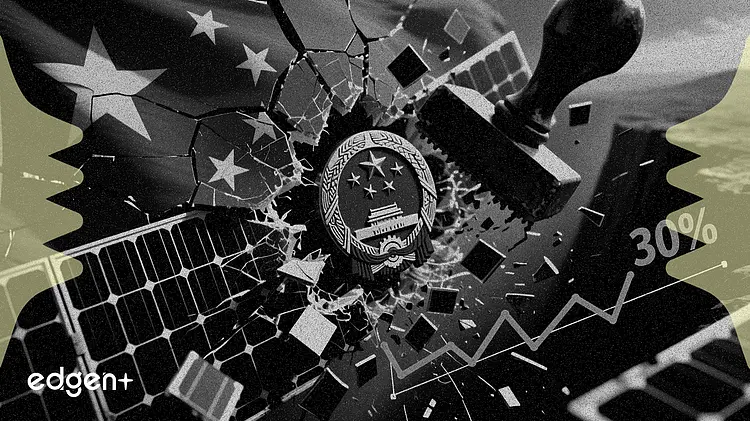
Beijing is preparing to impose mandatory energy efficiency standards on the photovoltaic sector that could eliminate roughly a third of existing production capacity, according to market sources.
China is set to introduce mandatory Tier-3 energy consumption standards for the solar photovoltaic sector as early as next week, a regulatory push that could phase out about 30% of existing production capacity across silicon materials, wafers and modules, according to market rumors cited by mainland media.
"Based on previous guidance, the measures could potentially phase out about 30% of existing production capacity," an executive at a photovoltaic company said during the SNEC PV and Energy Storage Expo last week, speaking on condition of anonymity as the rules have not been formally announced.
The standards would cover the full solar manufacturing value chain, from polysilicon and silicon wafers to finished modules. Companies contacted by mainland media said they had taken note of the claims but could not verify their authenticity. The move follows a broader policy reset under China's Document No. 136, introduced in February 2025, which rewired the country's approach to renewable energy returns and capital allocation, according to a pv magazine analysis.
The regulation would represent the most aggressive supply-side intervention in China's solar industry since the government began consolidating the sector. With Chinese solar manufacturers already grappling with overcapacity and compressed margins — solar installations may drop by a third this year as producers adjust to new wholesale power price rules — a 30% capacity reduction would reshape competitive dynamics, benefiting higher-efficiency producers while forcing smaller, less efficient players out of the market.
China's solar industry has expanded rapidly over the past decade, with clean-power industries now accounting for 11% of the country's GDP and roughly a third of its annual economic growth, according to Lauri Myllyvirta, co-founder and lead analyst at the Centre for Research on Energy and Clean Air. Solar, wind and hydropower account for about half of installed power capacity, with the equivalent of Germany's total electricity needs added each year.
Yet the breakneck expansion has created severe overcapacity. The mandatory Tier-3 standards would set minimum energy efficiency thresholds, effectively forcing the closure of older, less efficient production lines. The 30% capacity reduction estimate aligns with previous industry guidance suggesting the government would target the least efficient segment of the manufacturing base.
Grid constraints and the coal paradox
The efficiency push comes as China grapples with a deeper contradiction in its energy transition. While the country is adding renewable capacity at a record pace, overall power demand has outpaced renewable additions every year except 2025, Myllyvirta noted. China commissioned 78 gigawatts of new coal-fired power stations in 2025 alone — more than India built in the previous decade — partly as a hedge against the power shortages of 2021 and 2022.
The real constraint on renewable adoption, however, is China's electricity grid. Myllyvirta characterized the network as "a mess," still largely run using fixed prices and quotas rather than supply and demand, meaning a significant amount of renewable power goes unused. The country's 15th Five-Year Plan, unveiled in March, includes upgrading the electricity network as a major priority, with plans to install more high-voltage cables and overhaul pricing mechanisms.
Global trade tensions add pressure
The domestic regulatory crackdown coincides with escalating trade tensions abroad. On June 9, the US Department of Defense added several prominent Chinese energy storage and solar companies — including CATL, BYD, JA Solar, Trina Solar and Huawei — to its list of designated "Chinese military companies," banning the Pentagon from doing business with them from 2027. The move, part of a broader US crackdown on trade with China, adds another layer of uncertainty for Chinese manufacturers already facing tariffs and restrictions in Western markets.
If implemented as expected, the mandatory standards would accelerate the consolidation of China's solar manufacturing industry, concentrating market share among top-tier producers with higher efficiency ratings. CLSA has identified CATL as a top pick in the energy storage battery space, citing China's AIDC construction plan as a demand driver. The broader implication for global solar supply chains is clear: Chinese module prices, which have fallen sharply amid the capacity glut, could stabilize or even rise as less efficient capacity exits the market.
The timing of the announcement — potentially as soon as next week — suggests Beijing is moving to address overcapacity before the industry's financial health deteriorates further. For investors, the key question is whether the efficiency thresholds will be set high enough to achieve the 30% capacity reduction that market participants anticipate, or whether political considerations will water down the final rules.
This article is for informational purposes only and does not constitute investment advice.
