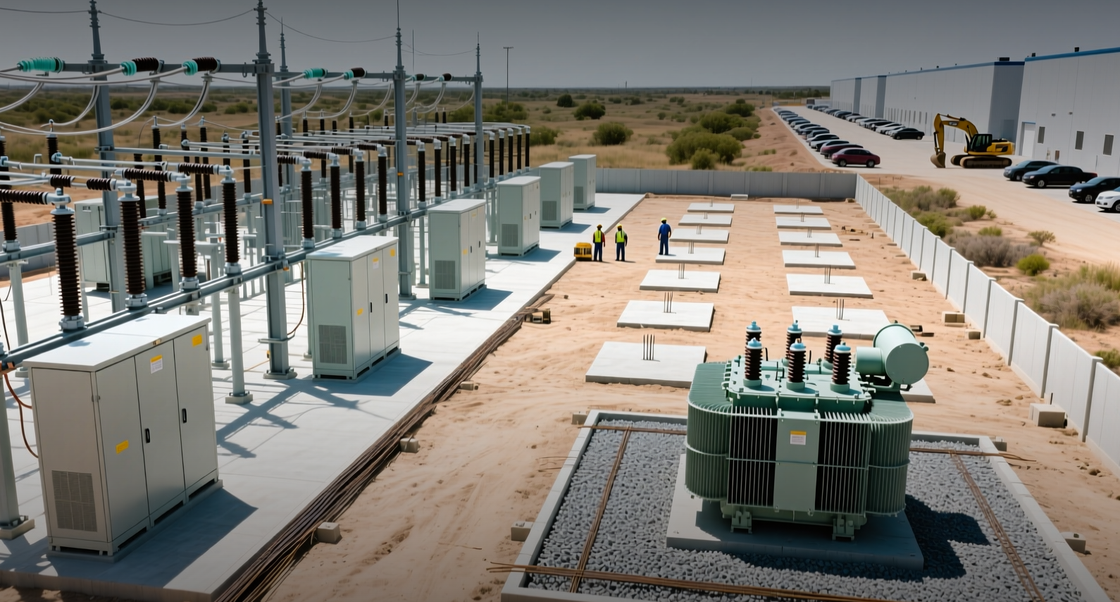
Flex agreed to buy power-conversion maker EPC Power for $4.4 billion, betting that 800-volt data center architectures will define the AI infrastructure buildout ahead of its planned Cloud and Power Infrastructure spin-off.
"A generational shift in power architecture is underway, driven by rising power density and the changing demands of digital infrastructure," said Revathi Advaithi, chief executive officer of Flex.
EPC Power, founded in 2010 and based in Poway, California, brings software-defined power conversion with more than 15 gigawatts deployed across 62 countries. Flex expects the unit to generate about $800 million in revenue this calendar year, grow organically about 40 percent in 2027 and expand EBITDA margin to roughly 30 percent. Its annual U.S. manufacturing capacity will surpass 30 gigawatts in 2027.
The acquisition lands as power availability becomes the gating factor for data center growth, with AI workloads driving higher power density and load volatility that can destabilize local grids. Flex plans to separate its Cloud and Power Infrastructure segment into an independent public company in the first quarter of 2027, placing EPC Power at the center of next-generation power systems.
An 800V Bet on the Grid-to-Chip Portfolio
EPC Power's platform is engineered for next-generation 800V data center power architectures, spanning rectifiers, DC-DC conversion and planned solid-state transformers. Combined with Flex's existing power, cooling and compute portfolio, the technology extends the company into an integrated grid-to-chip offering that delivers grid stabilization, backup power and clean 800V to drive modern GPUs.
"EPC Power has built a leading position by solving some of the most difficult power conversion challenges through integrated hardware, software and controls," said Jim Fusaro, chief executive officer of EPC Power. "As demand for AI infrastructure accelerates, customers need power systems that are more intelligent, efficient and resilient."
The move puts Flex in direct competition with established power-infrastructure suppliers such as Vertiv, Eaton and Schneider Electric that are also chasing data center electrification. EPC Power's Agile Grid Forming technology supports on-site energy storage, microgrid and grid-support configurations that let operators energize capacity faster and ride through grid instability — a capability utilities and data center operators are paying up for as electricity demand surges.
Financing and the Spin-Off Clock
Flex said it is evaluating financing alternatives and expects to fund the transaction with a combination of debt and equity, with committed financing from Citi and Bank of America. Evercore acted as lead financial adviser to Flex, with BofA Securities, Citi and PJT Partners also advising; Goldman Sachs & Co. and J.P. Morgan Securities advised EPC Power and its controlling shareholders Goldman Sachs Alternatives and Cleanhill Partners.
The deal is expected to close in the fourth quarter of 2026 following customary regulatory approvals. Flex's plan to spin off its Cloud and Power Infrastructure business in the first quarter of 2027 would hand the combined power portfolio to a separate listed entity, letting investors value the higher-growth infrastructure unit apart from Flex's broader manufacturing operations.
Under Goldman Sachs Alternatives and Cleanhill Partners, EPC Power expanded its domestic manufacturing footprint nearly tenfold in four years, a scale-up Flex now inherits as it chases the same demand. The transaction shows how power conversion has become a contested bottleneck in the AI buildout, with grid-forming technology increasingly treated as strategic infrastructure rather than commodity hardware.
This article is for informational purposes only and does not constitute investment advice.