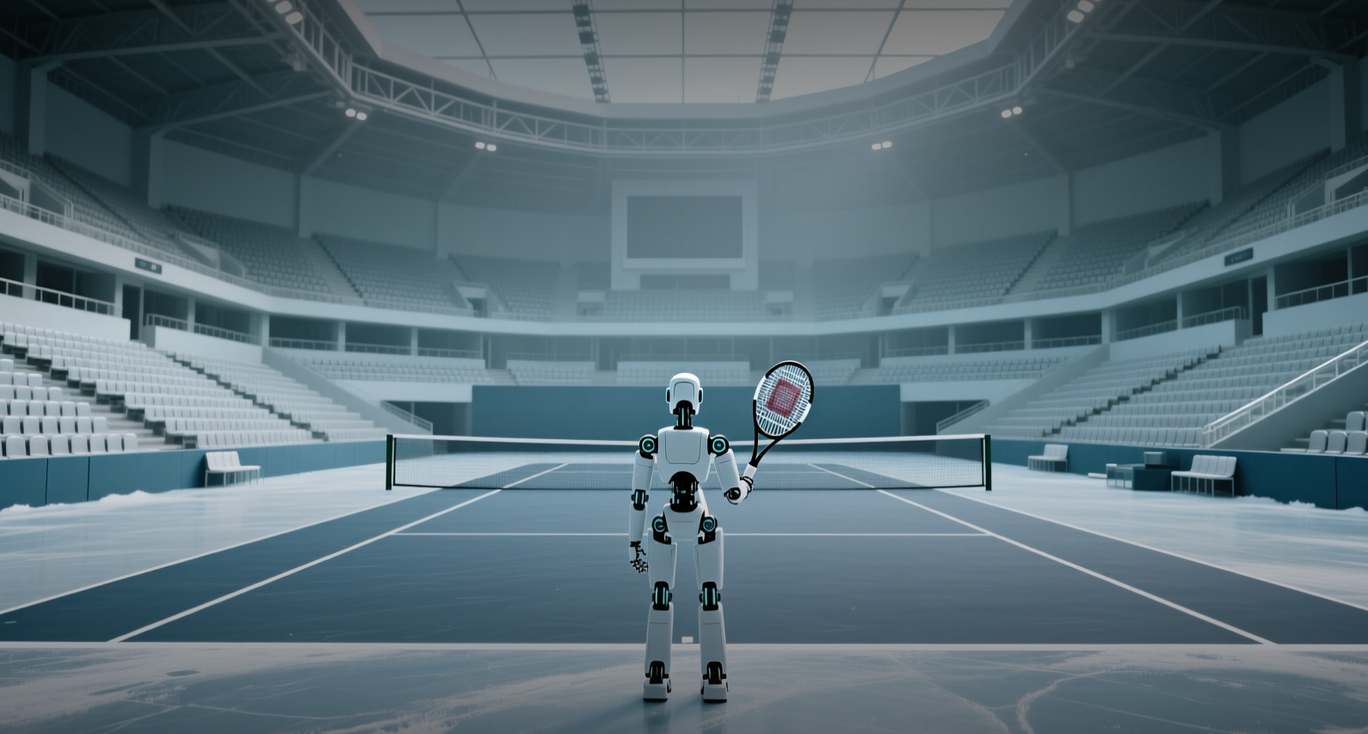
Galbot's humanoid robot played a full autonomous tennis match against professional players on live global television, a first for embodied AI.
Galbot's humanoid robot completed a world-first autonomous tennis match against professional players on Aug 22, broadcast live by China Central Television from Beijing's National Speed Skating Oval — a milestone that could accelerate commercial adoption of embodied AI across China's robotics sector.
"Tennis requires precise control of the robot's entire body to maintain balance, while its wrist movements must be highly precise," Wang He, chief technology officer at Galbot, said. "It combines high-level decision-making with precise motor control."
The robot, powered by Galbot's AstraBrain-Agent architecture, tracked incoming balls, predicted trajectories, adjusted its stance, and executed forehands, backhands, serves, and net play. In doubles, it repositioned based on teammate and opponent movements. When it fell during a rally, it stood up and resumed play.
The demonstration comes as Galbot, founded in 2023 by Peking University professor He Wang, prepares a Hong Kong IPO at a $3 billion to $4 billion valuation. Global humanoid robot shipments reached about 19,100 units in the first half of 2026, with Chinese-made units accounting for more than 97 percent, according to Smart Analytics Global.
Tennis is the hardest test for embodied AI
Tennis demands that perception, decision-making, and whole-body motion control happen within milliseconds. A robot must predict ball trajectory, move into position, adjust its swing based on body posture, and recover for the next shot — all while maintaining balance. The challenge is compounded by a lack of training data: human tennis videos cannot be directly transferred to robot control because human and robot body structures differ.
Galbot addressed this through its Galaxy Star Workshop platform, which converts fragmented human actions into robot-learnable data and generates training tasks in high-fidelity virtual environments. The robot trained through millions of simulated rallies, with multi-agent competition driving emergent tactical awareness. This Real2Sim-to-Sim2Real pipeline bridges the gap between virtual training and physical performance.
The tennis match builds on Galbot's Aug 19 launch of the ET1, its first bipedal humanoid robot, at the 2026 World Robot Conference. The ET1 runs AstraBrain-Agent, an architecture covering task understanding, whole-body motion control, and execution. Galbot applied the same technology stack across its bipedal ET1, wheeled G1, and heavy-load S1 platforms.
China ships 97% of global humanoid robots
The milestone arrives as China's five-year development roadmap designates embodied intelligence as a priority future industry. The second World Humanoid Robot Games, which opened Aug 22, features 666 teams and 2,056 robots competing in 51 events and 1,301 matches — up 138 percent in teams and more than quadrupled in robot count from the inaugural event last year.
The games also showcased broader progress: Beijing-based Tien Kung Ultra ran 100 meters in 9.39 seconds, eclipsing Usain Bolt's 9.58-second human world record, and cleared 2.8843 meters in the high jump. Unitree Robotics completed a blockbuster IPO the same week.
For investors, the question is whether these demonstrations translate into commercial deployment. Guo Yijie, technical lead of Tien Kung Ultra, cautioned that peak performance does not mean production readiness. "High-speed, long-distance running will expose structural fatigue, joint cooling, and drivetrain durability issues that must be addressed for long-term deployment," he said.
Galbot's planned Hong Kong listing would value the company at $3 billion to $4 billion, a premium that reflects investor appetite for embodied AI exposure. The company's AstraBrain technology, if it scales from tennis courts to factory floors and households, could justify that valuation — but the gap between showcase performance and consistent reliability remains the key risk.
This article is for informational purposes only and does not constitute investment advice.