


**Wall Street's biggest banks are warning that last week's equity rout marks the start of a structural unwind, not a one-off shock.
**Wall Street's biggest banks are warning that last week's equity rout marks the start of a structural unwind, not a one-off shock.
Wall Street's biggest banks are warning that last week's equity rout marks the start of a structural unwind, not a one-off shock.
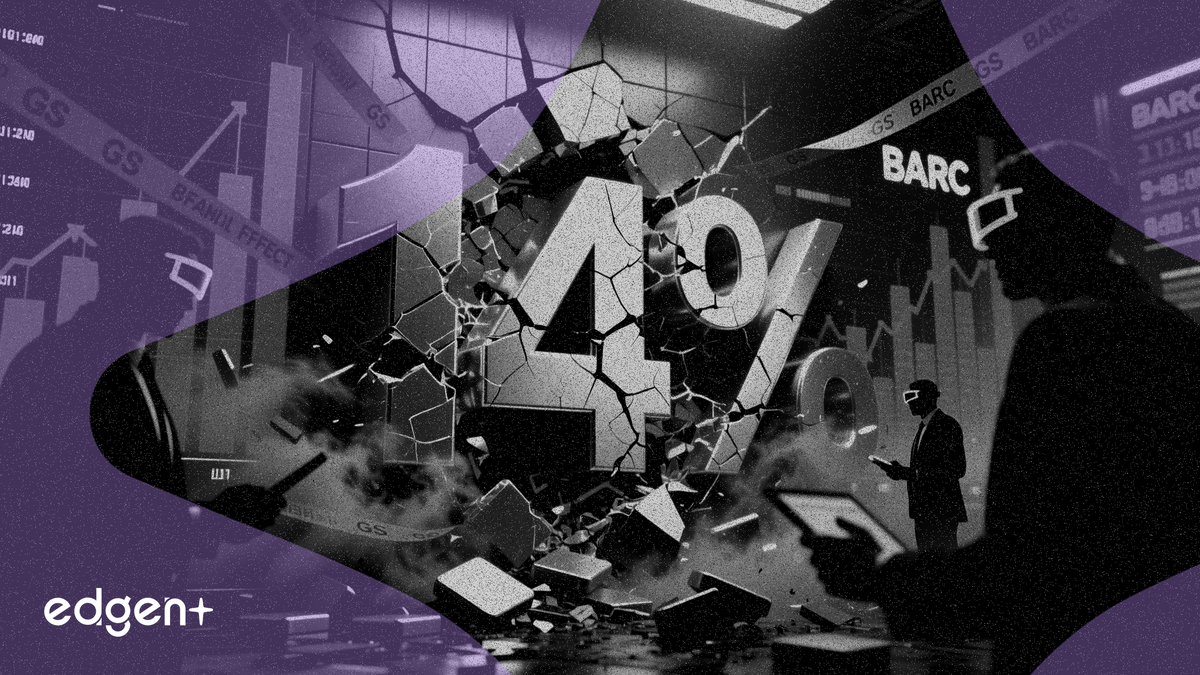
Volatility-control funds may need to cut equity exposure by 14 percentage points after the June 5 sell-off, Goldman Sachs Group Inc. and Barclays Plc warned.
"These factors create an environment where factor unwind shocks can be far more violent than index-level volatility suggests," Lee Coppersmith, a trader at Goldman Sachs, said in a note to clients.
The warning comes as crowded positioning, narrow market breadth and the prospect of interest rates staying higher for longer have left US equities vulnerable to sudden reversals. A 14-percentage-point reduction by volatility-control funds would mark the largest single-day de-risking since Feb. 6, according to Alexander Altmann, head of global equity tactical strategy at Barclays.
The scale of potential forced selling threatens to amplify losses in the momentum-driven names that powered this year's rally, creating a feedback loop that could extend the downturn. The warnings from two of Wall Street's largest trading desks suggest the sell-off's transmission mechanism — systematic fund deleveraging — may be more consequential than the initial trigger.
The June 5 decline caught many investors off guard after months of steady gains in momentum stocks. The S&P 500's drop coincided with a backup in Treasury yields as traders repriced the path of Federal Reserve policy, with the 10-year yield rising on expectations that rates will remain elevated through year-end.
Goldman's Coppersmith pointed to three structural vulnerabilities: concentrated positioning in a narrow set of mega-cap technology names, declining market breadth as fewer stocks participate in the rally, and the higher-for-longer rate environment that compresses equity risk premiums. Together, these conditions make the market more susceptible to violent position unwinding than the relatively calm VIX level would suggest.
Barclays' Altmann estimated that volatility-control funds — which automatically adjust equity exposure based on realized volatility — could be forced to reduce their US equity allocation by roughly 14 percentage points in a single day. That would represent the most aggressive de-risking since early February, when a similar positioning unwind swept through global markets.
The implications extend beyond the initial shock. If volatility-control funds are forced to sell into a declining market, the resulting price pressure could trigger further volatility, creating a self-reinforcing cycle. Systematic strategies, including commodity trading advisors and risk-parity funds, may also be forced to reduce exposure as volatility regimes shift.
For investors accustomed to the momentum-driven rally that defined much of 2026, the Goldman and Barclays warnings serve as a reminder that crowded trades can reverse with little warning. The next catalyst — whether a hotter-than-expected inflation print, a hawkish Fed signal, or an exogenous shock — could accelerate the deleveraging process.
This article is for informational purposes only and does not constitute investment advice.
