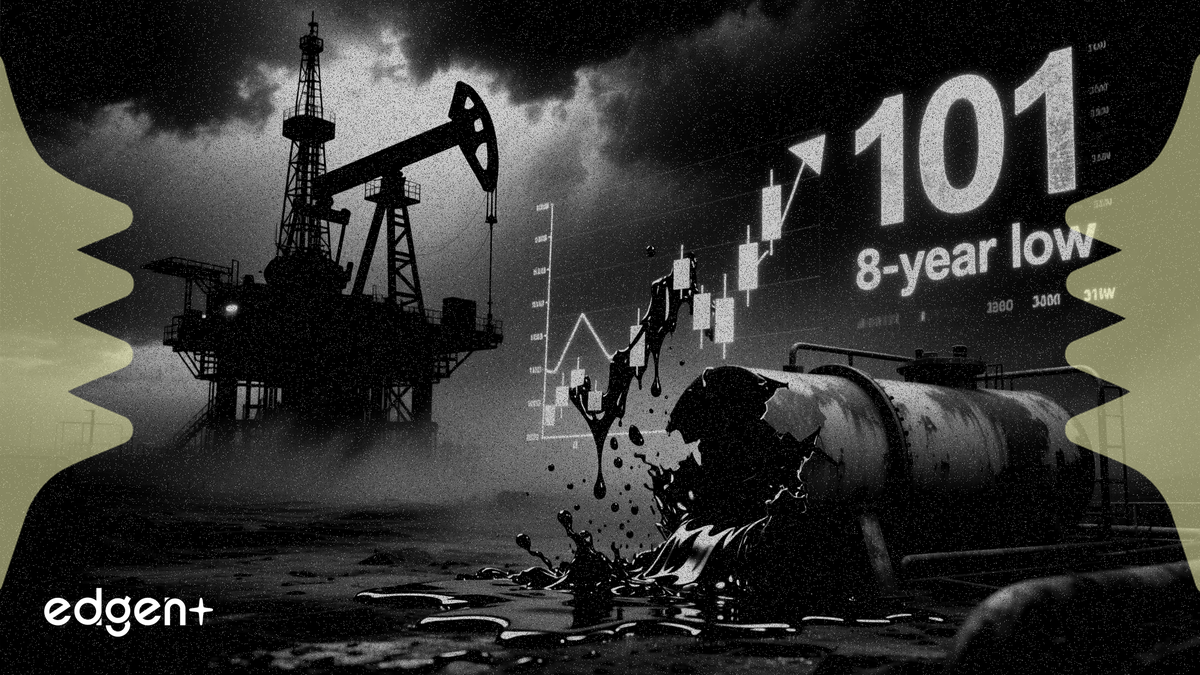
(Bloomberg) -- Global oil inventories are approaching an eight-year low, creating a precarious situation for energy markets as supply disruptions in the Middle East persist. Total global oil inventories currently stand at 101 days of forward demand, with the potential to fall to 98 days by the end of May, according to a recent report from Goldman Sachs.
“In this war driven oil shock, inventories have become the market’s primary balancing mechanism,” J.P. Morgan analysts, including Natasha Kaneva, head of global commodities strategy, said in a report. The bank noted that while the world began 2026 with a healthy 8.4 billion barrels in storage, only an estimated 0.8 billion barrels are “realistically available without pushing the system into operational stress.”
The supply shock stems from the ongoing blockade of the Strait of Hormuz, a chokepoint that handled roughly 20 million barrels per day (b/d) before the conflict. The disruption has removed an estimated 14m b/d from the market, leading to a cumulative supply loss of around 850 million barrels over the past two months, according to ING analysis. Of the accessible inventory buffer identified by J.P. Morgan, roughly 280 million barrels had already been consumed as of April 23.
The rapid drawdown has prompted analysts to revise price forecasts higher, with ING now seeing ICE Brent averaging $104 per barrel in the second quarter. Other analysts warn that top consuming countries could hit “operational minimums” by the end of May, a point at which J.P. Morgan says price increases could become “exponential rather than linear.”
The Race to ‘Tank Bottoms’
The rapid depletion of inventories in consuming nations has set the stage for what Frederic Lasserre, head of analysis at Gunvor Group, termed a race to “tank bottoms.” Analysts at J.P. Morgan have echoed this sentiment, forecasting that oil inventories in OECD countries will hit operational minimums sometime between May 9 and May 30.
This contrasts sharply with the situation in Iran, which faces hitting “tank tops,” or maximum storage capacity, within a month due to the U.S. naval blockade bottling up its exports. According to Bloomberg, Tehran is already taking steps to reduce crude output to avoid overwhelming its storage and risking permanent damage to its oilfields.
Prices Reflecting Scarcity
While crude futures have not yet reached the worst-case scenarios of $150-$200 a barrel—with Brent crude trading over $108 on Friday—prices for refined products are showing more significant strain. ING notes that while Brent futures are up around 80 percent this year, gasoil and jet fuel prices have climbed 102 percent and 120 percent, respectively.
This surge in product prices is already forcing demand destruction, estimated at around 1.6 million b/d, through flight cancellations and reduced industrial activity, particularly in Asia. However, many market observers believe the full impact has not yet been priced in. “It’s obvious to most that if you look at the unprecedented disruption in the world supply of oil and natural gas, the market hasn’t seen the full impact of that yet,” Exxon Mobil CEO Darren Woods told CNBC.
This article is for informational purposes only and does not constitute investment advice.