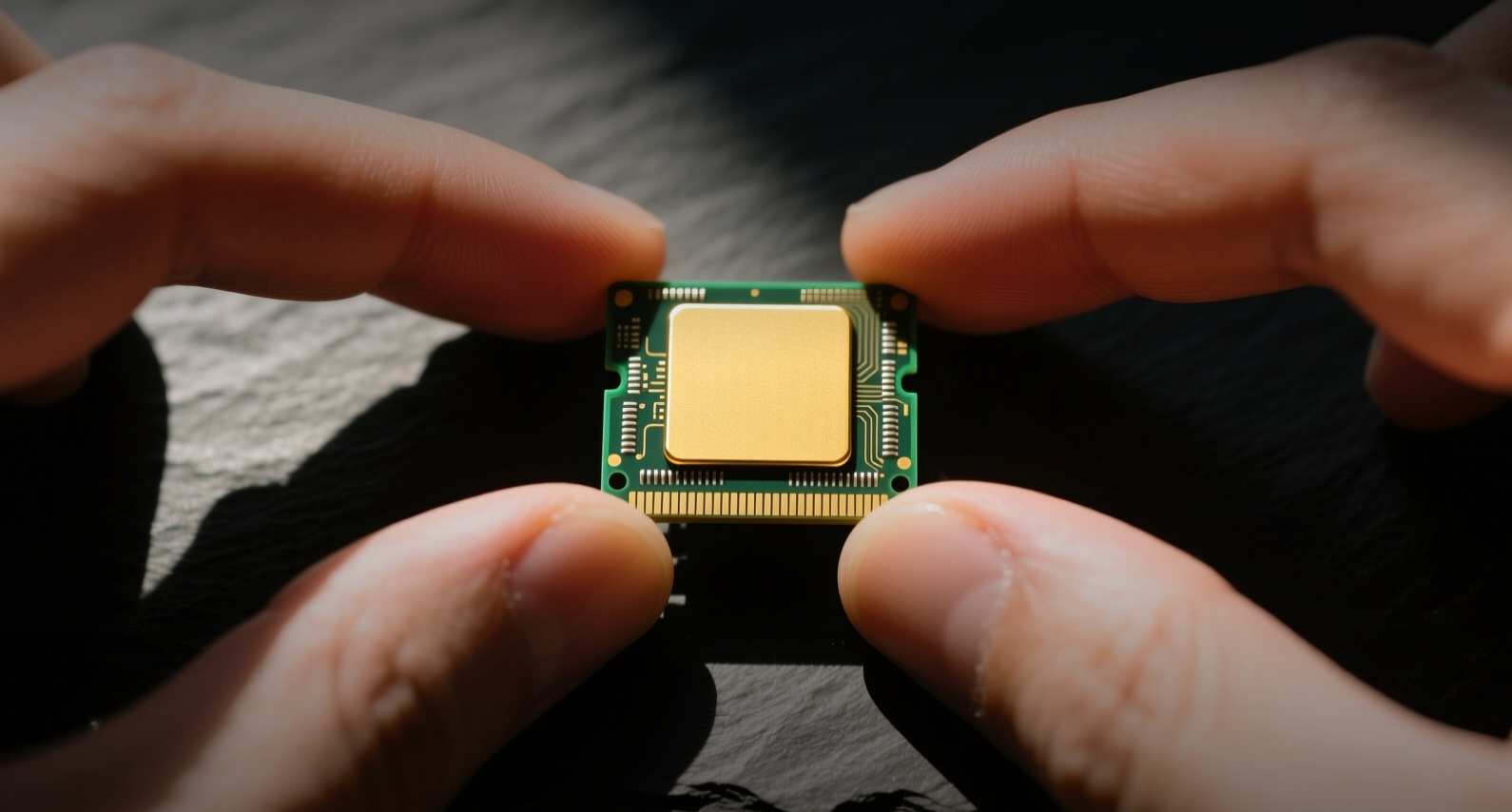
Intel, the company that abandoned memory for microprocessors in the 1980s, is quietly plotting a return to the business it left behind.
Intel Chief Executive Lip-Bu Tan is exploring a return to memory chips, hiring former SK Hynix chief Shil Lee and studying CPU-memory stacking as the memory market enters a supercycle that has pushed SK Hynix's market value past $1.2 trillion.
"I have a pet project studying some new memory architectures," Tan said in a conversation with investor Michael, a longtime friend. "You can probably guess what direction I'm thinking, but we're not ready to share details yet."
Tan said memory innovation has lagged, but new technologies have turned the commodity business into a strategic area worth mining. CPU-memory stacking, he said, offers multiple integration paths. Intel was founded in 1968 as a memory company before pivoting to microprocessors, and SK Hynix — now the world's second-largest memory maker — trades at roughly $1.2 trillion.
The move is part of a broader turnaround under Tan, who took over in 2024. Intel missed the mobile, cloud, and AI waves, and Tan has said he will not miss another. The memory push could reshape competitive dynamics against SK Hynix, Samsung, and Micron, which is riding a DRAM shortage expected to intensify through 2027.
A $1.2 trillion market Intel left behind
Intel's founding business was memory, not microprocessors. The company pivoted in the 1980s after Japanese rivals undercut its DRAM prices, a decision that built the PC era's dominant chip franchise but ceded the memory market to SK Hynix, Samsung, and Micron. Today that market is booming: semiconductor billings grew 134 percent year over year in June, led by memory chips, according to Wells Fargo. Micron, trading at 12 times forward earnings with a market value near $972 billion, has locked in five-year customer agreements as hyperscaler AI spending surges.
Tan's interest in memory dovetails with his vertical-integration strategy. He argues that product design, advanced packaging, and foundry manufacturing together create more value than any single layer. Intel's EMIB packaging technology is extending toward glass substrates and synthetic diamond materials, which Tan described as a superior insulating and heat-dissipating material — an area where he has already invested. He also flagged the cooling path from air to liquid to microfluidic systems as critical infrastructure for AI compute expansion.
The investor's playbook: 3,000% at Cadence
Before Intel, Tan built a reputation as a contrarian semiconductor investor. He backed Credo Semiconductor, now worth about $50 billion, and SambaNova, which uses a dataflow architecture to cut power consumption and is closing an $800 million to $1 billion Series F round. He also invested in Celestial AI, later sold to Marvell, and Dust Photonics, acquired by Credo. At Cadence Design, where he served as chief executive for 15 years, the stock rose more than 3,000 percent from about $2.
Tan said he applies the same playbook at Intel, which he expects to lead for 10 to 15 years. The company is the only US chipmaker competing at scale with advanced process nodes, and Washington, Nvidia, and SoftBank have all become investors. "I'm not someone who looks at the short term," Tan said. "I look at the next 10, 15 years — how to build a bigger platform that truly brings value to the whole industry."
For investors, the memory push adds a new variable to Intel's turnaround. A successful return to memory would pit Intel directly against SK Hynix, Samsung, and Micron in a market where supply is tight through 2027. But Intel has not disclosed a timeline, product roadmap, or capital commitment for the effort, and Tan acknowledged the company is "not ready to share details yet." Intel shares have yet to price in a memory business that does not yet exist.
This article is for informational purposes only and does not constitute investment advice.