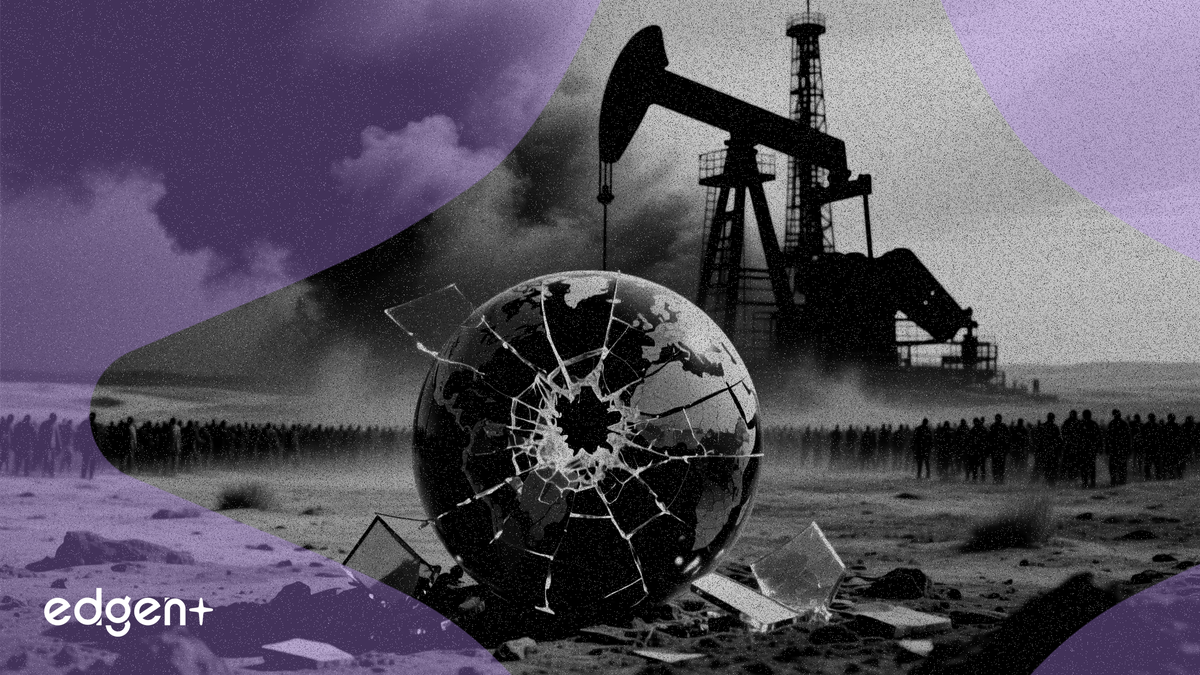
The Iran war that began Feb. 28 has shattered three decades of development orthodoxy, pushing more than 30 million people back into poverty and repricing the cost structure of global manufacturing, according to UN and IMF estimates.
"The system was priced for normality and never stress-tested for the correlated, fat-tailed disruption that began on 28 February," said Vincent James Hooper, a geopolitical analyst writing for the Times of Israel.
Brent crude hit a four-year high of $126 a barrel on April 30 before retreating to about $93, while Asian LNG spot prices surged more than 140% after an Iranian strike knocked out 17% of Qatar's export capacity at Ras Laffan — damage requiring three to five years to repair, according to Chatham House. Tungsten prices more than tripled as 80% of global supply originates from China. The IMF's April World Economic Outlook projects global growth at 3.1%, well below pre-pandemic averages, with the fund now advising that crisis responses be "time-bound and targeted at the most vulnerable."
The war has exposed a development model built on the assumption that tail risks would remain contained — open trade corridors, cheap energy, irreversible poverty reduction. That model is now being repriced in real time, with developing countries forming a collective Borrowers' Platform at the Spring Meetings to negotiate debt terms as a bloc rather than individually.
Brazil, which accounts for nearly 60% of global soybean exports and is the world's largest fertilizer importer, faces a sustained shortage of urea — 40% of global urea trade transits the Strait of Hormuz. The disruption threatens crop yields across the southern hemisphere, with cascading food-security implications for Africa, the Middle East and South Asia. The Sustainable Development Goals, already behind schedule, now face not a delay but a structural reversal, the UN said.
For Europe, the consequences are existential in an industrial sense. Chemical and steel manufacturers have imposed surcharges of as much as 30% to offset surging electricity and feedstock costs. The European Central Bank has warned of stagflation, with Germany and Italy facing technical recession by year-end. Morocco's automotive sector, now the European Union's largest supplier by export value with 90% of output shipped abroad, illustrates the contagion: when Renault and Stellantis cut production, Tangier's assembly lines go dark.
The last time a conflict simultaneously disrupted energy supply, fertilizer trade and manufacturing supply chains at this scale was the 1973 oil embargo, which triggered a global recession and a permanent shift in energy policy. The current shock is broader: it hits not just oil but LNG, helium — Qatar produces a third of the world's supply, essential for semiconductor fabrication — and industrial metals, with copper and aluminum facing supply shortages that UBS projects will persist over the medium term.
Broad commodities have gained more than 20% year to date, based on the UBS CMCI Composite total returns index. Gold remains 16% below its January all-time closing high, with UBS cutting its year-end forecast to $5,500 an ounce from $5,900, citing elevated Treasury yields and dollar strength. Yet the Swiss bank maintains that structural drivers — elevated government debt, central bank diversification away from the dollar, and persistent fiscal deficits — support gold over the long term.
In the United States, the largest part of the economy grew faster in May even as inflation rose to multi-year highs, according to MarketWatch. Many companies have adopted temporary hiring freezes to offset rising costs, a pattern consistent with the stagflationary pressures the ECB has flagged for Europe.
The new development model emerging from the crisis will prize redundancy over efficiency, Hooper said. The UAE's emergency currency swap with Bahrain and the IMF-World Bank's emergency financing pledges for developing nations are early signals — improvisations that will harden into architecture. In options terminology, the global development model needs to move from being short volatility to being long convexity: structured not for the median outcome but for survival under extreme moves.
This article is for informational purposes only and does not constitute investment advice.