
South Korea's KOSPI plunged 17% in a single week as forced liquidations wiped out retail investors who had piled into leveraged bets on semiconductor stocks.
South Korea's KOSPI plunged 17% in a single week as forced liquidations wiped out retail investors who had piled into leveraged bets on semiconductor stocks.
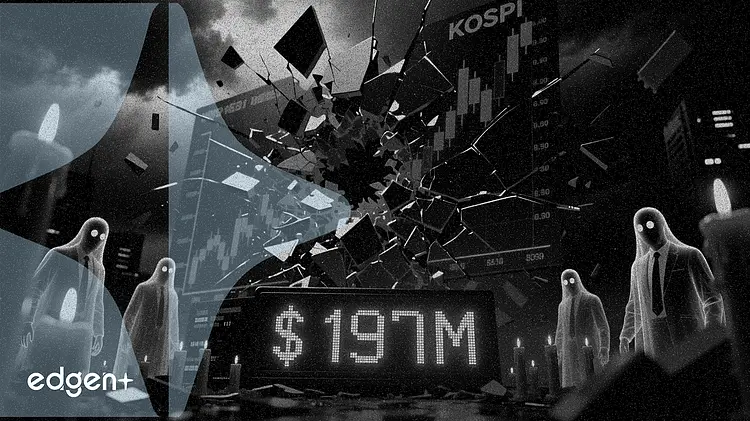
The KOSPI index plunged 17% in a week, triggering forced liquidations of nearly 300 billion won ($197 million) at a record margin debt of 38 trillion won.
"Market declines are most dangerous not because of the price drop itself, but because of forced liquidations," said Kim Seok-hwan, an analyst at Mirae Asset Securities. He advised investors to "reduce leverage, hold more cash, and focus on high-quality assets."
The forced liquidation ratio hit 9.1% on Friday, the highest level this year, according to Korea Financial Investment Association data. Margin debt stood at 37.8 trillion won as of Monday, only slightly below the record 38 trillion won set on May 29, suggesting the deleveraging cycle has further to run. The KOSPI had rallied roughly 100% year-to-date before the crash, matching the Nasdaq 100's 102% gain ahead of the dot-com bubble peak in 1999.
Most of the recent margin buying was concentrated in the KOSPI 8,200 to 8,400 range, according to Noh Dong-gil, an analyst at Shinhan Securities. He noted that investors typically begin cutting positions after a 15% loss, while forced liquidations become a material risk at a 20% loss — meaning further downside could trigger another wave of mechanical selling.
How the Leverage Cycle Unraveled
The selloff was driven almost entirely by retail momentum traders who had piled into Samsung Electronics and SK Hyniu on margin, pushing the KOSPI to repeated highs even as foreign investors steadily exited. The concentration was extreme: even as the index hit new records, the number of stocks making new lows continued to rise, signaling that the rally was confined to a handful of AI and semiconductor names.
The mechanics of forced liquidation are straightforward. Investors borrow from brokerages to buy stocks, putting up 30% to 40% of their own capital. When the stock price falls enough to push the account below the maintenance margin, the brokerage automatically sells the position at the next opening auction — regardless of price. Each forced sale pushes prices lower, triggering the next round of margin calls in a cascading cycle.
New Leveraged ETFs Added Fuel to the Fire
A new variable amplified the downturn: single-stock 2x leveraged ETFs launched in late May 2026. These products, which double the daily return of individual stocks, had boosted the rally on the way up. On the way down, they acted as accelerators, magnifying losses and forcing additional selling pressure. ZeroHedge had previously warned that the rise of leveraged ETFs could exacerbate volatility during reversals.
The combination of foreign capital outflows providing fundamental downward pressure and mechanical margin calls adding forced selling has made this deleveraging event particularly severe. With margin balances still near record highs and the KOSPI trading below the entry zone of most leveraged buyers, the risk of additional forced liquidation remains elevated.
This article is for informational purposes only and does not constitute investment advice.
