
Key Takeaways:
- Lightmatter joins Nvidia's NVLink Fusion ecosystem for AI data centers.
- Its photonic interconnects cut fiber and connector requirements by 50%.
- The partnership targets bandwidth bottlenecks in next-generation AI clusters.
Key Takeaways:
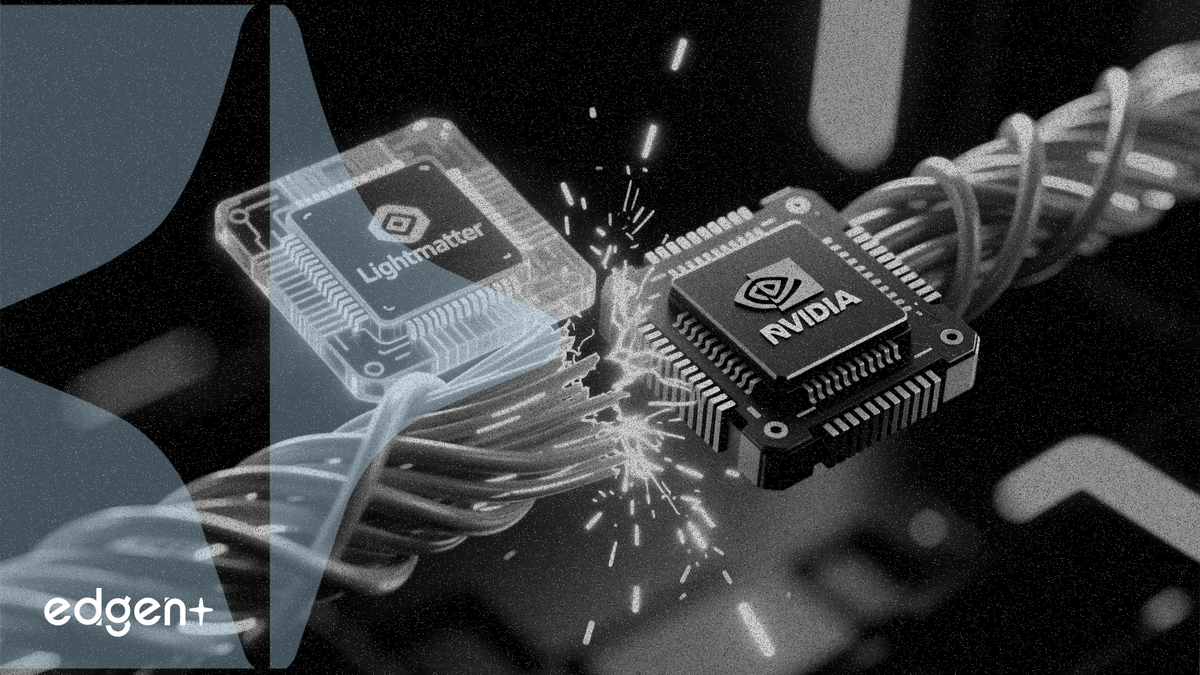
Lightmatter's photonic interconnects will reduce fiber and connector requirements by 50 percent in Nvidia's NVLink Fusion ecosystem, addressing the bandwidth bottleneck that limits AI cluster scaling.
"This is what the next era of AI infrastructure looks like," Nick Harris, founder and chief executive officer of Lightmatter, said. "By integrating Passage CPO solutions with Nvidia's NVLink Fusion architecture, we are combining the industry's most advanced AI platform and the world's leading interconnect to unleash generations of leading frontier AI models."
The company will deliver Co-Packaged Optics and Near-Packaged Optics products compatible with Nvidia's optical and SerDes technologies. Its bi-directional optical link architecture enables semi-custom XPUs from various suppliers to connect with Nvidia switch silicon through a unified platform, reducing fiber and connector needs by half.
The partnership marks a critical milestone in the maturation of co-packaged optics, according to Alan Weckel, co-founder and analyst at 650 Group. "By making its Passage 3D photonic roadmap compatible with Nvidia's high-speed interconnect, Lightmatter is significantly expanding the addressable market for its CPO products," he said. "This partnership provides a validated blueprint for hyperscalers to overcome traditional I/O bottlenecks and scale AI clusters to the levels required for next-generation intelligence."
How Photonic Interconnects Solve the I/O Wall
AI clusters today face a fundamental constraint: electrical interconnects cannot keep pace with the data throughput demands of thousands of parallel processors. Lightmatter's Passage platform — the world's first 3D-stacked silicon photonics engine — replaces copper traces with light-based data transmission, delivering higher bandwidth density at lower power. The company's Guide light engine connects thousands to millions of processors, targeting the data bottlenecks that limit model training and inference at scale.
Nvidia's NVLink Fusion ecosystem is designed to give hyperscale customers flexibility to build semi-custom AI factories using chips from multiple suppliers. Lightmatter's CPO and NPO products create a seamless high-bandwidth bridge between those custom XPUs and Nvidia's switch silicon, effectively standardizing optical connectivity across heterogeneous hardware.
"AI is being fused into every computing platform, requiring fundamentally re-architected data centers," Ashish Karandikar, vice president of engineering at Nvidia, said. "Integrating Lightmatter's advanced photonic engines into the NVLink Fusion ecosystem provides our partners and hyperscale customers with more choice and flexibility to build specialized, energy-efficient AI infrastructure at unprecedented scale."
Investment Implications
For Nvidia, the partnership reinforces its ecosystem moat by adding optical interconnect capability without requiring in-house photonics development. For Lightmatter, the Nvidia validation could accelerate adoption among hyperscalers and potentially drive future funding rounds or acquisition interest. The broader AI infrastructure sector benefits from faster interconnect innovation, which directly impacts the cost and speed of training frontier AI models. Companies developing competing optical interconnect technologies — including Lumentum and Coherent — face a higher bar as Nvidia standardizes around Lightmatter's architecture within its ecosystem.
This article is for informational purposes only and does not constitute investment advice.
