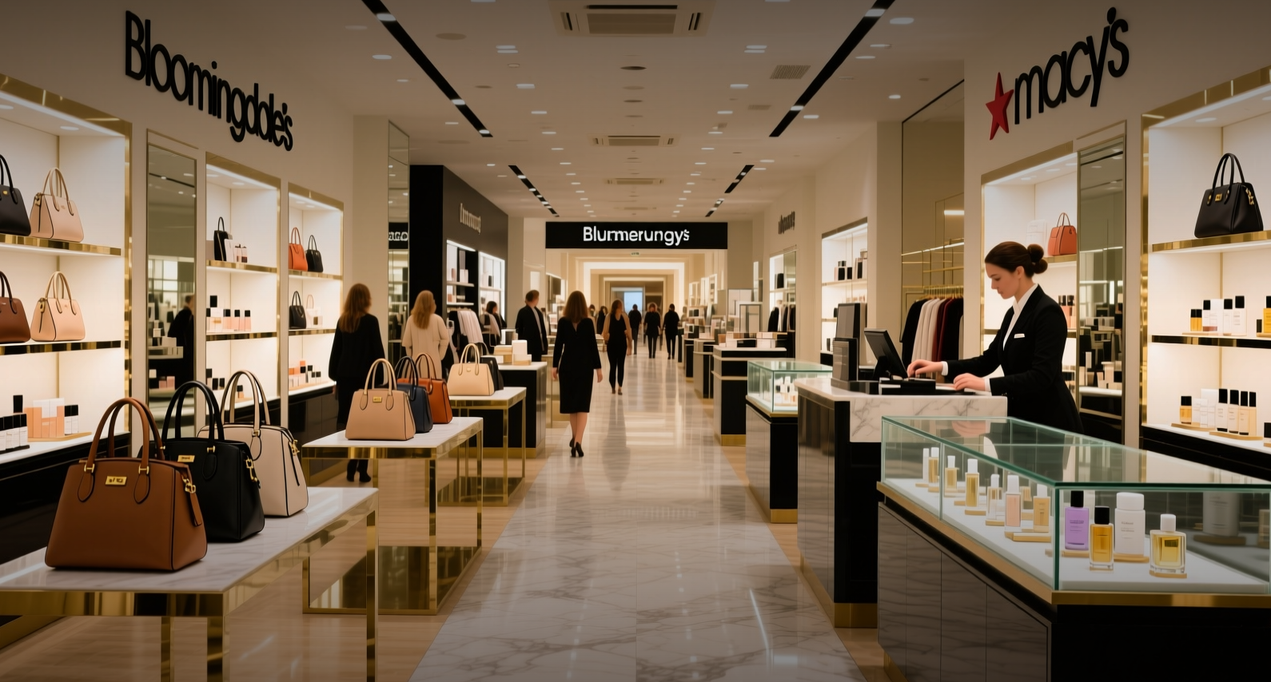
Macy's Inc. raised its fiscal 2026 net sales forecast to $21.68 billion to $21.83 billion, the second upward revision in three months, after second-quarter revenue topped estimates on double-digit growth at Bloomingdale's.
"The investments we're making are driving results across our portfolio," Chief Executive Officer Tony Spring said in a statement.
The department-store operator lifted the top end of its annual sales range by $80 million from the $21.50 billion to $21.75 billion outlook issued in June. Adjusted earnings per share guidance rose to $2.15 to $2.35, from $2.00 to $2.20 previously. Second-quarter net sales increased 1.1% to $4.87 billion, beating the $4.83 billion average estimate compiled by LSEG. Adjusted profit climbed 80% to 63 cents a share.
The raise rests on the company's upmarket chains rather than its namesake stores. Comparable sales at Bloomingdale's rose 11.3% and Bluemercury gained 6.2%, while Macy's namesake stores grew 1.1%. That split leaves the guidance dependent on higher-income shoppers, who have kept spending on luxury apparel, handbags, fragrances and skincare even as value-conscious middle-income customers pull back.
Tariff refunds contributed 23 cents a share to quarterly earnings, and Macy's said it has collected $116 million in refunds so far. Stripping that out, adjusted EPS of roughly 40 cents would have been a smaller increase over the prior-year period. The company said its forecasts reflect macroeconomic and geopolitical uncertainties that could affect consumer spending, alongside the benefit of those refunds.
Shares rose about 5% in premarket trading following the release.
What the guidance raise does and does not prove
The revision is a narrower signal than the headline suggests. Macy's has now raised twice since June, which points to steadier discretionary demand than the sector's cautious consensus assumed. But the growth is concentrated in two banners that together represent a minority of revenue, and the namesake chain — the bulk of the store base and the most exposed to middle-income trade-down — grew at roughly a third of the pace needed to hit the high end of the range.
Spring's "Bold New Chapter" strategy, launched in 2024, has prioritized higher-margin products and full-price selling, closed underperforming stores and redirected resources toward stronger markets. The second quarter is the clearest evidence yet that the approach is lifting profitability, with adjusted profit up 80% year over year.
The read-across to peers is limited but real. Department-store and apparel retail demand is stabilizing rather than accelerating, and the divergence between luxury and mass channels is the defining feature of the current US consumer. Retailers with heavier exposure to value-seeking shoppers — including Kohl's and Nordstrom's off-price operations — face a harder comparison than the luxury-exposed names.
For holders, the guidance raise supports the case that Macy's can expand margins even with flat-to-low-single-digit sales growth, and the stock's 3.32% dividend yield remains covered. The next test is the third-quarter report, where investors will look for whether Bloomingdale's comps hold above 10% and whether the namesake chain can clear 2% without tariff refunds flattering the profit line.
This article is for informational purposes only and does not constitute investment advice.