

New York City's socialist mayor is escalating a regulatory fight with Amazon that could reshape how 2.5 million daily packages reach city doorsteps.
New York City's socialist mayor is escalating a regulatory fight with Amazon that could reshape how 2.5 million daily packages reach city doorsteps.
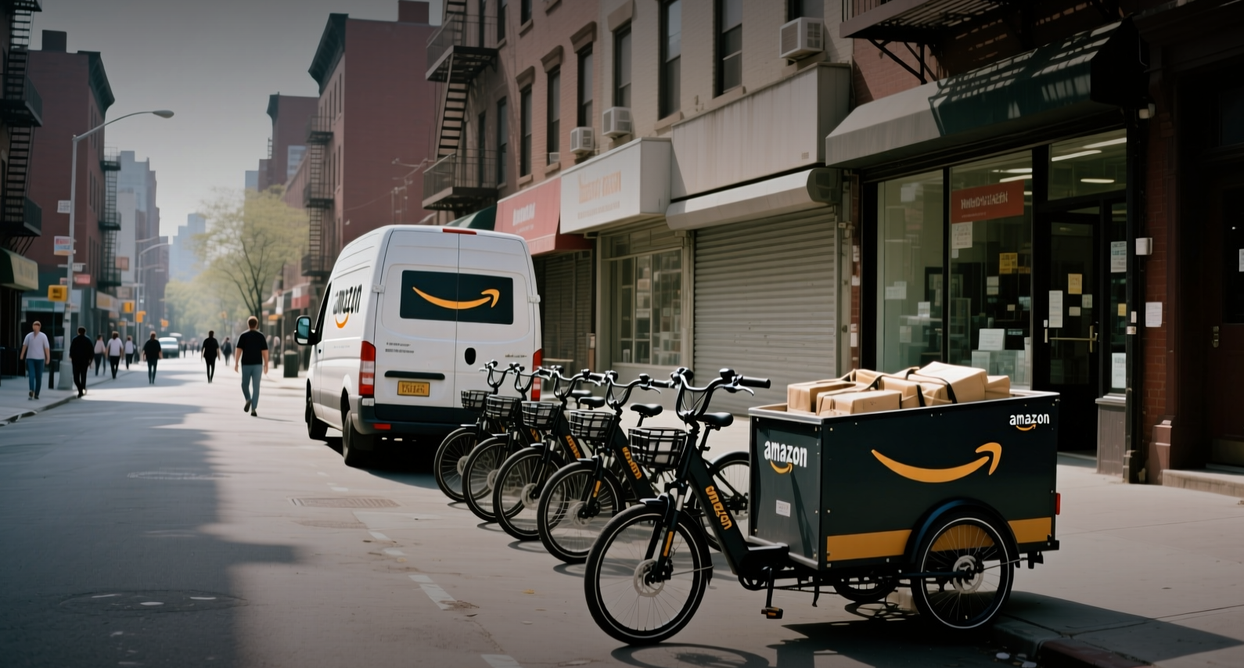
New York City Mayor Zohran Mamdani has backed the Delivery Protection Act, which would force Amazon to directly hire roughly 5,000 couriers now employed by independent delivery firms across the five boroughs.
"We're working to bring down the cost of things, and we're also laser focused on increasing what workers get to keep in their pockets," said Julie Su, New York's deputy mayor for economic justice. "We are going to send a clear message to companies who break the law that New Yorkers deserve better."
The bill, introduced by Council Member Tiffany Cabán, would require warehouse operators to obtain city licenses by meeting new safety, training, and employment standards. Amazon has contributed roughly $5 million to the Five Borough Jobs Campaign opposing the legislation, which the company says could eliminate more than 5,000 delivery jobs and push it to relocate warehouses outside the city. A study by AKRF, funded by the opposition campaign, estimated the bill could raise household costs by $664 a year.
The showdown echoes 2019, when Amazon abandoned its $2.5 billion plan for a New York City headquarters after progressive opposition. If the bill passes, Amazon's cost structure in the city would shift dramatically — its last-mile model depends on roughly 40 independent delivery service partners, 25 percent of which are Black- or Hispanic-owned and 10 percent veteran-owned, according to company testimony.
The Delivery Protection Act targets the subcontracting model that underpins Amazon's urban logistics. Rather than employing couriers directly, Amazon contracts with independent delivery service partners — small businesses that hire their own drivers. The bill would ban this arrangement for last-mile delivery, forcing facility operators to directly employ every driver.
Amazon says the legislation would liquidate dozens of independently owned delivery firms across the five boroughs, many paying starting wages above $20 an hour with health care, retirement contributions, and tuition benefits. Workers at these firms earn around $24 per hour on average with employer-funded healthcare, according to testimony at a seven-hour City Council hearing where several hundred delivery workers appeared to oppose the bill.
The company has invested more than $12 billion in safety technology and features for its delivery contractors since 2020, reporting a 48 percent decline in accident rates. That includes DNY7, a training facility in Brooklyn where worker onboarding goes beyond federally mandated safety training, and camera-equipped vans and electric bikes.
Proponents point to injury data showing Amazon's last-mile subcontractors at 8.3 injuries per 100 workers versus 2.4 for all private employers. But the national average for couriers is 8.0, suggesting Amazon's subcontractors are in line with industry norms.
The International Brotherhood of Teamsters and the New York City Central Labor Council, AFL-CIO, are backing the bill. Under federal labor law, Amazon's subcontracted delivery partners can be individually unionized, but the labor contract wouldn't be signed with Amazon itself. Banning subcontracting would force Amazon to hire these couriers as direct employees, making them easier to organize.
Attorney Alex MacDonald has described this as part of a larger union strategy: if organizing through "organic, boots-on-the-ground campaigns" fails, unions lobby for laws that "read like a shortcut to organizing." The legislation may also be preempted by the National Labor Relations Act, which was designed as a "scheme of overlapping rights, obligations, and zones of self-help" creating a cohesive national labor code.
The bill regulates warehouses, not deliveries. Amazon has warned it may relocate delivery operations outside New York — across the Hudson to New Jersey or to Long Island — which would strip the city of local jobs and oversight while adding emissions from longer routes.
Patrick Penfield, professor of supply chain practice at Syracuse University, said the bill would increase Amazon's costs. "Their last-mile delivery model is based on third-party subcontractors, and that's how they've been able to deliver things cheaply within New York City," he said.
The Manhattan Chamber of Commerce, representing 125,000 businesses, has come out against the bill. Its president and CEO, Walker, wrote that the legislation "wipes out local companies to punish a global one" and that costs would land on "the family in East Harlem ordering diapers, the senior on the Lower East Side who can't carry groceries up four flights."
José Huerta, a delivery driver who works for a delivery service partner out of Amazon's DBK1 facility in Queens, makes $23.75 an hour delivering 250 to 290 packages a day, four days a week. A member of the Teamsters, he supports the bill because drivers would have more leverage to seek better benefits if more directly tied to Amazon.
Kris Basmagy, owner and founder of DashWave Delivery, said the bill "takes the ability for small businesses, small mom-and-pop businesses to operate away. It gives the keys basically to the large corporations in the city to basically employ everybody."
Political consultant Hank Sheinkopf said Mamdani's actions around Amazon speak to his national ambitions. "It's smart for him because he is a national figure. He has national ambitions," Sheinkopf said. "What better way to start the second phase of the revolution, but to take on the most recognizable delivery entity in the world?"
The City Council is expected to vote on the bill in the coming months. If it passes, Amazon has said it would consider relocating its warehouses, and consumers could face higher delivery costs or new fees similar to Instacart's $5.99 surcharge introduced in response to New York's minimum wage law for grocery delivery workers.
This article is for informational purposes only and does not constitute investment advice.
