Jensen Huang's on-stage endorsement of Marvell Technology at Computex Taipei has added more than $40 billion to the chipmaker's market value in a single session, underscoring how AI networking silicon is becoming the next battleground in the infrastructure buildout.
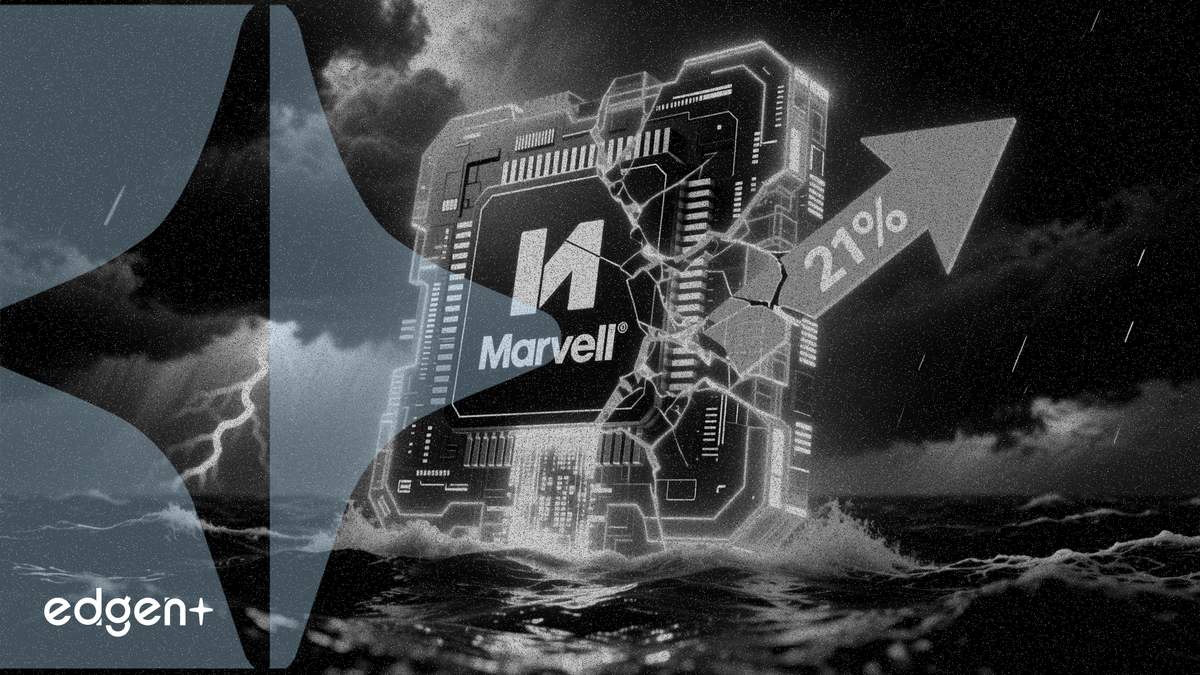
Marvell Technology Inc. shares surged as much as 21 percent in Tuesday trading, pushing the company's market capitalization past $230 billion, after Nvidia Corp. Chief Executive Officer Jensen Huang predicted the chipmaker would become "the next trillion-dollar company" during a joint appearance at the Computex trade show in Taipei.
"Next trillion-dollar company, ladies and gentlemen," Huang said, interrupting Marvell CEO Matt Murphy unprompted after being invited on stage. Murphy responded: "Let's do it together." The exchange, captured on video from the keynote, crystallized the deepening strategic partnership between the two companies, which in March announced a collaboration on Nvidia's NVLink Fusion networking technology.
Marvell's networking semiconductors are critical to Nvidia's AI data center architecture, handling the high-speed interconnects that link thousands of GPUs into training clusters. As hyperscalers scale their AI infrastructure, demand for Marvell's custom silicon and networking chips has accelerated. The company in May raised its fiscal 2028 revenue forecast to $16.5 billion, up $1.5 billion from its prior outlook, citing surging AI-related orders. Marvell generated $483 million in free cash flow in the fiscal first quarter, representing a 20 percent margin, with trailing 12-month free cash flow reaching $1.67 billion.
The Networking Bottleneck Becomes the Opportunity
The endorsement comes as the AI industry shifts focus from raw compute to the infrastructure connecting it. While Nvidia's H100 and Blackwell GPUs dominate headlines, the networking fabric that ties them together — switches, retimers, and custom ASICs — has become a gating factor for data center scale. Marvell's custom silicon partnerships with cloud giants including Google, announced in April, and Amazon Web Services position it as a key beneficiary of the $180 billion to $190 billion in combined capital spending that hyperscalers plan this year.
Marvell's stock has gained more than 158 percent year-to-date, far outpacing the Philadelphia Semiconductor Index's 34 percent advance over the same period. The company first breached the $100 billion valuation mark in December 2024 after an earnings beat and an Amazon deal. At Tuesday's intraday high, Marvell traded at roughly 14 times the midpoint of its raised fiscal 2028 revenue guidance — a premium to Broadcom Inc., its closest peer in networking silicon, which trades at about 11 times forward sales.
AI Rally Lifts Broader Semiconductor Complex
The surge in Marvell shares unfolded against a broader AI-driven rally that pushed the S&P 500 and Nasdaq Composite to record closing highs on Tuesday. Micron Technology Inc. joined the trillion-dollar club for the first time, jumping 19.3 percent, as investors bet that memory-chip demand will accelerate alongside AI compute spending. Nvidia shares also rose, extending gains from Monday when the company unveiled its RTX Spark processor — its first fully integrated chip for Windows laptops, capable of running local AI agents.
Huang's appearance at Marvell's Computex event was one of several high-profile moments at the Taipei conference. He also joined Arm Holdings CEO Rene Haas on stage, quipping that "every product I announce, his stock price goes up." Arm shares rose 15.7 percent on Monday following the RTX Spark announcement.
What the Endorsement Means for Investors
For Marvell, Huang's public blessing provides a powerful narrative catalyst, but the company's valuation now reflects aggressive growth assumptions. At a projected $3.3 billion in free cash flow by fiscal 2028 — assuming 20 percent margins on the raised revenue forecast — Marvell would trade at roughly 70 times that figure at Tuesday's intraday prices, a multiple that leaves little room for execution missteps. The company's ability to convert its design wins into sustained revenue growth, particularly as hyperscalers increasingly develop in-house silicon, will determine whether Huang's trillion-dollar prediction proves prescient or premature.
This article is for informational purposes only and does not constitute investment advice.