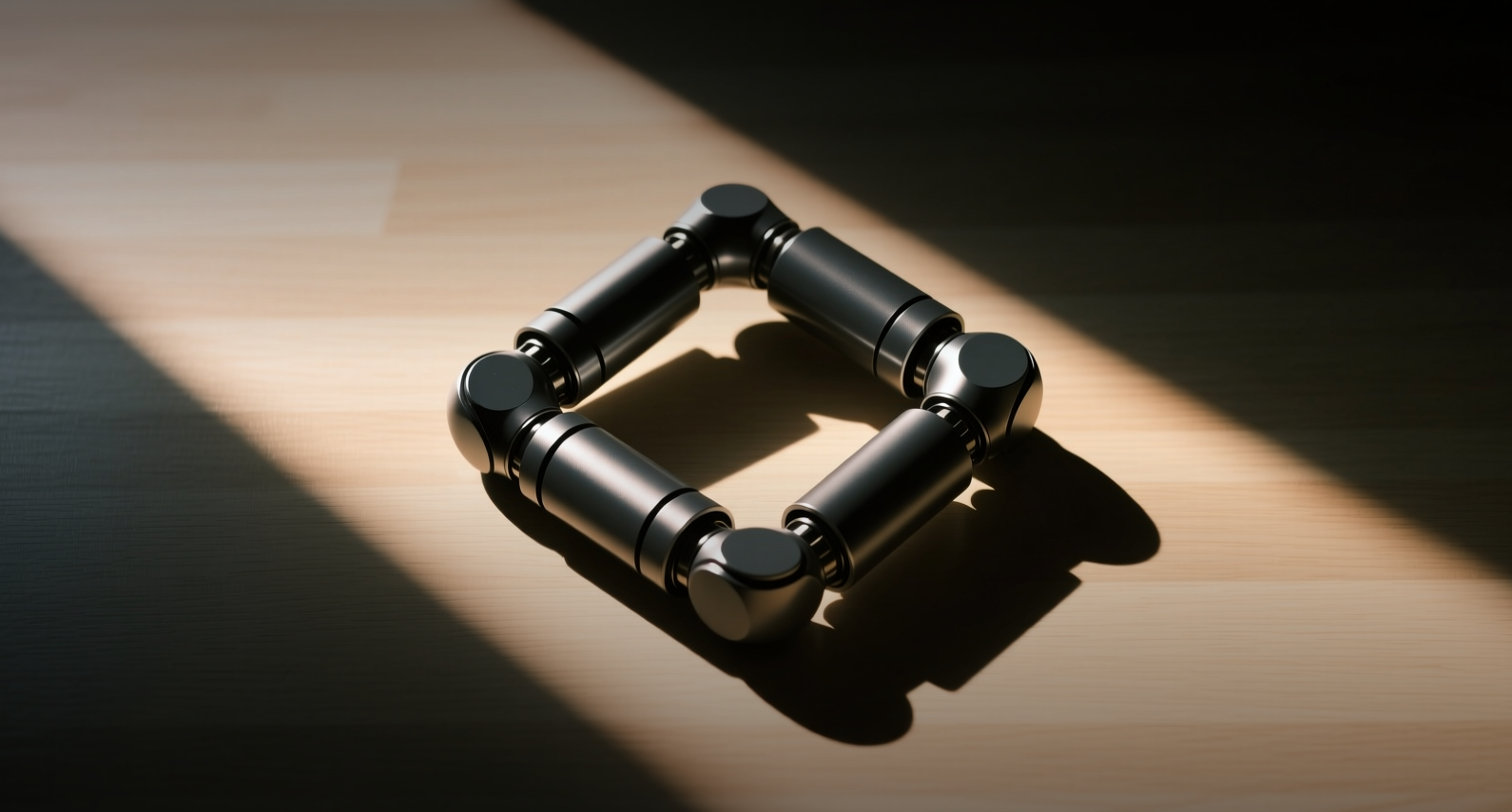
Morgan Stanley argues a swarm of 2.2 billion robots, not data centers, is SpaceX's fastest route to 1 terawatt of compute.
Morgan Stanley says 2.2 billion robots carrying 500 watts each could hand SpaceX 1.1 terawatts of distributed compute by 2040 — faster than any data center build-out. The estimate, from analyst Adam Jonas's Aug. 13 note, rests on a "distributed inference cloud" that links fixed and mobile edge nodes over Starlink.
"Very few investors are bullish SpaceX's AI business beyond neocloud," Jonas wrote, arguing the market prices the whole AI unit at about $12 a share, "well below even neocloud peers."
The robot math starts with Tesla's AI5 chip, built for the Optimus humanoid at 250 watts. Morgan Stanley assumes that climbs to 500 watts as compute demands grow, so 2.2 billion units across its global robotics model produce roughly 1.1 terawatts. That compares with the bank's own SpaceX forecast of about 380 gigawatts by 2040 — well short of the 1-terawatt "Terafab" Musk has floated, a plan investors have mostly read as ground-based or orbital data centers.
The gap matters for a stock trading near $140 against Morgan Stanley's $300 target. Stripping out the bank's $127-a-share discounted-cash-flow value for space and connectivity leaves the AI business at roughly 1.5 times 2028 enterprise value-to-sales, a discount to emerging cloud peers.
Grok Nears the Frontier as Usage Data Stays Opaque
Grok 4.6 scored 61 on the Artificial Analysis intelligence index, near the current high of 63 and above Grok 4.5's 56 in mid-July and Grok 4.3's 38 in April, at a cost comparable to China's Kimi K3. Musk said Grok 4.7, built on a new 2.1 trillion-parameter base model, should be ready in three to four weeks, with Grok 5 — at 6 trillion to 10 trillion parameters — due by year-end. Token use tripled in the weeks after Grok 4.5 became Cursor's default model, though Morgan Stanley notes OpenRouter cannot capture usage from X and Cursor, the two main channels. The bank expects fuller disclosure once the $60 billion Cursor acquisition closes this quarter.
Compute Prices Point Up, Not Down
CoreWeave raised prices about 25 percent across all SKUs on tightening demand and signed Nvidia Ampere chip contracts running to 2029. Morgan Stanley's model prices compute at about $31 a watt in the fourth quarter of 2026, compressing to $17 a watt a year later as capacity comes online. Holding $31 a watt through 2027 would add about $42 billion in revenue — roughly triple the bank's base case of a doubling — while $50 a watt implies near 4.5 times growth, even at about half the compute Musk has targeted. Blackwell GPU rentals are up about 30 percent this year to $5.25 per GPU-hour, or $20 to $25 a watt, per Compute Desk.
Starship Flight 14 Looms as a Milestone
Beyond earnings, Morgan Stanley calls Starship's 14th flight — the first attempt to catch the ship itself — one of the most important stock events since the IPO. Booster 21 completed cryo-testing around July 20 and is expected to static-fire near Aug. 20, pointing to a September launch. The FAA must modify its Part 450 license to cover ship-tower capture; the precedent from Flight 5, the first booster catch, saw approval land the day before launch. A successful ship catch would cut the cost of orbital "real estate," opening new growth for space, connectivity and AI. Flight 15 would attempt the harder simultaneous catch of ship and booster.
SpaceX shares, which closed above their $135 IPO price for the first time since mid-July before slipping about 5 percent, point about 1 percent higher in premarket. Morgan Stanley's $300 target implies more than double the current price, and the bank argues the AI valuation discount lifts as investors see more evidence on Cursor and Grok usage. The question is whether the market prices the AI unit as a modest cloud upstart or as the operator of a 1-terawatt robot network.
This article is for informational purposes only and does not constitute investment advice.