
July Nymex natural gas tests whether a narrowing storage surplus can overcome a split demand map and pipeline maintenance.
July Nymex natural gas tests whether a narrowing storage surplus can overcome a split demand map and pipeline maintenance.
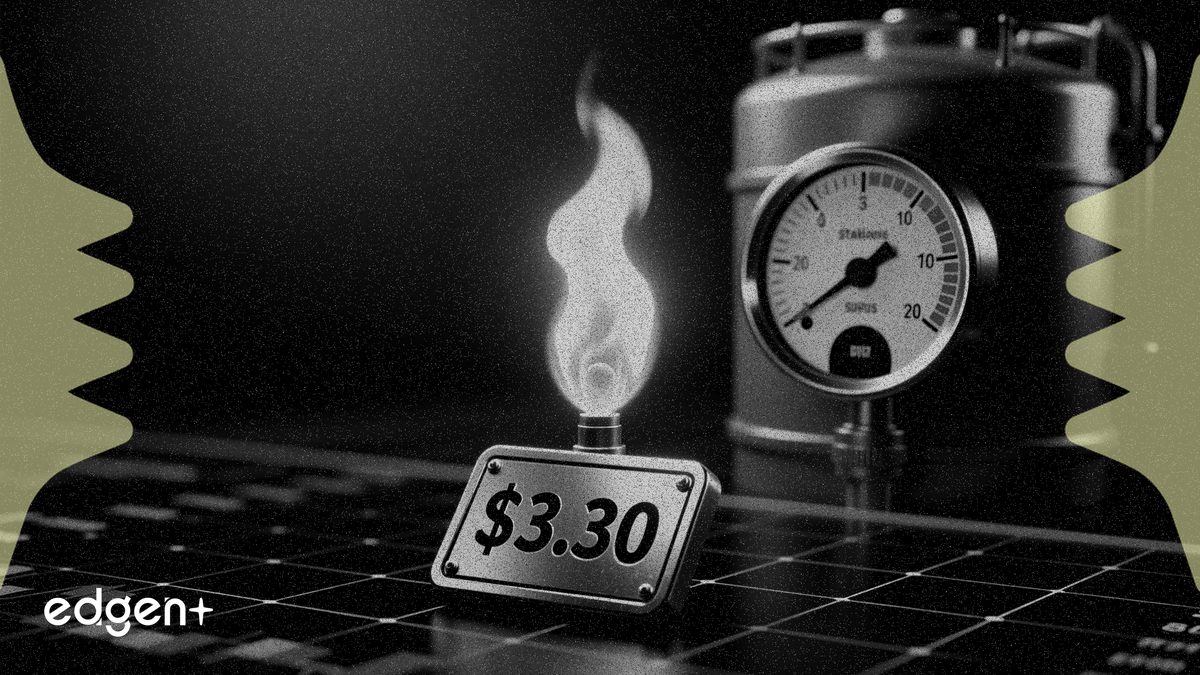
July Nymex natural gas settled at $3.30 on June 1 after pulling back from overnight highs, as a narrowing storage surplus and western heat forecasts offset the drag from cooler eastern temperatures and a temporary pipeline outage at Sabine Pass.
"The market is caught between three bullish drivers and one counterweight, and the question is which side breaks first," said James Hyerczyk, a technical analyst with over 40 years of experience in futures markets. "The $3.387 level stopped the rally last week, and that price is the whole trade going into June."
The Energy Information Administration reported a 92 Bcf injection for the week ending May 22, below the 95-96 Bcf consensus, leaving total working gas at 2,483 Bcf. The surplus over year-ago levels has compressed to just 21 Bcf, while the gap to the five-year average has narrowed to 144 Bcf. Active natural gas drilling rigs have dropped to 125, and Lower 48 dry gas output has pulled back to a range of 107 Bcf/d to 109.4 Bcf/d from 109.8 Bcf/d in April.
The next EIA storage report on June 4 will determine whether the bull case holds. Another light injection would confirm that the storage cushion is evaporating, potentially driving prices toward the resistance cluster at $3.651 to $3.734. A production rebound toward 110 Bcf/d or a national demand miss would give sellers their opening, with the first downside target at $3.141.
Above-average temperatures across the western half of the US are expected from June 1 through June 10, according to the Commodity Weather Group, dragging cooling demand into early June. That part of the forecast is doing the work for the bulls. The Midwest and East are running cooler than normal, and those regions hold the largest population centers. National cooling demand cannot spike when half the country does not need air conditioning, which makes the western heat a thin trade to build a rally on.
Creole Trail pipeline maintenance between May 31 and June 1 is pulling roughly 0.8 Bcf/d out of Sabine Pass LNG deliveries. That volume does not leave the market — it redirects into domestic supply. Feedgas demand has been averaging 18.6 Bcf/d with global LNG prices high enough to keep exporters running full. If July futures absorb that extra supply without cracking $3.20, the demand underneath this market is stronger than the headline storage numbers suggest.
The supply picture carries its own contradictions. The rig count has fallen to 125, and some Permian Basin producers are voluntarily holding back output amid weak local pricing. But high crude oil prices keep oil-directed rigs running, and every barrel drilled in the Permian produces associated gas. Haynesville output continues to expand, and pipeline bottlenecks that currently restrain some supply tend to get resolved over time. The bulls are borrowing time from production restraint that was never designed to last.
The broader energy complex adds another layer. US gasoline inventories have posted 15 straight weeks of draws, the longest such run since 2012, with stockpiles falling to 211.5 million barrels — the lowest for this time of year since 2014, according to EIA data. Gasoline prices have surged 50% to around $4.33 per gallon since the US and Israeli war against Iran began on Feb. 28. While gasoline and natural gas are distinct markets, the same geopolitical forces that have disrupted Middle Eastern energy flows — including damage to Qatar's Ras Laffan LNG plant, which lost 17% of its export capacity — are tightening global gas supply and supporting US export demand.
The technical setup reinforces the uncertainty. July futures posted one of their biggest weekly trading ranges in two months last week, reaching the highest level since late March before settling. The main weekly trend remains down, but the minor trend has shifted up, creating a momentum conflict. The $3.387 pivot stopped the rally last week. Above that, the resistance cluster at $3.651 to the 52-week moving average at $3.734 is where real selling is expected to emerge. Below $3.387, the pullback target is $3.141, and bulls need that level to hold to preserve the higher-bottom pattern.
This article is for informational purposes only and does not constitute investment advice.
