
Nvidia's physical AI business — chips and software for robots, cars and drones — generates about $10 billion in annual revenue and targets tenfold growth within a decade.
Nvidia's physical AI business — chips and software for robots, cars and drones — generates about $10 billion in annual revenue and targets tenfold growth within a decade.
Nvidia's physical AI business — chips and software for robots, cars and drones — generates about $10 billion in annual revenue and targets tenfold growth within a decade.
Nvidia's physical AI business — chips and software for robots, cars and drones — generates about $10 billion in annual revenue, and Chief Executive Jensen Huang expects it to grow tenfold within a decade as China's robot makers adopt its stack.
"Physical AI gives Nvidia a path from data centers into the much larger physical economy — vehicles, factories, warehouses and robots," Michael Frank, chief executive of intelligence startup Radiant Intel, said.
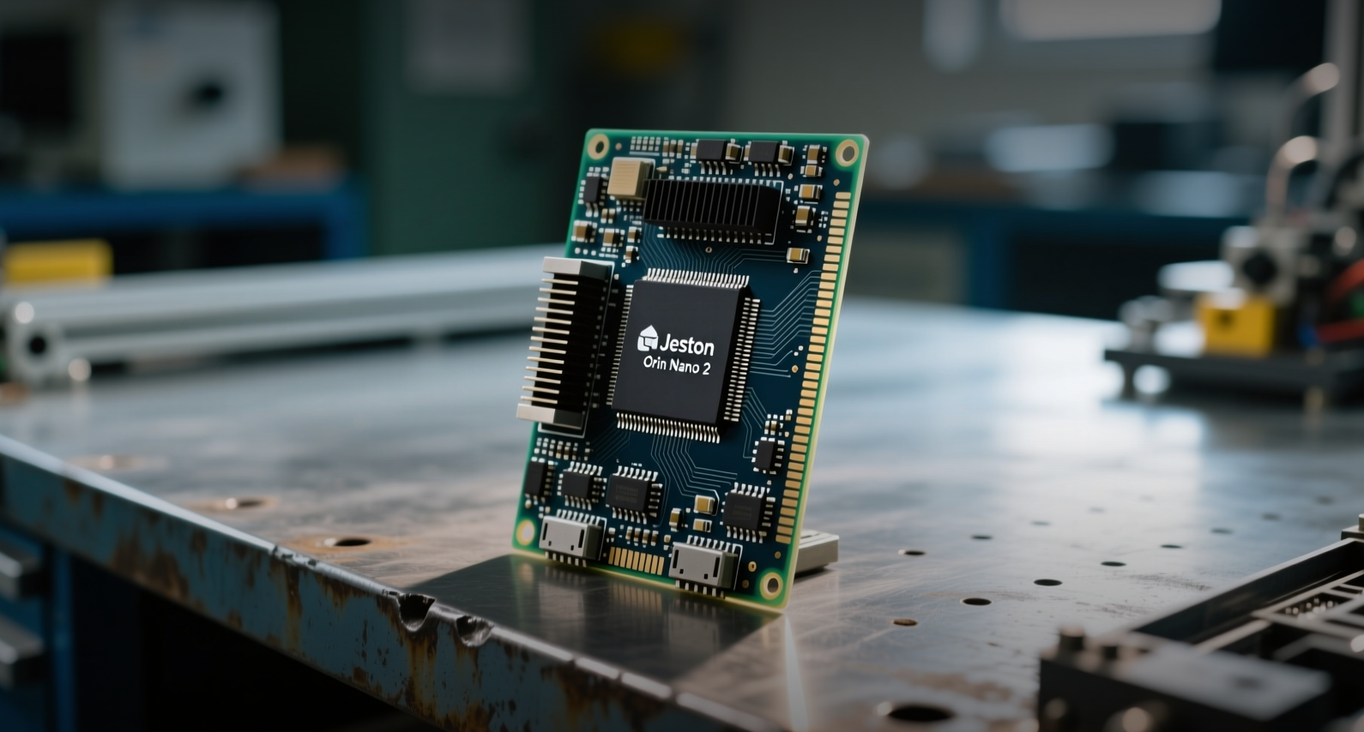
The business remains a fraction of Nvidia's $303 billion in trailing revenue, but the company is applying the hardware-plus-software playbook that built its CUDA developer franchise. It pairs Jetson robot computers — including the entry-level Orin Nano 2 released Aug. 25 — with open-weight models such as GR00T for robot brains and Cosmos for world simulation. China, which shipped about 90 percent of the world's humanoid robots in the first half, is the most eager customer, with Unitree, AgiBot and Fourier machines populating Nvidia's labs in the U.S. and China.
The expansion lets Nvidia collect a toll on the physical economy regardless of which robot maker wins, but it carries policy risk: Washington could extend export curbs to robot and car chips, and Chinese vendors including Huawei, Black Sesame and Horizon Robotics are testing homegrown alternatives.
Two decades ago Nvidia paired chips with software until developers were committed to the stack, a strategy that built a company valued in the trillions. The physical AI version pairs Jetson computers with open-weight models developers can freely download and modify, plus the Thor chip at the high end. Huang has put his children on the effort — daughter Madison oversees marketing for the physical AI division, and son Spencer is a director of product management — a sign he treats it as a decades-long franchise rather than a side bet.
Nvidia is not just selling to robot makers; it is funding them. Its robotics bets include Figure AI, which just produced its 1,000th robot, Skild AI's $1.4 billion round, Field AI at a $2 billion valuation and Germany's Neura Robotics. Big tech is arming up around it: Meta acquired robotics-AI startup Assured Robot Intelligence in May, Google backs Apptronik, and OpenAI holds robotics stakes of its own. Every program, rival or not, makes the picks-and-shovels player stronger.
Robots are data-starved — there is no internet of touch, balance and friction. Nvidia's answer is to manufacture the data. Jim Fan, who leads Nvidia's GEAR embodied-AI research group, frames the endgame as a "Physical Turing Test" — machines doing physical tasks indistinguishably from humans within two to three years for narrow domains. His formula: "Compute now equals environment equals data." If the scarce input is training data and that data is increasingly manufactured in simulation, the advantage flows to whoever owns the simulation stack and the compute underneath it — Omniverse, Cosmos, GR00T and CUDA.
Nvidia, the world's largest company by market value, reports earnings Aug. 26 with consensus data-center revenue at $85.7 billion and total revenue near $92.2 billion. The physical AI story is a longer-term growth vector, but the near-term money is industrial, vehicular and airborne — and the humanoid robots that run on Nvidia silicon remain years from mainstream utility. The risk cuts both ways: export restrictions could shrink the China franchise, while the FCC's import bans on Chinese robots narrow the U.S. market for the very machines that run on Nvidia chips.
This article is for informational purposes only and does not constitute investment advice.
