

The biggest AI companies are spending $100,000 per foreign hire as the battle for specialized talent intensifies.
The biggest AI companies are spending $100,000 per foreign hire as the battle for specialized talent intensifies.
The biggest AI companies are spending $100,000 per foreign hire as the battle for specialized talent intensifies.
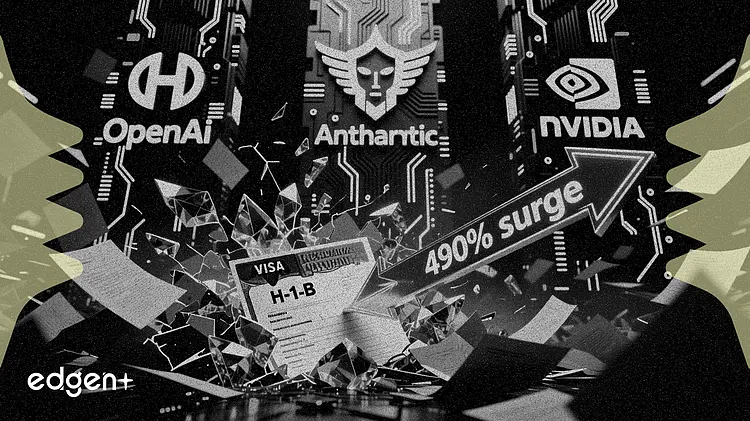
Anthropic, OpenAI, and Nvidia filed more H-1B visa applications in the second quarter of fiscal 2026 than a year earlier, even as a new $100,000 fee and tighter lottery rules made the process costlier and more uncertain.
"The $100,000 fee is a rounding error against the cost of not landing the right researcher," Raghu Shivakumar, a recruiter at Nexocean, said.
Anthropic posted the largest percentage increase, with 59 certified applications in Q2 2026, up from 10 in the same period last year, according to Department of Labor data reviewed by Business Insider. OpenAI filed 63, up from 20. Nvidia, the chipmaker with the largest absolute count, reported 765 certified applications, up from 641. The increases contrast sharply with declines at Meta, Microsoft, Amazon, and Google, which saw a 64% drop.
The divergence reflects a structural shift in tech hiring. Companies are cutting broad head count while concentrating talent in smaller, specialized teams — or "pods," as Meta calls them. For AI leaders, foreign-born researchers with expertise in model training, inference optimization, and infrastructure engineering have become central to competitive strategy, even as the visa process grows more difficult.
The H-1B program has become harder to navigate under new rules. A wage-tier system gives higher-paid applicants a better chance in the lottery, disadvantaging younger workers, said Sneha Puri, an economist at the Indeed Hiring Lab. The government also imposed a temporary $100,000 fee on applicants living overseas. Overall lottery submissions fell to 211,600 for the 2027 allocation from 343,981 the prior year, US Citizenship and Immigration Services data show.
"The pressures from visa policy changes help explain why lottery submissions fell," said Justin Parsons, a partner at Berry Appleman & Leiden, an immigration law firm. Some employers sat out this year's lottery while they waited to see how the new rules would play out, he said.
For Anthropic and OpenAI, the calculus is different. Both companies are private and burning cash to secure the talent needed to train frontier models. Shivakumar said they operate with a "mindset of 'do whatever it takes'" for hiring. Nvidia, meanwhile, has maintained the most aggressive hiring posture in the semiconductor industry, with a workforce that has more than tripled since 2020.
The talent push comes as the broader tech industry slows. Google has conducted smaller, rolling job cuts targeted at specific teams. Meta has trimmed head count while reorganizing around AI. Microsoft and Amazon have also pulled back on H-1B filings, the data show.
For investors, the filing data shows which companies are betting most aggressively on AI leadership. Nvidia's sustained hiring reinforces its dominant position in AI chips — the company trades at roughly 35 times forward earnings, a premium that depends on maintaining its technological edge. For OpenAI and Anthropic, the escalating talent spend adds to already-heavy cost structures ahead of potential public listings. The broader takeaway: the AI talent war is accelerating, and the cost of entry is rising for everyone.
This article is for informational purposes only and does not constitute investment advice.
