
Quantum X Labs' AI decoder beat Google's published benchmarks on real quantum-hardware data while training only on synthetic samples.
Quantum X Labs' AI decoder beat Google's published benchmarks on real quantum-hardware data while training only on synthetic samples.
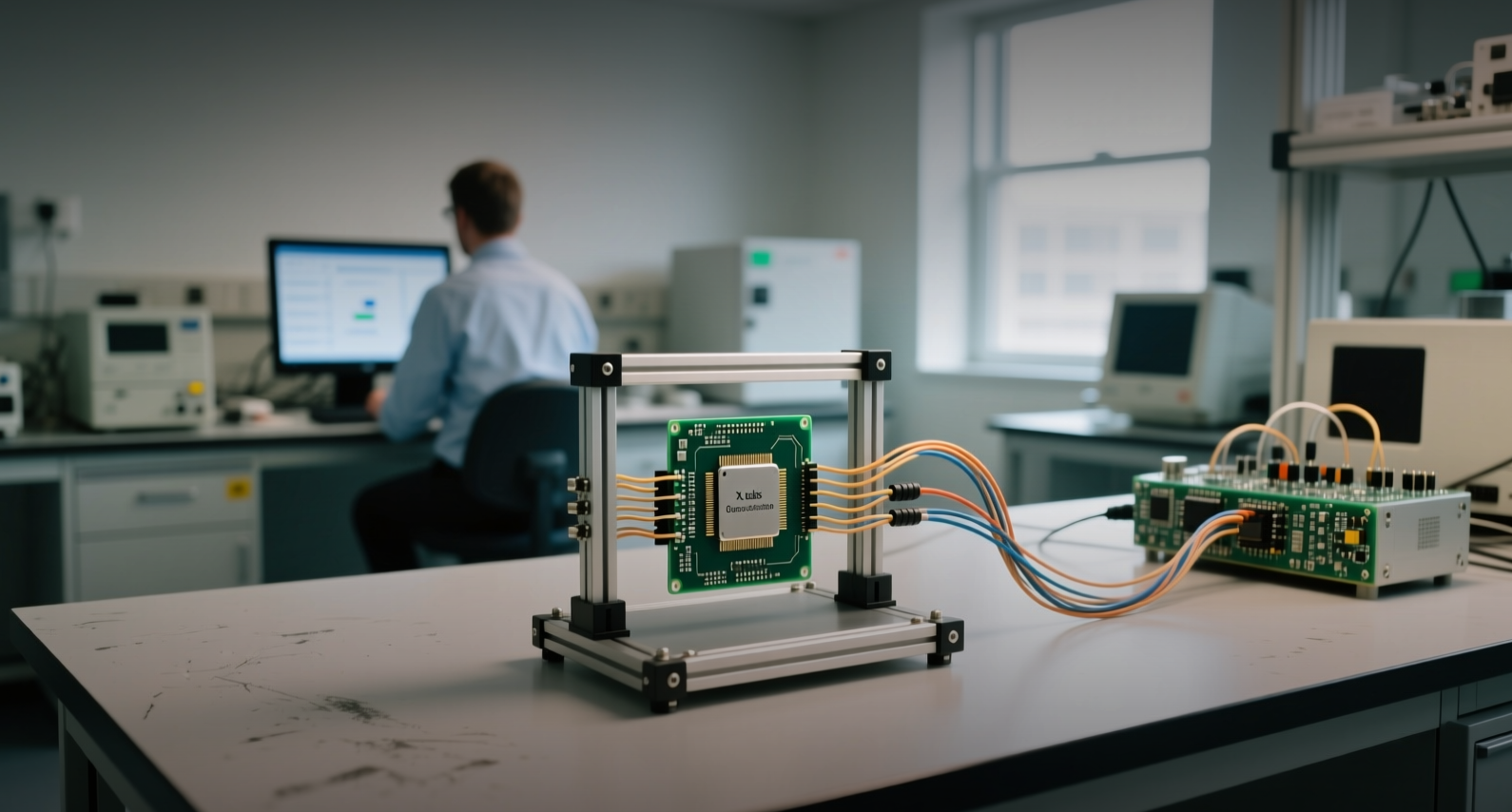
Quantum X Labs' AI decoder beat Google's published benchmarks on real quantum-hardware data while training only on synthetic samples.
Quantum X Labs Inc. said its AI-driven quantum error-correction decoder outperformed Google's published matching-family benchmarks on a real surface-code dataset, a step toward the fault-tolerant machines the industry needs to scale beyond experiments.
"These results are important because they bring us closer to the point where AI-driven quantum error correction can be evaluated against real hardware behavior, not only simulation," Prof. Nir Sharon, chief quantum technology scientist at Quantum X Labs, said.
The Tel Aviv-based company tested its updated decoder on Google's public surface-code configuration using the same cross-validation approach Google applied to its published decoder comparisons. QXL's model was trained exclusively on synthetic samples and never saw the real hardware shots in Google's dataset, yet it beat Google's correlated-matching and PyMatching results for the same configuration.
The result supports QXL's roadmap toward low-latency and eventually real-time decoding, with the AI component built for GPU acceleration and integration with NVIDIA's CUDA-Q platform. QXL shares closed at $4.47, down 2.6 percent, on the Nasdaq.
Quantum computers are highly sensitive to noise, and quantum error correction is widely viewed as the foundation for scaling quantum systems from experimental demonstrations toward reliable computation. Decoders interpret syndrome data — the error signatures a quantum processor produces — to decide which corrections to apply. A decoder that works only in simulation has limited value; the industry needs models that generalize to real hardware behavior.
QXL's decoder combines quantum-code structure, syndrome information and AI-based error weighting, an approach designed to preserve a practical path toward efficient implementation while improving decoder performance. Sharon acknowledged the result covers one benchmark configuration, and the company's next objective is to replicate and extend it across additional device centers and code configurations.
The AI component is built for GPU acceleration and integration into broader quantum error-correction workflows, supporting QXL's roadmap toward low-latency and eventually real-time decoding. That roadmap includes real-hardware data evaluation, workflows with NVIDIA accelerated computing and NVIDIA CUDA-Q, and planned IQCC syndrome experiments.
For investors, the significance lies in competitive positioning. Quantum error correction is the key technical milestone determining whether quantum machines can scale from experimental devices into practical tools for drug discovery, transportation and security — the segments QXL's Quantum X Labs Ltd. subsidiary targets. Google, IBM and others are racing to demonstrate fault tolerance, and QXL's claim of beating Google's own published benchmarks on Google's dataset, while training only on synthetic data, gives the company a reference point in that race.
QXL shares, which closed at $4.47, have traded lower after prior AI-related announcements. The company's two earlier decoder and sampling results were followed by average 24-hour declines of 5.29 percent, according to StockTitan data, a pattern investors may weigh against the technical progress.
This article is for informational purposes only and does not constitute investment advice.
