

Rocket Lab shares tumbled 10.8% on Friday, their worst single-day drop in three months, as SpaceX's record-breaking IPO pulled capital away from smaller space-technology companies.
Rocket Lab shares tumbled 10.8% on Friday, their worst single-day drop in three months, as SpaceX's record-breaking IPO pulled capital away from smaller space-technology companies.
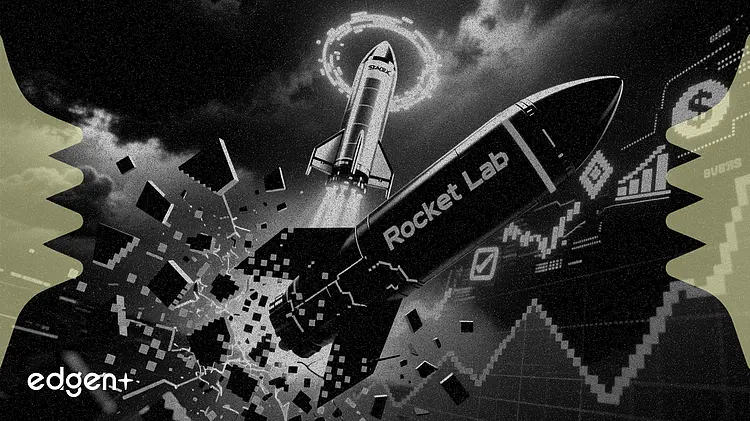
Rocket Lab shares tumbled 10.8% on Friday, their worst single-day drop in three months, as SpaceX's record-breaking IPO pulled capital away from smaller space-technology companies.
Rocket Lab Corp. fell 10.8% to $102.39 on Friday, its steepest single-day decline since March, as SpaceX's $2.11 trillion market debut drew investor capital from smaller space-tech peers.
"The SpaceX IPO is reshaping capital allocation across the space sector in a single session," said Sarah Lin, equity strategist at Edgen. "Investors are selling existing positions to fund allocations to the new public company, which is compressing valuations across the group."
SpaceX shares began trading near $160, up 19% from the $135 IPO price, in a debut that was more than four times oversubscribed. The selloff extended beyond Rocket Lab: EchoStar Corp. fell more than 9%, and Rocket Lab itself has lost 13.4% over the past month. The broader market rallied, with the S&P 500 rising 0.6%, the Dow Jones Industrial Average adding 0.9%, and the Nasdaq Composite gaining 0.3%.
Despite Friday's decline, Rocket Lab remains up 275% over the past 12 months and trades roughly 32% below its lifetime high. The company is expected to report second-quarter revenue of $233 million, up 61% from a year earlier, with losses narrowing to $0.05 per share from $0.10. The iShares Semiconductor ETF rose 2.3% on Friday, adding to an 8.4% rally on Thursday after Oracle's capital expenditure report signaled sustained AI infrastructure spending.
The divergence between Rocket Lab and the broader market highlights the gravitational pull of SpaceX's public listing. At $2.11 trillion, Elon Musk's company now commands a market capitalization that exceeds the combined value of most publicly traded space and satellite companies, making it the dominant benchmark for space-sector investors.
The 10-year Treasury yield rose 1.6 basis points to 4.48%, while the University of Michigan's consumer sentiment index climbed to 48.9 in June, above the 46.0 consensus estimate. WTI crude oil fell more than 3% on hopes for a US-Iran interim peace agreement that could reopen the Strait of Hormuz, a development that also supported airline stocks including United Airlines, American Airlines, and Southwest Airlines, each up more than 3%.
Rocket Lab was among five stocks added to the Nasdaq 100 Index, effective June 22, alongside Astera Labs, CoreWeave, Nebius Group, and Teradyne. The index inclusion could provide a floor for the stock as passive funds adjust their holdings. Energy stocks also gained on lower oil prices, with Occidental Petroleum, Valero, and Marathon Petroleum each rising more than 2%.
This article is for informational purposes only and does not constitute investment advice.
