
Small-cap stocks are beating their large-cap peers by the widest margin in years, a divergence that has historically preceded painful reversals.
Small-cap stocks are beating their large-cap peers by the widest margin in years, a divergence that has historically preceded painful reversals.
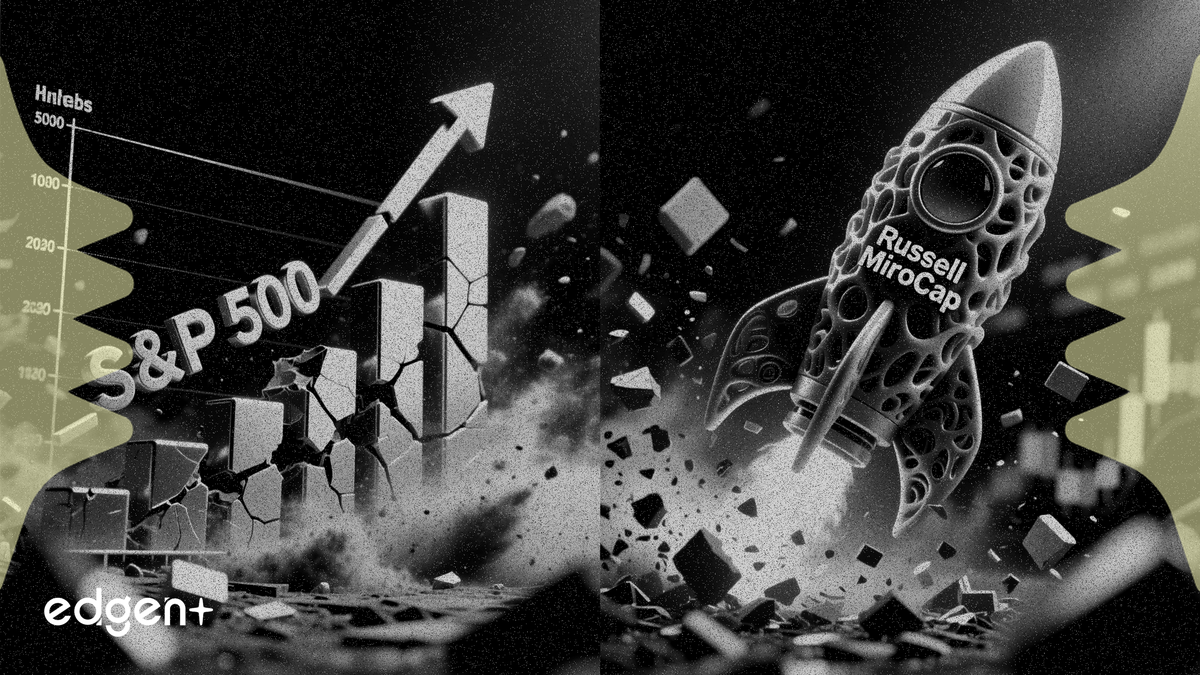
The Russell Microcap index has surged 21% year to date, more than triple the S&P 500's 6% gain, as investors rotated out of megacap technology names into smaller companies.
"The scale of outperformance is chunky, and it's happening for reasons that range from the speculative to the structural," said James Mackintosh, investment columnist at the Wall Street Journal.
The Russell 2000 small-cap index has also outpaced the S&P 500, while the Russell Top 50 of the largest US companies has gained just 6%. The Magnificent Seven — Amazon, Alphabet, Apple, Meta, Microsoft, Nvidia and Tesla — have fared even worse, falling 16% in the first quarter before a partial recovery. Penny stocks within the Microcap index have risen 28% since March 30, outpacing the 22% gain for non-penny Microcap components, according to the Journal.
The last two times small-caps beat large-caps by this magnitude — in 2021 and late 2022 — the rallies proved unsustainable, with small-cap indexes subsequently stagnating or collapsing as Big Tech regained leadership. The current rotation carries echoes of those episodes, raising questions about whether the move reflects genuine economic broadening or speculative excess.
Three forces behind the divergence
The first is the oil-price shock following the US-Israeli conflict with Iran in the first quarter, which hit multinational megacaps harder than domestically focused small companies. The US is a net exporter of petroleum products, cushioning the blow to domestic-oriented firms while large multinationals faced exposure to harder-hit European and Asian economies.
The second is the AI infrastructure build-out, which has lifted not just Nvidia but a constellation of smaller suppliers. Fuel-cell maker Bloom Energy has surged 235% year to date and 14-fold over the past 12 months, pushing its market capitalization to $83 billion — larger than 3M or NXP Semiconductors. Yet Bloom remains in the Russell 2000 index until the annual reconstitution later this month, meaning its gains have artificially boosted the small-cap gauge. Sandisk, the memory-chip maker now worth $261 billion and the 45th-largest US company by market value, is still classified as a midcap.
FTSE Russell, which manages the indexes, will shift to semi-annual reconstitution from annual to reduce such distortions. The change comes after Bloom Energy became the first stock since at least 2008 to vault directly from small-cap to megacap status, skipping the midcap tier entirely.
The third factor is plain speculation. Penny stocks — shares trading below $5 with minimal analyst coverage — have risen 28% since late March, outpacing the broader Microcap index. The Royce Micro-Cap Fund returned 68.2% over the 12 months through May, beating the Russell Microcap Index's 62.2% gain, according to Morningstar data. Holdings such as Ultra Clean Holdings, up 342% over the same period, and Ichor Holdings, up 353%, show how deeply the AI trade has penetrated even the smallest names.
The iShares Micro-Cap ETF, which tracks the Russell Microcap Index, has returned 62.2% over the past year, while the Vanguard Small-Cap ETF gained 28.8%. The Russell 2000 has returned about 40% over the same period, compared with roughly 17% year to date.
What comes next
The divergence carries risks. In 2021, small-cap outperformance ended in a bust as speculative tech, SPACs and cannabis stocks collapsed. In late 2022, small caps rebounded strongly only to stagnate while Big Tech powered ahead. If history repeats, the current rotation may prove to be a trap for investors chasing momentum into the smallest names.
The US 10-year Treasury yield, a key driver of equity valuations, has moved in tandem with the rotation, while the dollar index has softened, providing tailwinds for domestically focused small caps. WTI crude oil, which surged during the Iran conflict, has added a layer of complexity by benefiting energy-exposed small caps while pressuring large-cap industrials and airlines.
This article is for informational purposes only and does not constitute investment advice.
