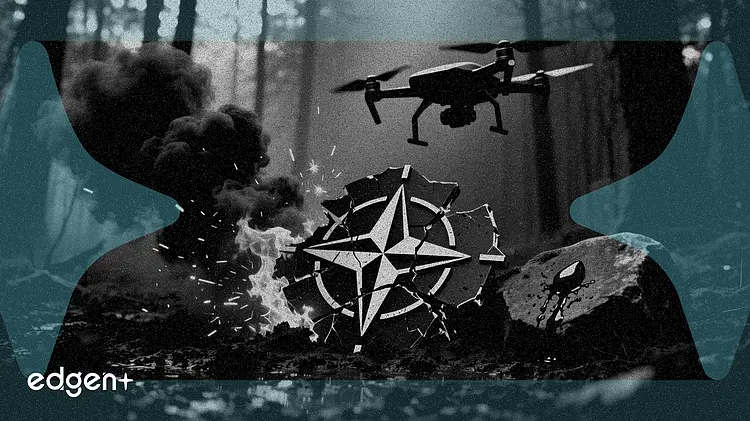
A Russian armed drone struck a residential building in NATO member Romania early Friday, the first such attack to cause civilian casualties on alliance territory since the war began.

A Russian armed drone crashed into a residential building in the Romanian city of Galati early Friday, injuring two civilians and prompting NATO to scramble F-16 fighter jets in what alliance leaders called a dangerous escalation of the war beyond Ukraine's borders.
"Russia's reckless behavior is a danger to us all," NATO Secretary-General Mark Rutte said after a phone call with Romanian President Nicusor Dan. "They continue to target civilians and civilian infrastructure across Ukraine. And last night showed yet again that the implications of their illegal war of aggression don't stop at the border."
The drone crossed from Ukraine into Romanian airspace around 1:53 a.m. local time and struck the 10th floor of an apartment block in Galati, a city of about 250,000 on the Danube River near the Ukrainian border. A 53-year-old woman suffered first-degree burns and a 14-year-old boy was treated for a panic attack, according to local authorities. Emergency services evacuated roughly 70 residents from the building as a fire broke out on the roof.
Romanian Brig. Gen. Gheorghe Maxim said the military had only four minutes between detecting the drone in Romanian airspace and the impact, leaving no realistic opportunity to engage it safely without endangering civilians. Two Romanian F-16s were scrambled but could not intercept the drone in time. The incident marks the first time a residential building has been struck on NATO territory since Russia's full-scale invasion of Ukraine began in February 2022, and the first with civilian injuries on alliance soil.
Escalation Along NATO's Eastern Flank
The Galati strike is the latest in a series of drone incursions across NATO's eastern border that have tested the alliance's air defense capabilities. Last week, a drone entered Lithuanian airspace, triggering air-raid alarms that sent lawmakers into bunkers in Vilnius. Estonia reported a drone shot down over its territory days earlier, which it suspected was a Ukrainian rocket knocked off course by Russian electronic warfare. Earlier this month, two Ukrainian drones struck an oil storage site in Latvia after Russian interference disrupted their navigation systems.
These incidents have exposed gaps in NATO's ability to defend against the low-cost, hard-to-detect drones that have become a central weapon in both Russian and Ukrainian arsenals. Unlike manned aircraft or ballistic missiles, small drones can fly at low altitudes, evade radar, and cross borders in minutes — the same window that prevented Romania from responding in time.
Romanian President Dan convened an emergency session of the Supreme Council of National Defense and summoned the Russian ambassador. Bucharest formally requested accelerated delivery of anti-drone systems from its NATO allies and alerted the United Nations Security Council. "Full responsibility lies with the Russian Federation, whose behavior demonstrates total disregard for international law and for the safety of the citizens of a NATO member state," Dan said.
Market Implications and the Risk Premium
The strike adds a geopolitical risk premium to European markets already on edge. The last time a Russian-linked incident struck NATO territory — the November 2022 missile strike in Poland that killed two — European equities fell 1.8 percent in the following session while gold rose 1.2 percent and the euro weakened 0.6 percent against the dollar. Defense stocks rallied across the continent, with Rheinmetall and Saab gaining 4 percent or more.
European defense shares are likely to see renewed buying as governments accelerate air defense procurement. Romania's request for anti-drone systems mirrors similar moves by Poland and the Baltic states, which have collectively committed more than $5 billion to drone detection and interception systems since 2023. The Stoxx Europe 600 Aerospace & Defense Index has already gained 14 percent this year on elevated military spending expectations.
EU foreign policy chief Kaja Kallas called the strike a "blatant and serious violation of Romania's sovereignty and European airspace." US Ambassador to NATO Matthew Whitaker condemned the "reckless incursion," adding: "We stand with our NATO ally." The alliance has not indicated whether Romania will trigger Article 4 consultations, which allow any member to request discussions when it perceives a threat to its security — a step taken three times since Russia's 2022 invasion.
This article is for informational purposes only and does not constitute investment advice.