Nvidia's new CMX storage tier for AI inference will consume more than 100 million terabytes of NAND flash by 2027, reshaping the memory industry's demand structure.
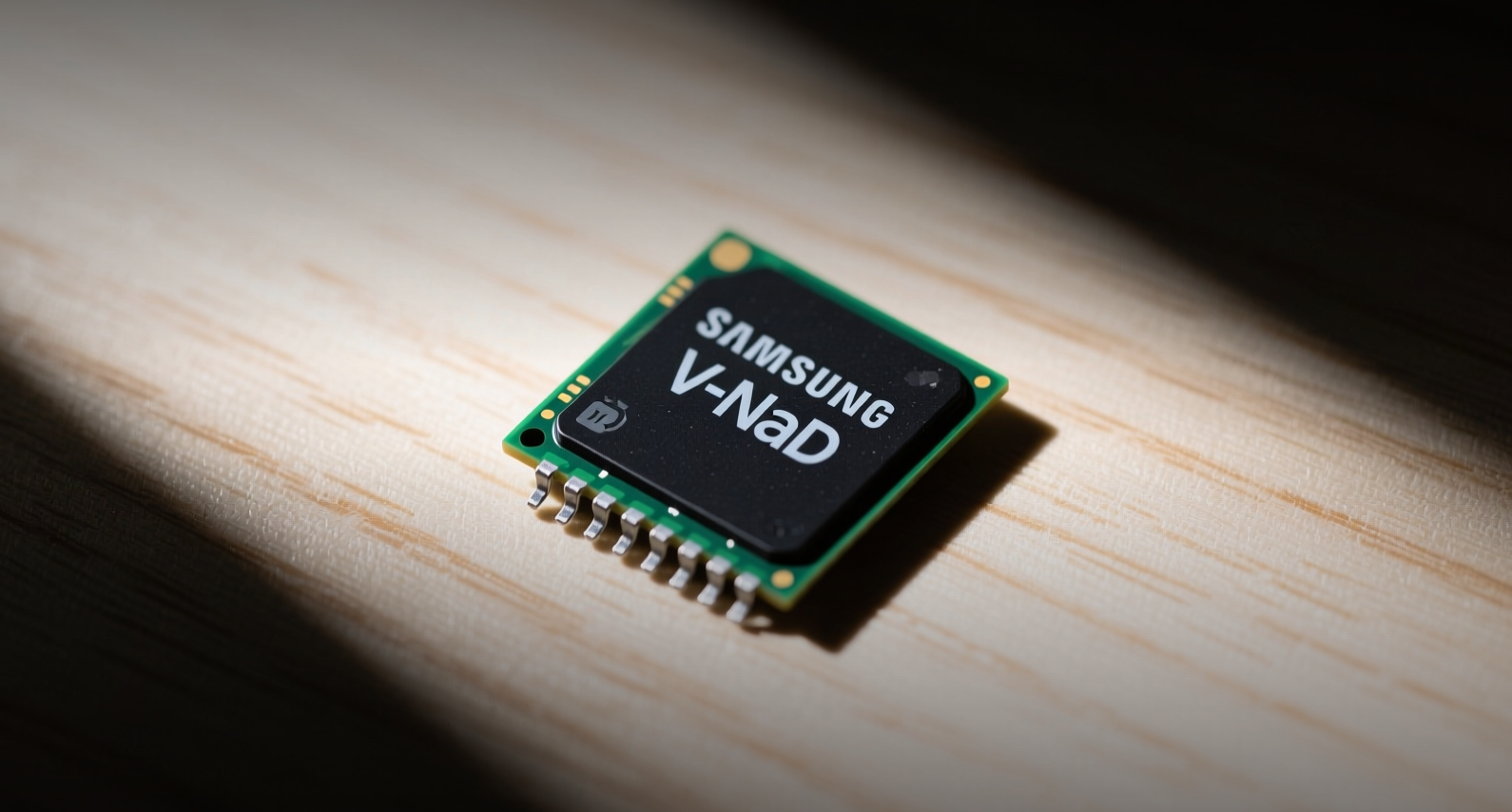
Samsung Electronics has begun mass-producing its 10th-generation V-NAND and supplying it to Nvidia, as the chipmaker's new Context Memory Storage device creates a flash demand channel projected to exceed 100 million terabytes by 2027.
"This is effectively adding an Apple-sized demand source to the NAND market overnight," semiconductor industry analyst @jukan05 posted on X. "The supply chain implications are enormous."
V10 uses roughly 400 stacked layers, a 50% density improvement over the 286-layer V9, according to the Seoul Economic Daily. Samsung has allocated about 60% of its monthly V-NAND output — exceeding 100,000 wafers — to V9 production, while V10 accounts for less than 5% of total output as it ramps. The company is also trialing V11, targeting 400 to 500 layers.
Samsung's 2026 profit is expected to exceed its cumulative earnings over the past four decades, driven largely by AI storage demand. But the deepening alliance with Nvidia — spanning HBM, NAND, and foundry services — threatens to starve the rest of the market of supply, pushing up prices for consumer SSDs and enterprise storage.
CMX Turns Flash Into an Inference Accelerator
Nvidia's CMX is not a conventional storage appliance. It functions as a pod-level shared context layer for long-context and agentic AI inference, offloading key-value cache — the intermediate state language models retain to avoid recomputing tokens — from expensive GPU high-bandwidth memory to Ethernet-connected flash storage. The system uses Nvidia's BlueField-4 data processing units for NVMe management and encryption offload, with Spectrum-X Ethernet handling the network layer.
Each CMX unit houses 576 solid-state drives, providing 9,600 terabytes of capacity. The architecture targets up to a fivefold improvement in sustained token processing performance and power efficiency for long-context workloads, according to Nvidia's technical documentation.
A Three-Generation Production Sprint
Samsung is running three V-NAND generations simultaneously. V9 has reached stable production with yields above 80% and accounts for the majority of output. V10 entered mass production in the first half of 2026 and is now being supplied to Nvidia, though its share remains below 5% of total V-NAND output. The company's P4 facility in Pyeongtaek still has more than half its NAND clean room space unutilized, providing room for expansion.
V10 marks the first large-scale commercial use of molybdenum to replace tungsten wiring, reducing interconnect thickness by 30% to 40%. V11 trial production began earlier this year, targeting a stacking height of 400 to 500 layers, with plans to double trial output in the second half to gather yield data.
Industry estimates project CMX-related NAND demand will grow from 35 million terabytes in 2026 to more than 100 million terabytes in 2027. Samsung's total NAND shipments are expected to reach about 250 million terabytes this year, positioning it as Nvidia's primary CMX supplier.
Samsung shares benefit directly from the structural demand shift, with the company's 2026 profit on track to surpass its cumulative earnings over the past 40 years. But the supply concentration carries risks for the broader market. With roughly 60% of Samsung's V-NAND capacity already allocated to Nvidia's CMX pipeline, other enterprise customers and consumer SSD buyers face tighter supply and higher prices. The DRAM market experienced a similar shock during the initial AI buildout; NAND is now following the same pattern.
Lee Jae-yong, Samsung's chairman, is scheduled to meet Nvidia Chief Executive Officer Jensen Huang in San Francisco to discuss HBM and next-generation NAND supply, as well as potential data center construction in South Korea. The meeting underscores how deeply the two companies' product roadmaps have become intertwined.
This article is for informational purposes only and does not constitute investment advice.