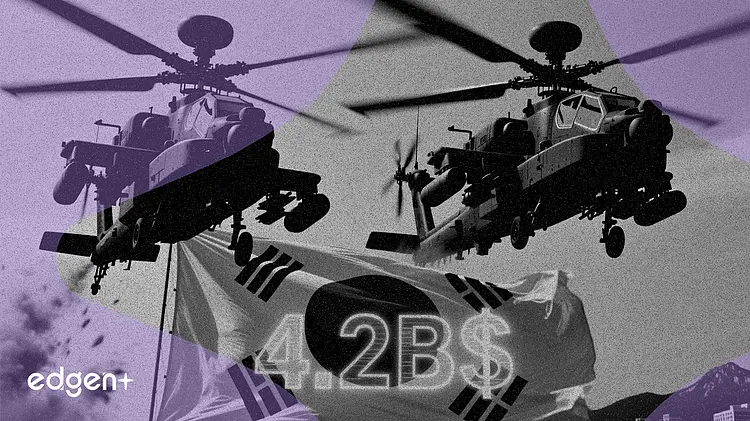
South Korea's $4.2 billion helicopter order from Boeing and Lockheed Martin will generate significantly more profit for Lockheed, highlighting the widening margin gap between the two defense contractors.
South Korea requested approval to purchase two batches of military helicopters and equipment from Boeing and Lockheed Martin this month, the State Department advised Congress. The deals — a $1.2 billion parts order to upgrade Boeing's AH-64E Apache attack helicopters and a $3 billion purchase of 24 Lockheed MH-60R Sikorsky Seahawk multimission helicopters — come as Seoul accelerates defense spending amid heightened regional tensions.
"The scale and composition of this order reflect South Korea's focus on both land-based attack capability and anti-submarine warfare," said Elena Fischer, geopolitical risk analyst at Edgen. "The inclusion of 24 Airborne Low Frequency Sonar systems with the Seahawks signals a priority on countering submarine threats in the Yellow Sea and Sea of Japan."
Congress must pass a joint resolution of disapproval to block the sales, a step taken only once in the last 50 years and never in the last 30, according to Roll Call. Both deals are widely expected to proceed, allowing Boeing and Lockheed to recognize revenue from the contracts.
The $4.2 billion total underscores the strategic calculus behind Seoul's procurement. South Korea operates 36 AH-64E Apaches with 36 more on order, and the new radar and radio systems will standardize its attack helicopter fleet. The Seahawks, built by Lockheed's Sikorsky unit, will replace aging anti-submarine platforms at a time when North Korea's submarine-launched ballistic missile program and China's naval expansion have elevated undersea threats.
Profit Divergence Between Boeing and Lockheed
Lockheed's Rotary and Mission Systems division, which houses helicopter sales, earned $1.3 billion in operating profit on $19.7 billion in revenue last year, a 6.7% margin. In the first quarter of 2026, RMS margins expanded to 9.2%, according to S&P Global Market Intelligence data. At that rate, the $3 billion Seahawk contract would generate roughly $277 million in operating profit for Lockheed.
Boeing's Defense, Space & Security division has been a different story. BDS posted operating losses from 2022 through 2025, narrowing to $128 million last year before turning positive in the first quarter of 2026 with $233 million in operating profit, up 50% year over year. Even at BDS's current 3.1% margin, the $1.2 billion Apache parts sale would contribute only about $37 million in profit — less than 1.1% of Boeing's $3.3 billion trailing 12-month operating earnings.
The margin disparity extends to valuation. Boeing trades at 90 times trailing earnings, while Lockheed commands a more modest 26 times multiple, making Lockheed the more attractive pick on a relative-value basis.
Geopolitical Context and Market Implications
The helicopter orders follow a week of brief fighting in the Strait of Hormuz, where Iran launched drone attacks on commercial shipping and the U.S. Navy responded. While both sides continue to treat the ceasefire as intact, the escalation has reinforced demand for U.S. defense equipment among allied nations. South Korea's procurement aligns with a broader trend: global military spending reached a record $2.44 trillion in 2025, according to SIPRI, with Asia-Pacific accounting for the fastest growth region.
For investors, the takeaway is clear. Lockheed's higher-margin RMS business stands to benefit disproportionately from the current cycle of allied defense spending. Boeing's BDS turnaround is underway but remains fragile, and the Apache parts contract, while strategically important for Seoul, will do little to move the needle on Boeing's bottom line.
This article is for informational purposes only and does not constitute investment advice.