
Key Takeaways:
- SpaceX will invest $100 billion in a Vermilion Parish spaceport
- 3,000 direct jobs at $92,600 average salary, 192% above local wage
- Construction starts 2027, first launch targeted as soon as 2029
Key Takeaways:
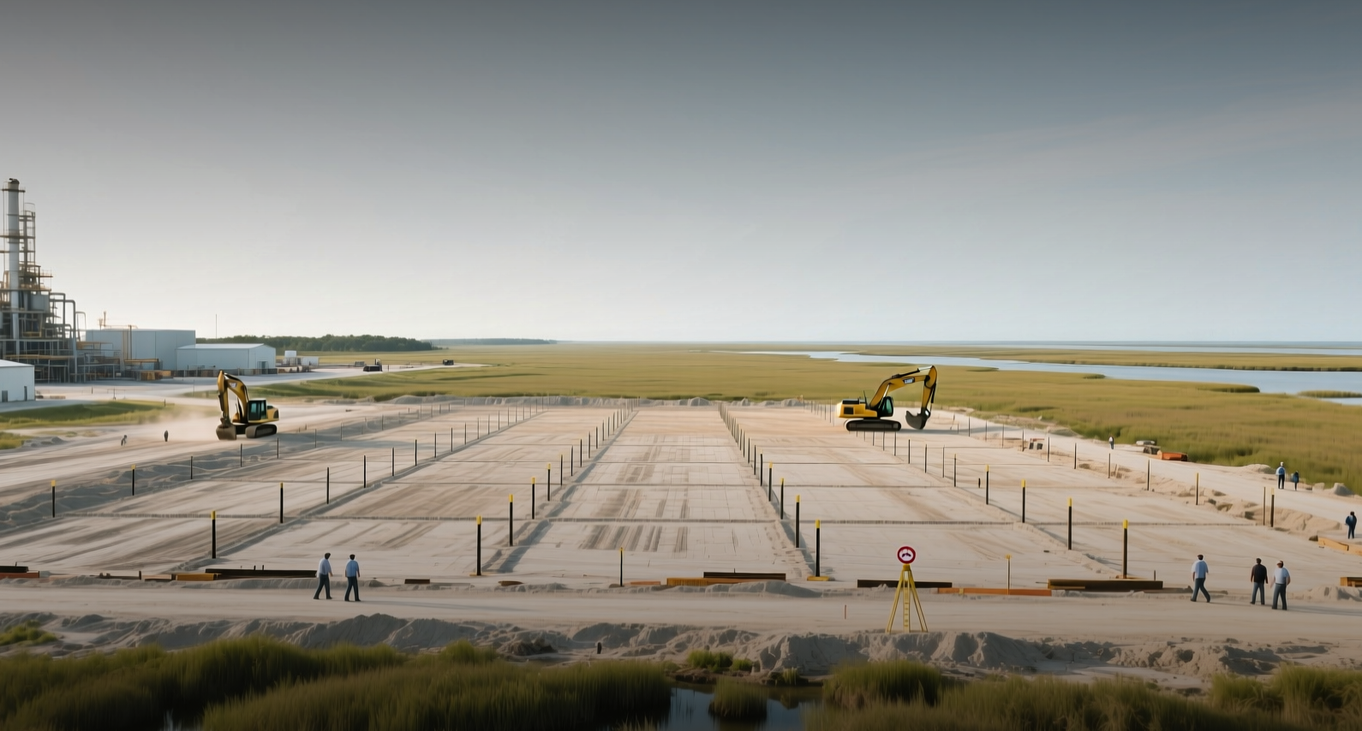
SpaceX will invest $100 billion to build its largest launch facility in Vermilion Parish, Louisiana, a spaceport designed to support thousands of launches annually and named "Starbase Louisiana."
"We're preparing to build a spaceport that, until now, has only existed in science fiction," SpaceX founder and CEO Elon Musk said at the Abbeville press conference. "Starbase, Louisiana will unlock that future."
The facility, on the former Exxon property near Pecan Island, becomes the company's fourth and largest launch site, with five launch complexes each holding two pads and a propellant farm. Construction begins in 2027, with the first launch targeted as soon as 2029.
The project is expected to create 3,000 direct jobs paying an average of $92,600 a year — 192 percent above the Vermilion Parish average wage — plus 8,100 indirect jobs across Acadiana, according to Louisiana Economic Development.
Governor Jeff Landry said the project pushes Louisiana beyond $250 billion in new investment and puts the state "at the center of the next great frontier." The state sold the former Exxon property to SpaceX, returning the land to commerce as the home of one of the world's most advanced projects.
The spaceport is central to SpaceX's plan to make Starship, its fully reusable launch system, operational at scale. At full buildout the site will include a propellant production facility, power generation, vehicle processing and residential housing for employees and their families. The company aims to support missions to Earth orbit for building orbital data centers, along with flights to the Moon and Mars.
The scale dwarfs SpaceX's existing sites. Its Boca Chica facility in Texas, where Starship has flown test missions, and its pads at Cape Canaveral and Vandenberg handle a fraction of the launch cadence the Louisiana site is designed for. The announcement also pressures rivals including Blue Origin and United Launch Alliance, which are racing to expand heavy-lift capacity as commercial and government demand for launch grows. NASA, a major SpaceX customer for crew and cargo missions, stands to gain additional launch options from the new site.
Louisiana's pitch leaned on advantages rivals could not easily match: abundant natural gas for power and fuel, expansive acreage and a Gulf Coast location enabling launch to a wide range of trajectories. LED Secretary Susan B. Bourgeois said the project taps the same skilled workforce that built the state's oil and gas industry.
The state offered SpaceX a competitive incentives package tied to capital investment, job creation and a $25 million charitable donation to the Community Foundation of Acadiana. On the local level, SpaceX entered a payment-in-lieu-of-taxes agreement paying $25 million a year for 25 years plus a $20 million upfront payment, expected to generate more than $820 million in direct local payments. The company also offered Vermilion Parish residents a 50 percent discount on Starlink internet service.
SpaceX has engaged the Louisiana Department of Wildlife and Fisheries and the Coastal Protection and Restoration Authority to address potential impacts on wildlife and fisheries near the site, which sits next to a wildlife refuge.
For investors, the project shows SpaceX's commitment to scaling Starship production and launch capacity — a prerequisite for its Starlink satellite network, orbital data center ambitions and eventual Mars missions. The $100 billion figure, if realized, would make the Louisiana campus one of the largest industrial investments in US history, though SpaceX has not disclosed how the buildout will be financed.
This article is for informational purposes only and does not constitute investment advice.
