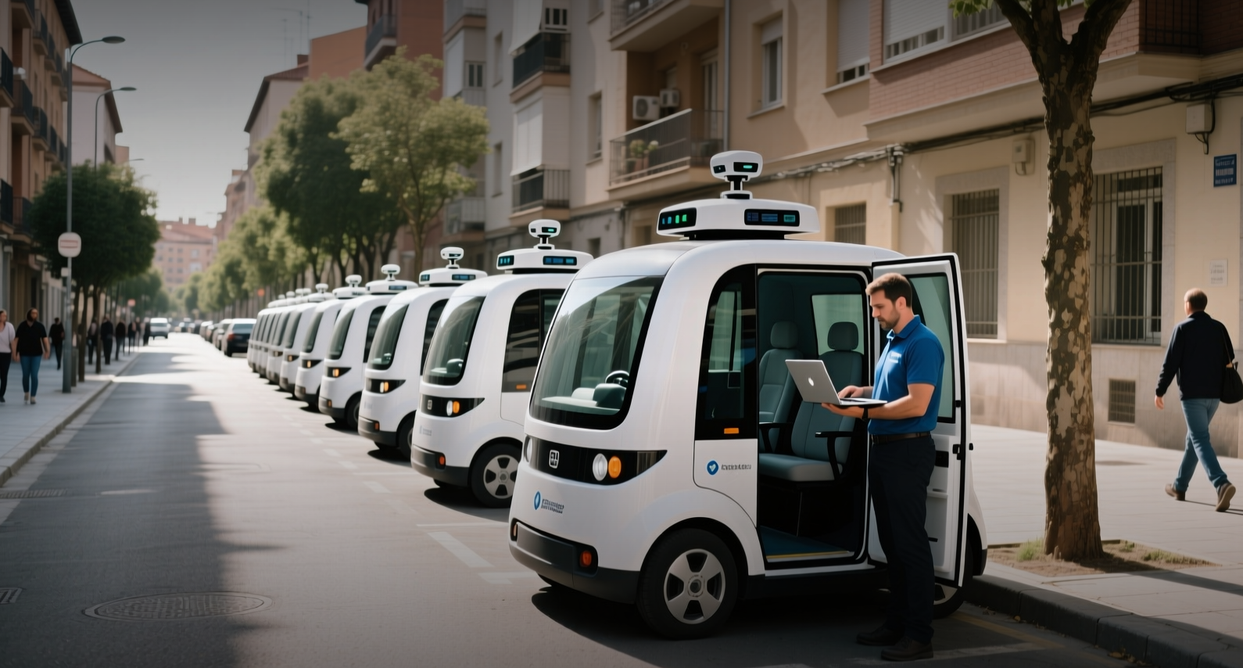
Spain's Directorate General of Traffic issued the country's first national permit for Level 4 autonomous passenger vehicles on Sept. 10, handing WeRide, Uber and fleet operator AVOMO a 20-vehicle foothold in Greater Madrid and a template other EU regulators can copy.
The permit, granted under the DGT's ES-AV framework, authorizes mapping, route validation and operational-readiness testing on public roads. It does not authorize paid rides. "Receiving this permit is a significant achievement for WeRide as it marks our ninth autonomous driving permit worldwide," Jennifer Li, chief financial officer and head of international at WeRide, said. "The Madrid region is a key gateway for our European expansion."
Commercial robotaxi service on the Uber app is targeted for the end of 2026, contingent on further regulatory and operational milestones the permit does not itself grant. The initial fleet of 20 WeRide GXR vehicles will run with an in-car specialist aboard, the same supervised configuration Uber uses in Zagreb and London. AVOMO, the autonomous vehicle arm of Moove Cars Group, will handle fleet operations — the role it already plays for Uber's AV programs in Austin and Atlanta, where it manages about 400 vehicles with more than 200 specialists.
Madrid is the fourth city counted under the WeRide-Uber strategic partnership, which targets 15 cities and tens of thousands of autonomous vehicles on public roads by 2030. The first three — Abu Dhabi, Dubai and Riyadh — are all in the Middle East. Abu Dhabi's fleet was averaging dozens of daily trips per vehicle and approaching breakeven unit economics as of February, according to company disclosures. Another 11 cities are planned by 2030.
Why the DGT permit matters more than the Madrid launch
The ES-AV framework is the DGT's national program for evaluating automated vehicles before regular service, with phased testing that begins with a safety operator on board. That structure is the reason the Spanish approval carries weight beyond one city: it establishes a national certification path for a specific vehicle model rather than a municipal pilot. The permit is the first national approval for WeRide's GXR in the EU and creates a benchmark for future vehicle certification across the bloc.
The division of authority is the detail investors should watch. The DGT permit covers the vehicles and their testing; authorization to carry paying passengers is a regional matter, which is why the Regional Government of Madrid is named as a partner in the announcement. Madrid's regional government has positioned the city as a testbed for autonomous mobility, and Uber's global head of autonomous mobility and delivery, Sarfraz Maredia, framed the region as "one of Europe's most forward-looking environments for autonomous mobility."
Uber is assembling a European autonomous footprint with a different technology partner in each city, a structure chief executive Dara Khosrowshahi has described as a deliberate platform strategy. Zagreb became the first European city where passengers could book an autonomous ride through Uber on Aug. 19, when Pony.ai, Rimac-backed Verne and Uber launched commercial service. London followed on Sept. 3, with Wayve and Uber offering supervised rides in all-electric Ford Mustang Mach-E vehicles; a Transport for London-licensed private-hire driver remains behind the wheel, and more than 140,000 Londoners had opted in to receive autonomous rides through their Uber settings ahead of launch.
In Switzerland, WeRide and Uber announced plans in June to launch commercial robotaxi services in the Greater Zurich region with Rydera as fleet operator. WeRide secured a driverless permit from Switzerland's Federal Roads Office in November 2025 — the first of its kind for a robotaxi in Europe — enabling autonomous operations in Zurich's Furttal area. WeRide also holds Level 4 permits in France for its Robobus in Valence and in Belgium for its Robobus in Leuven, though neither service runs through the Uber app.
The asset-light math behind 20 vehicles
WeRide's expansion model keeps capital requirements off its own balance sheet. The company supplies autonomous driving technology through its WeRide One platform, a local partner funds and runs the fleet, and a ride-hailing platform handles demand. AVOMO's roughly 400-vehicle US operation is the proof case for that division of labor; Madrid is the first time the same three-way structure is applied in Europe.
Uber has committed more than $10 billion to purchasing autonomous vehicles and taking equity stakes in AV developers, according to Financial Times calculations based on deal disclosures and analyst estimates. In February the company formed Uber Autonomous Solutions, a unit consolidating physical and digital infrastructure, rider experience tools and fleet operations services for AV developers.
Competitors are moving on the same continent at different speeds. Uber is preparing to test Level 4 robotaxis with Chinese startup Momenta in Munich, though no commercial permit or public Uber-app service has been granted. Waymo said in August that Munich will be its second European city, with commercial rides targeted for the end of 2027.
The near-term revenue contribution from Madrid is small — 20 supervised vehicles against a 15-city, tens-of-thousands-of-vehicles target. The value sits in the certification precedent. If the ES-AV template holds through the testing phase and Madrid grants paid-passenger authority, WeRide and Uber gain a documented path to replicate in other EU member states, and the 11 remaining partnership cities become easier to finance. If the regional authorization stalls, the fleet stays in mapping mode and the end-2026 commercial target slips.
WeRide shares closed at $5.82, down 4.28%, and Uber at $71.08, down 2.80%, on the session before the announcement, according to Seeking Alpha market data.
This article is for informational purposes only and does not constitute investment advice.